AI citation sources: what 4,231 citations across five engines showed
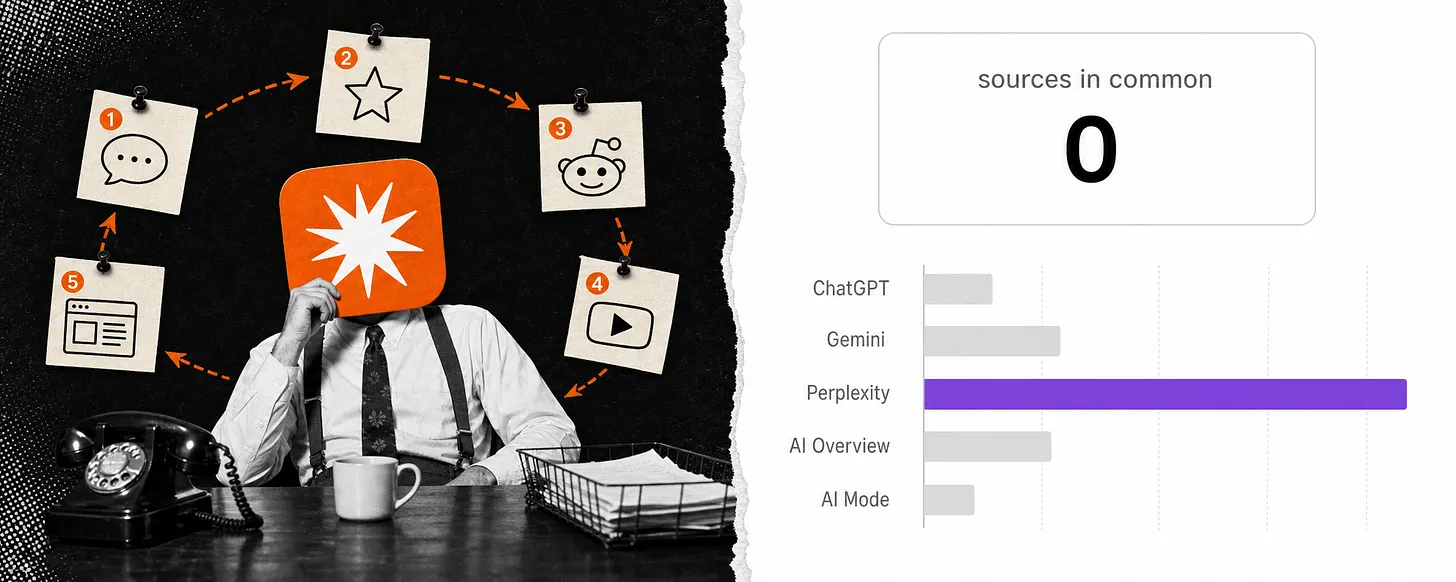
Five AI search surfaces answered the same 100 software buying questions. On 85 of the 98 questions answered by all five, they shared no source at all.
This article shows how those AI citation sources differed, which channels each system used, and a seven-step plan for choosing where to focus.
If you want to plan and publish SEO content from one place, try Distribb.
How the AI citation sources study was run
I collected answers to 100 buying questions on 26 August 2026. The same questions went through ChatGPT, Gemini, Perplexity, Google AI Overview and Google AI Mode.
The test covered 25 business software categories and four question shapes. That produced 500 answers with 4,231 citations to 1,318 unique sources. The searches ran in US English without personalization.
I sorted the sources into vendor sites, independent publishers, review directories, media, communities, video and smaller categories. I also hand-checked a sample of 50 source classifications. Forty-seven matched, so the category shares are useful to a few percentage points rather than to a decimal.
This was one snapshot. It shows which sources appeared together, but it cannot prove why an engine chose a source.
The five engines usually cited different pages
All five surfaces returned an answer for 98 of the 100 questions. On 85 of those 98, there was no source cited by every surface. The median number of sources shared by all five was zero.
The same pattern appeared in pairs. ChatGPT and Gemini had a median source overlap of 0.000 on the same question. The closest pair was Perplexity and Google AI Overview at 0.158, which is roughly one shared source in six.
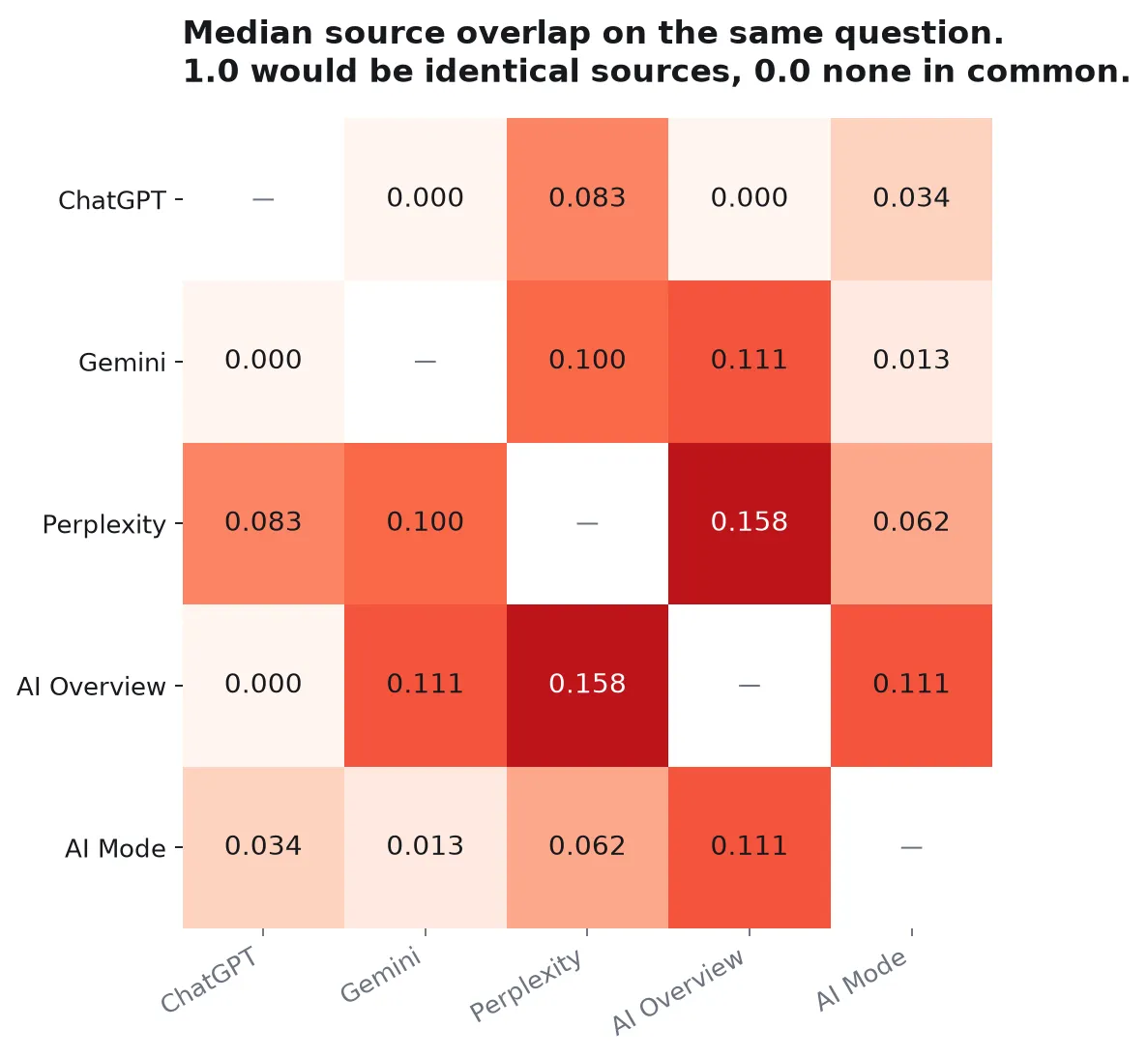
An article, review or Reddit thread that appears in one engine can be absent from the other four. Measure each surface separately.
Perplexity cited four times as many sources per answer
Perplexity cited a median of 17 sources per answer and never dropped below 14 in this sample. Google AI Overview cited 7, Google AI Mode cited 6, and ChatGPT and Gemini each cited 4.
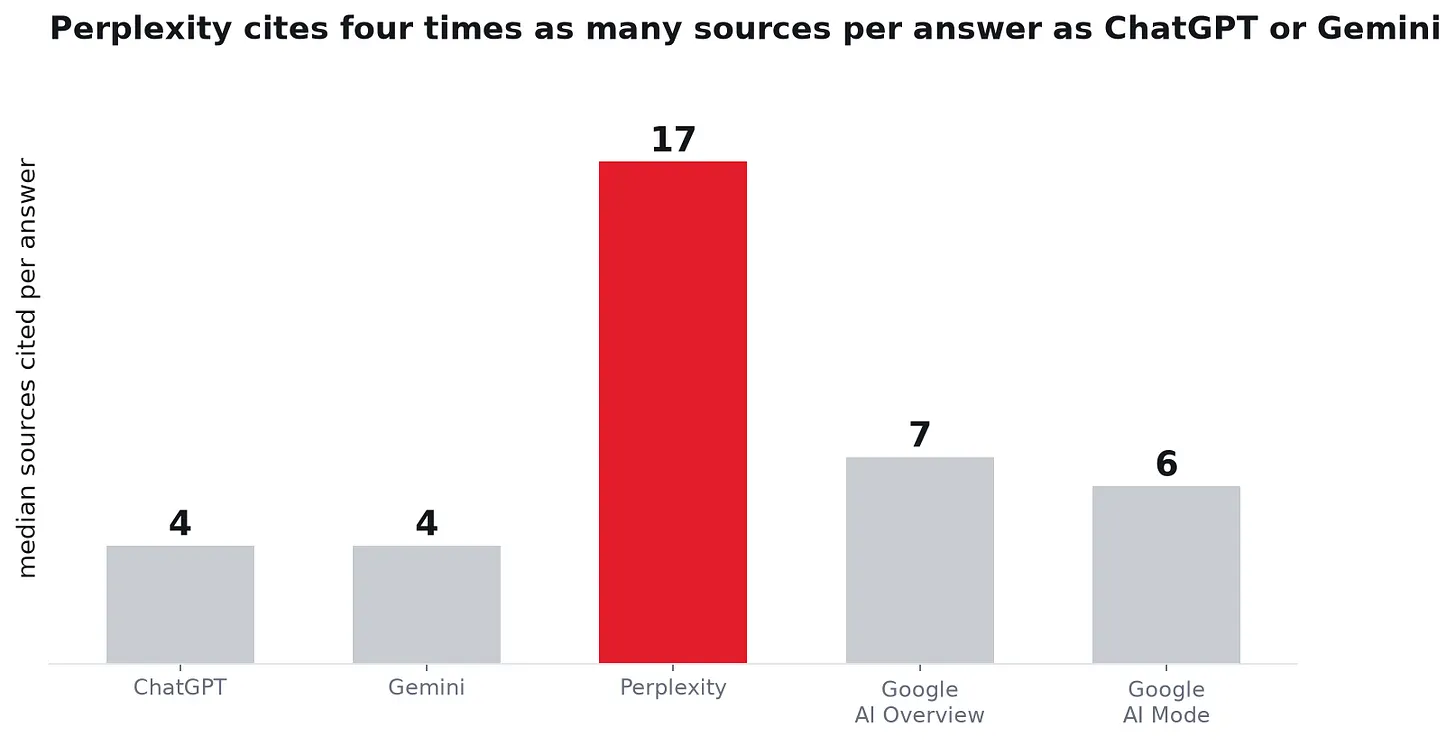
Gemini had the narrowest range. Its largest answer cited 6 sources, and one answer cited none. Perplexity gave a business far more possible citation slots on the same question.
The wording of the question changed the source mix
Reddit was the most cited source in the whole study, with 219 appearances across the five surfaces. The result changed sharply when the wording changed.
ChatGPT cited Reddit in 0% of its citations for three question shapes: "best X software," "best X tool for a small business," and "cheapest X software that is actually good." Its Reddit share rose to 24.1% for "X software recommendations from real users."
Gemini moved from 0% on "best X software" to 19.5% on the real-users question. Google AI Overview stayed between 4.6% and 8.4% across all four shapes.
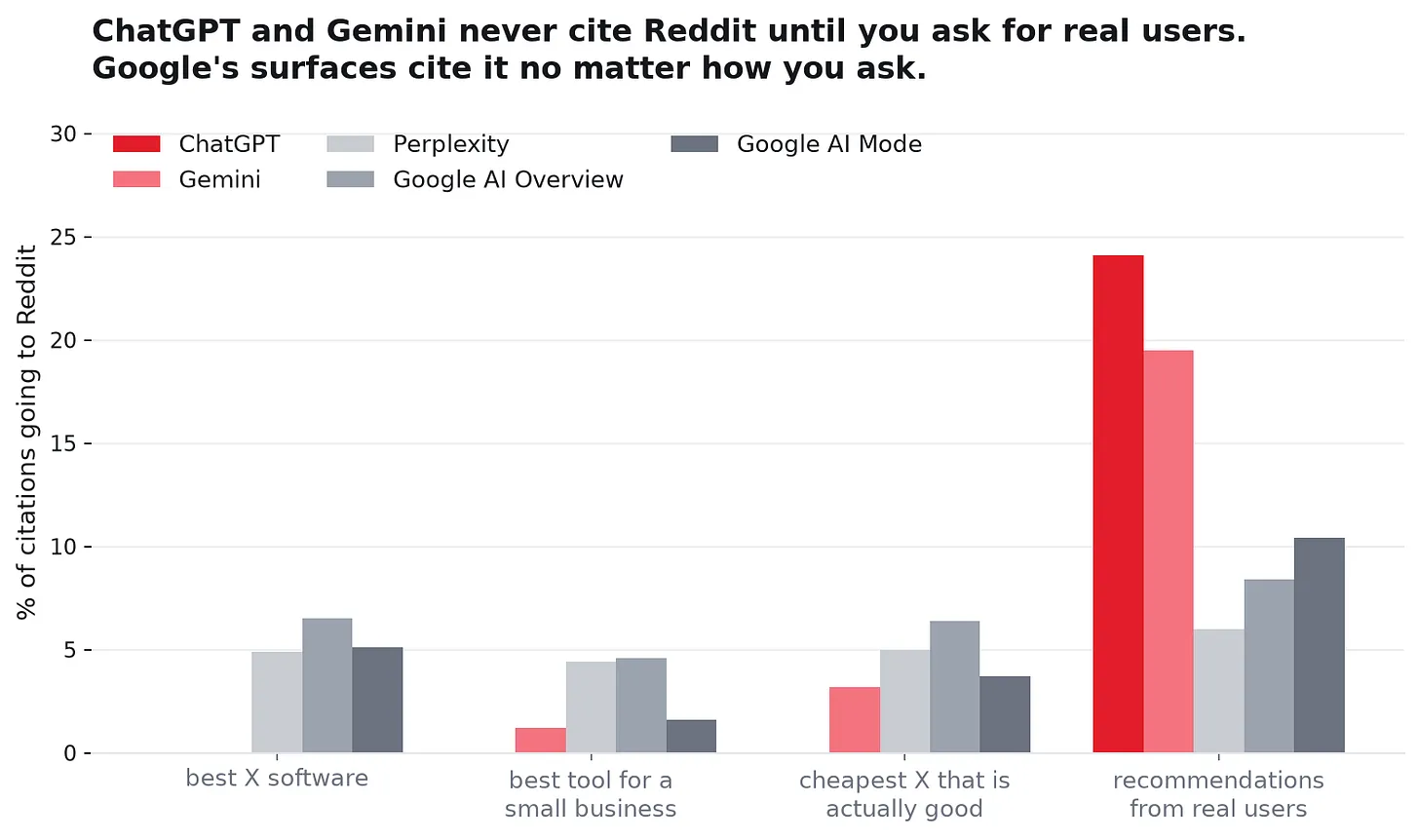
The grid had only four question shapes, and the words "real users" may explain part of the result. Still, one prompt per category would have missed the biggest source change in the study.
YouTube appeared on Google and almost nowhere else
YouTube appeared in 63 of 100 Google AI Overview answers and 63 of 100 Google AI Mode answers. Gemini cited it in 3 answers. ChatGPT and Perplexity cited it in none of their 100 answers.
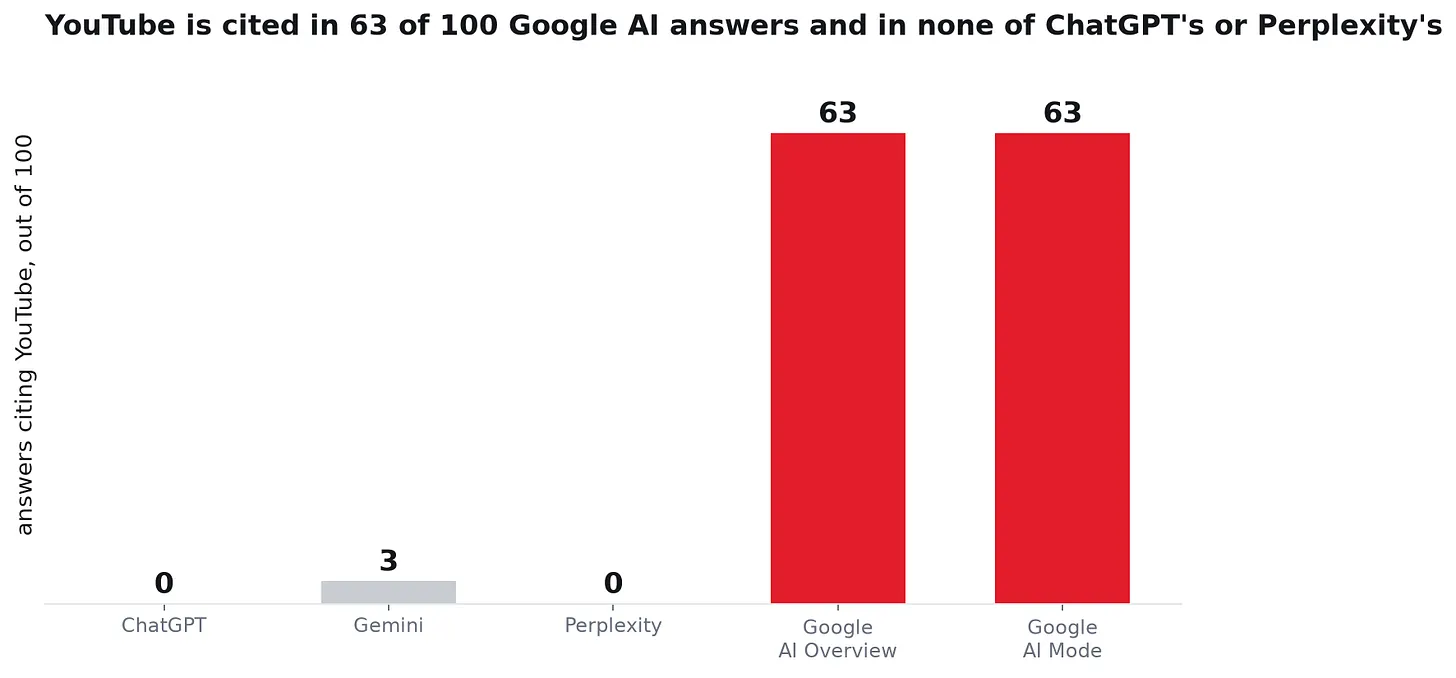
A product demo on YouTube matched Google's citation pattern in this sample. It did not create a visible citation route into ChatGPT or Perplexity.
Vendor pages were the largest source category everywhere
Vendor sites made up 36.0% of Google AI Overview citations and 47.4% of Google AI Mode citations. They were also the largest category for ChatGPT, Gemini and Perplexity.
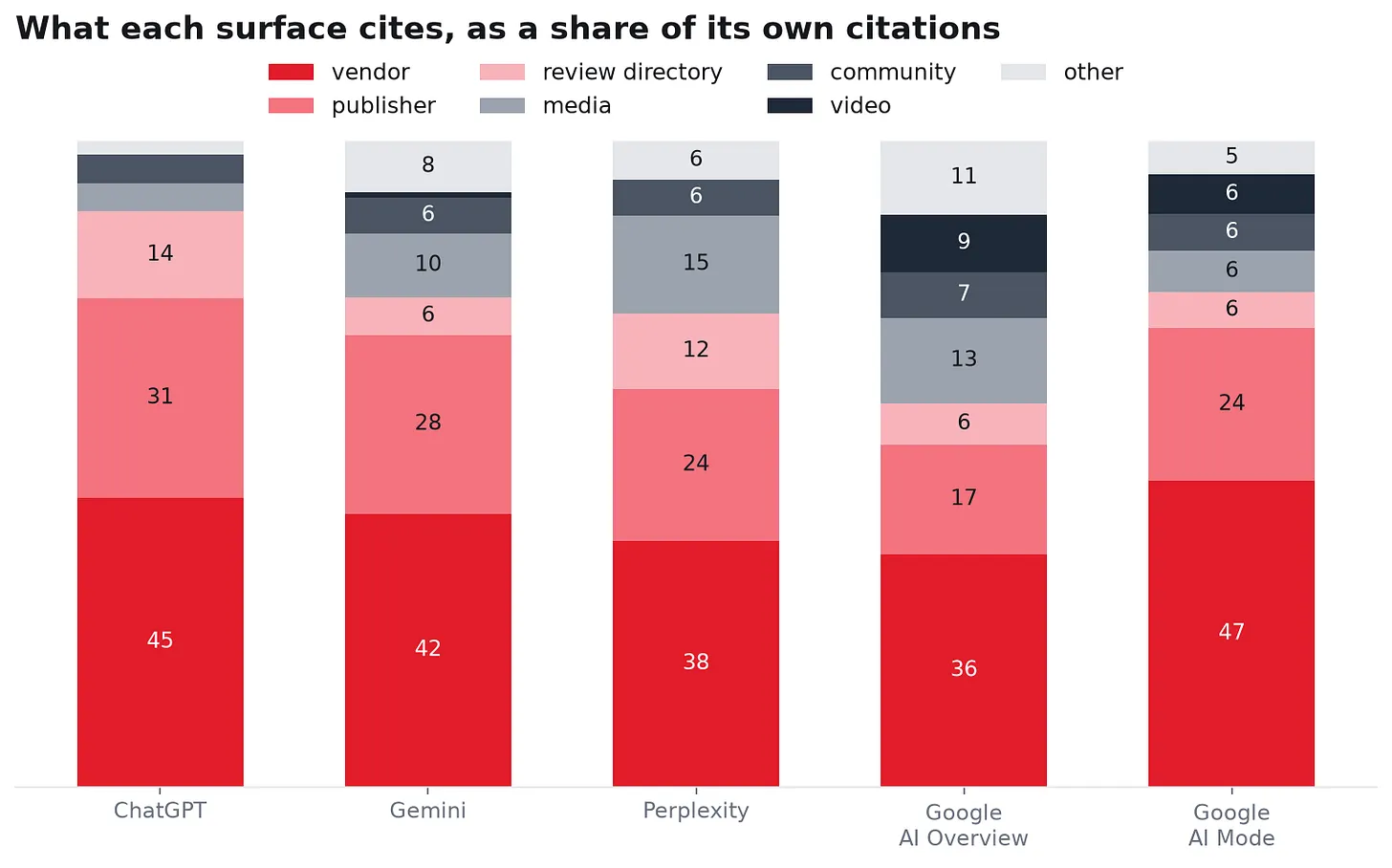
The next source type depended on the surface. ChatGPT gave 13.5% of its citations to review directories. Perplexity gave 15.2% to media sites. Google AI Mode gave 23.6% to independent publishers.
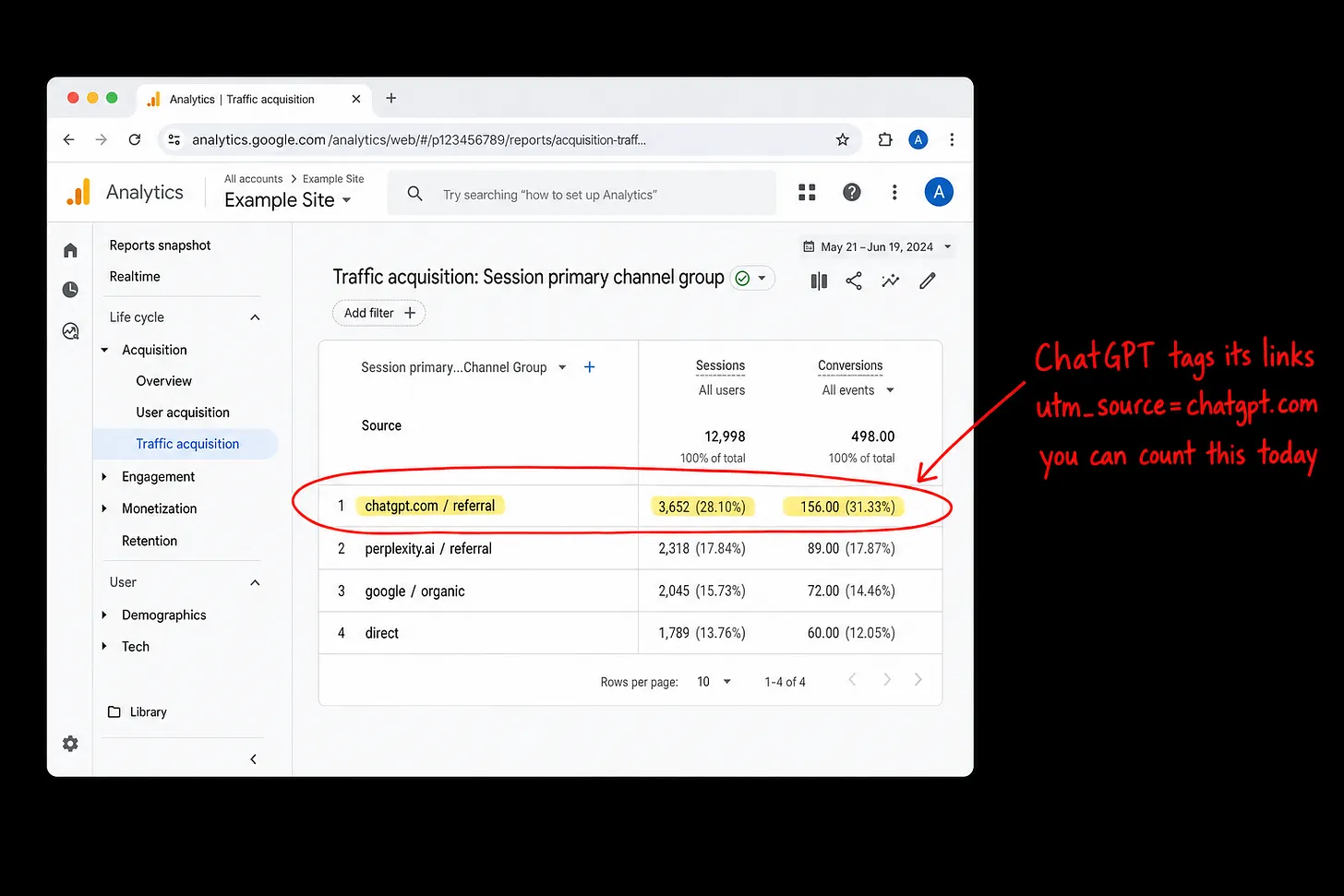
Two tracking details are useful. ChatGPT adds utm_source=chatgpt.com to outbound links. Perplexity referrals also appear in analytics. Google's citation links use a google.com/goto redirect, so the visible publisher must be stored separately when you collect the answer.
A seven-step AI citation sources plan
Step 1: pick one surface and one backup
Start with the assistants your buyers already use. Check analytics for utm_source=chatgpt.com and Perplexity referrals, then ask recent customers which assistant they used before finding you.
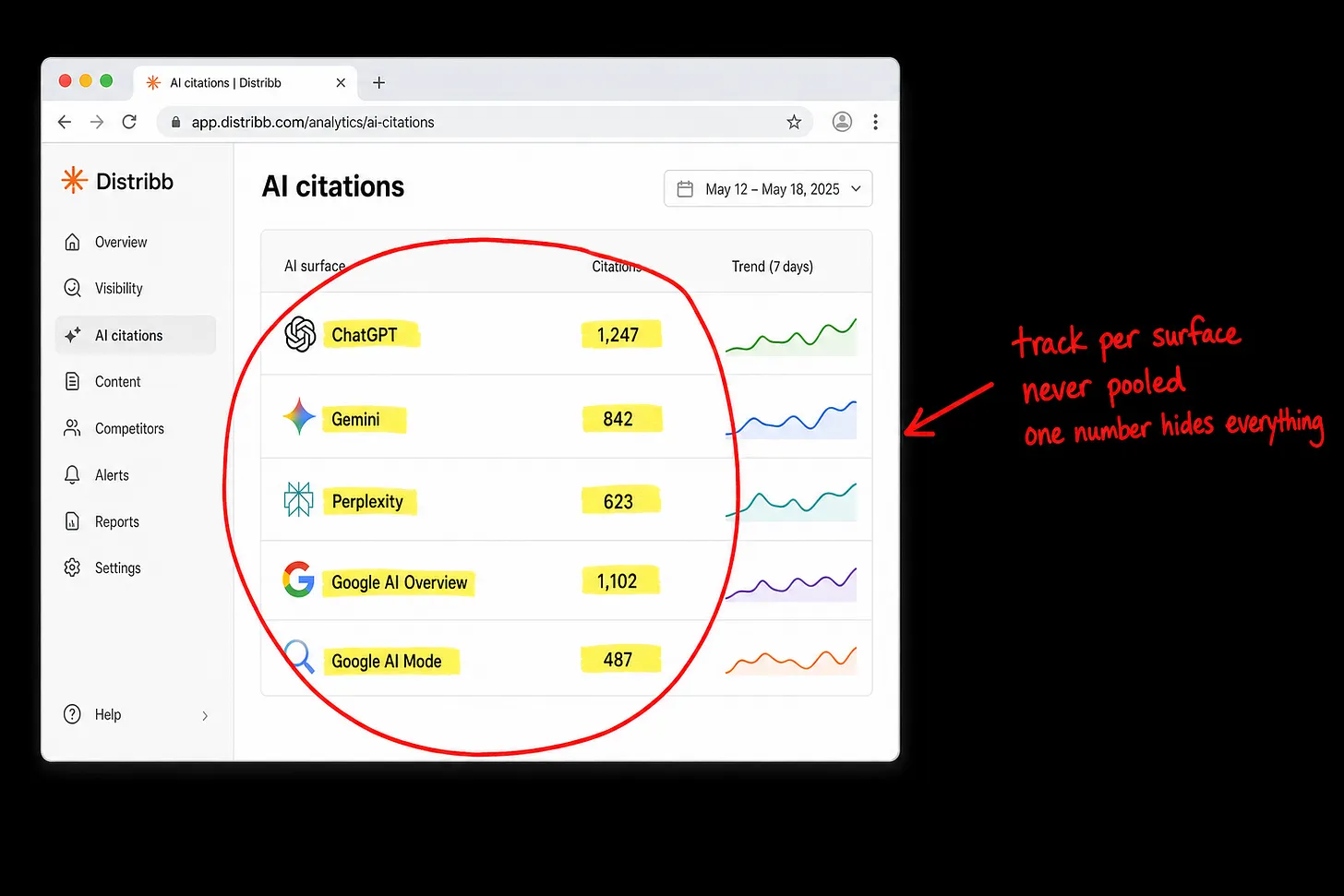
Choose one primary surface and one backup. The low overlap means one pooled "AI visibility" score will hide where your pages are actually being cited.
Step 2: claim your review directory profiles
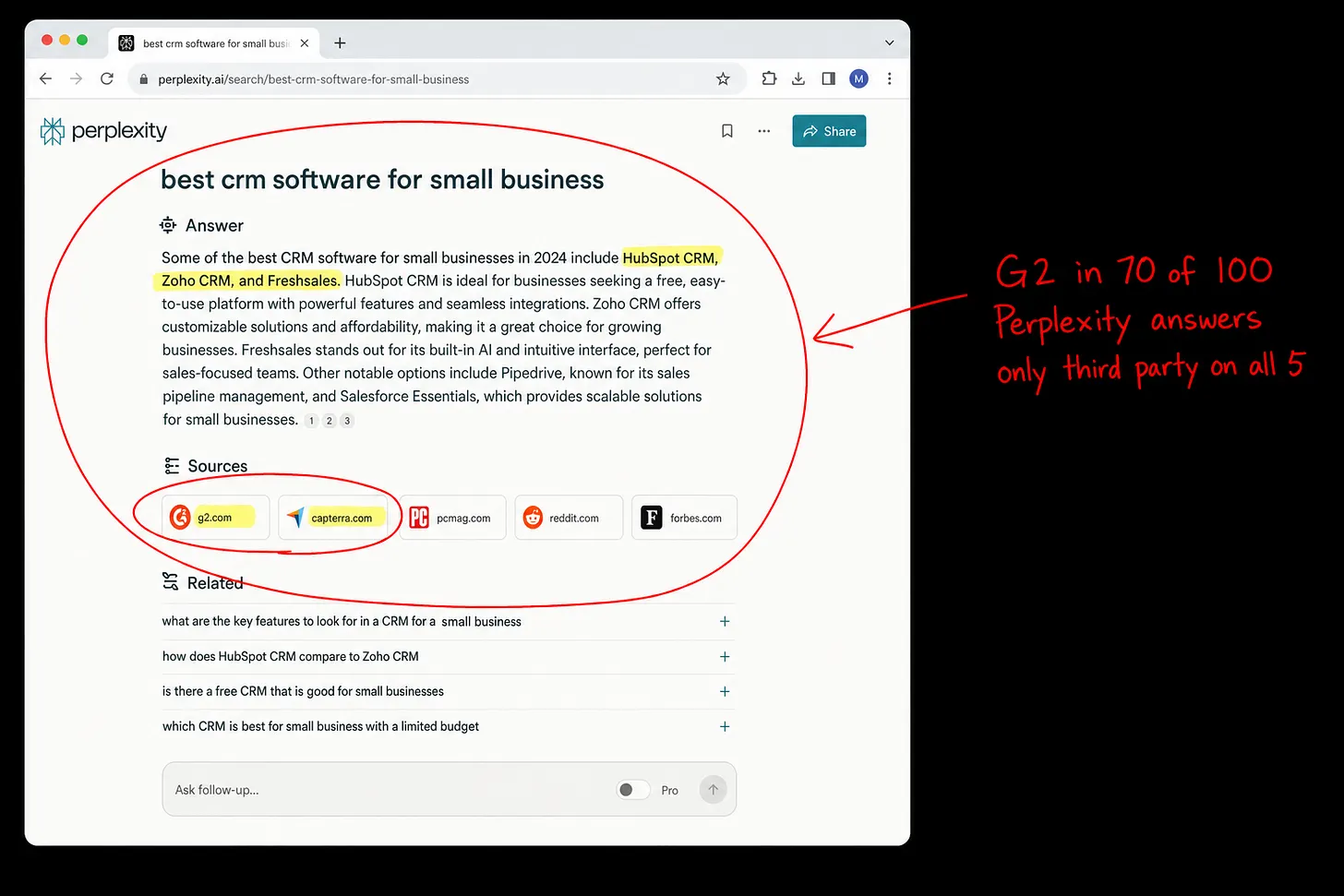
Review directories were the only third-party category cited by every surface. G2 appeared in 161 answers, behind only Reddit. Capterra appeared 74 times.
G2 appeared in 70 Perplexity answers, 32 Google AI Mode answers, 26 ChatGPT answers, 23 Google AI Overview answers and 10 Gemini answers. Claim the correct profile and ask real customers for honest reviews.
Step 3: answer real recommendation questions on Reddit
Look for threads where someone is already asking for a tool in your category. Answer as yourself, say that you built the product, and name credible alternatives when they fit.
The Reddit result was strongest for questions that asked for recommendations from real users. Spam that gets removed has no chance of being cited.
Step 4: make one useful YouTube demo for Google
Publish a video that shows the product completing one real task. Use the category question in the title so the video answers the same query a buyer asks Google.
This step is supported for Google AI Overview and Google AI Mode by the 63 of 100 result. The study found no YouTube citations in ChatGPT or Perplexity.
Step 5: answer each buying question on your own site
Vendor pages were the largest source bucket on all five surfaces. Create one page for a distinct buying question and state the information the buyer needs, including price when the question is about cost.
Keep comparison pages accurate and name the products a buyer is genuinely considering. Each page should answer the question in the words the buyer uses.
Step 6: pitch the listicles your chosen surface cites
Independent publishers made up 17.0% to 30.8% of citations, depending on the surface. Pull the exact listicles from the surface you selected in step 1.
PCMag, TechRadar, Forbes, Fit Small Business, Venture Harbour and Zapier's blog appeared on at least three surfaces in this study. Pitch the writer with product access and one checked reason the product belongs in the article.
Step 7: track each surface and question shape every month
Save the question, answer date, cited page and surface. Use several wording patterns for each category because the Reddit share moved by more than 24 percentage points on ChatGPT.
Repeat the same question set monthly. The study is one dated snapshot, and every surface can change its sources.
Frequently asked questions
What are AI citation sources?
AI citation sources are the pages, videos, directories and community posts linked or named inside an AI-generated answer. In this study they included vendor sites, independent publishers, review directories, media sites, Reddit and YouTube. The mix differed by surface and by the wording of the question.
Which AI search engine should I optimize for first?
Start with the AI surface your buyers already use or the one already sending referral traffic. Check ChatGPT and Perplexity tags in analytics, then ask recent customers which assistant helped them research the purchase. Pick one primary surface because the five engines usually cited different pages.
Does ChatGPT cite Reddit for software recommendations?
ChatGPT cited Reddit only for one of the four question shapes in this sample. Its Reddit share was 24.1% for requests phrased as recommendations from real users and 0% for the other three shapes. The result covers 25 software categories and four question shapes. Broader prompts could behave differently.
Do YouTube videos help with ChatGPT citations?
YouTube did not appear in any of the 100 ChatGPT answers collected for this study. It appeared in 63 Google AI Overview answers and 63 Google AI Mode answers. A YouTube demo therefore matched the Google surfaces in this snapshot, while the study found no YouTube citation path into ChatGPT.
Should I get reviews on G2 and Capterra for AI citations?
G2 and Capterra were cited across all five AI surfaces in this study. G2 appeared in 161 answers and Capterra appeared in 74. Claim the correct listing and collect honest customer reviews on that listing because the engines cited the directory page.
How often should I measure AI citations?
Run the same tracked question set once a month. Save results by surface and question shape so a change on one engine is not hidden by a pooled score. Keep the date because this study only describes the answers collected on 26 August 2026.
Which AI surface sends your company the most qualified traffic today?
If you want to plan and publish the pages behind that work, try Distribb.

Interesting how little overlap there is between AI engines. Definitely makes “AI search” feel less like one channel and more like several.
Something we’re keeping in mind with ScaleBlogger too.
The five engines do not share the same shortlist. Pick one surface and one page and log who gets named on three to five buyer questions each week. Keep that log or the mix across five engines just looks like noise.