AI coding should not turn software development into a black box
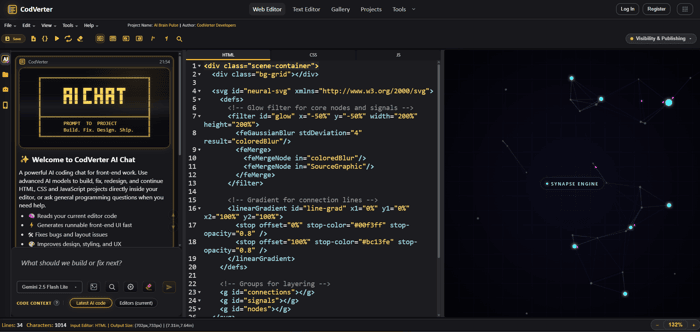
One thing that worries me about some AI coding tools is how quickly they can turn development into a black box.
The demo feels magical:
describe what you want,
click generate,
get an app.
But if the code is hidden, unclear, or constantly rewritten by the tool, the developer slowly loses control.
That may be fine for a quick prototype, but I think it is dangerous as a long-term workflow.
Software development is not only about getting an output. It is also about understanding structure, making tradeoffs, debugging problems, improving details, and knowing why something works.
If AI removes the developer from that process completely, the result can look impressive at first, but become fragile later.
I do not think the best future is “AI replaces the developer.”
I think the stronger future is human + machine:
AI helps move faster.
The developer keeps judgment.
AI suggests and edits.
The developer sees the code.
AI reduces repetitive work.
The developer keeps control of architecture, quality, and intent.
That is especially important in front-end projects.
HTML, CSS and JavaScript are visual, iterative, and detail-heavy. Small changes can break layout, responsiveness, accessibility, or behavior. If the tool hides too much, it becomes harder to trust.
This is one of the reasons I am building CodVerter the way I am.
I do not want it to be a black-box app generator.
I want it to be an online HTML/CSS/JS workspace where the code stays visible, editable, and understandable, while AI helps inside the workflow.
The goal is not to make development feel cheap or automatic.
The goal is to give developers leverage without taking away control.
I think that distinction matters.
AI coding tools should not only ask:
“Can we generate the result?”
They should also ask:
“Can the developer still understand, own, and continue the work after generation?”
That is where I think the real value is.
For context, this is what I am building:
https://codverter.com/html-editor/

The black box only bites you later. The first time a generated module breaks you realize you never built the mental model to debug it, so you end up reverse-engineering your own app. I still let the tool write, but I read every file it touches like I'll have to defend it in review, which is slower today and much cheaper the week after.
That is a very good way to describe it.
The first version can look fine, but the real cost appears later when something breaks and you realize you do not have the mental model for the code anymore.
I think reading every file the AI touches is the right discipline. It feels slower in the moment, but it is much cheaper than reverse-engineering your own app later.
For me, the code has to stay visible and owned by the developer. AI can help write, but the human still has to understand and be able to defend the change.
"Defend the change" is the part I keep coming back to. Reading every file the AI touches feels slow until the first time something breaks at 2am and you actually know where to look. Ownership doesn't transfer just because the typing did. The teams that stay fast are the ones who treat AI output as a draft they still have to be able to explain, not a finished thing they inherited.
One thing we learned while building AI-assisted engineering workflows is that the real bottleneck isn’t code generation anymore — it’s context integrity.
Most teams are now generating code faster than they can validate assumptions, architecture decisions, or downstream impact.
That’s where things become dangerous:
AI should compress implementation time, not remove engineering clarity.
The teams that win will probably be the ones that treat specs, validation, and workflow structure as first-class citizens instead of treating prompts like magic.
I agree.
Generating code faster is useful, but only if people can still understand what changed and why.
Otherwise the team is not really moving faster. It is just pushing the confusion forward.
AI should help reduce the boring parts of implementation, not remove engineering clarity.
Specs, validation, and a visible workflow still matter more than prompt magic.
Honestly, this AI thing sometimes genuinely unnerves me. To keep myself from sliding into laziness, I refactor everything it produces after each task. But on the upside, asking it for solutions instead of hunting them down myself has drastically cut my research time. It's a strange new normal — I'm curious to see what the future holds. :)
Yeah, “strange new normal” is exactly how it feels.
Not that long ago we were digging through docs, Stack Overflow threads, GitHub issues and half-broken examples for hours.
Now the research loop is much shorter, but the responsibility is still ours. The answer is faster, but we still need to understand what we are putting into the codebase.
the tension you're describing maps well to what i think of as the "legibility gap" - as AI systems generate more of the implementation, the ability of the developer to reason about causality (why did this break? what did that change affect?) degrades faster than the velocity gain. the tools that preserve legibility are the ones that let devs stay in a genuine review posture rather than an approval-rubber-stamp posture. for vibe coding specifically, what's your approach to keeping context windows clean enough that the AI suggestions stay architecturally coherent over a long session?
“Legibility gap” is a great way to describe it.
I am not a big believer in long vibe-coding sessions, especially for serious systems. Maybe people will understand the risk more clearly when the broken code is not just a landing page, but something load-bearing.
My approach is pretty conservative: keep the code in front of me, keep the task narrow, and use AI mostly in ask/review mode. I do not like giving an agent free access to roam through a large codebase and “do what it thinks is right.”
I have already seen that cost many hours of cleanup and frustration.
For me, the goal is not to keep the AI’s context window clean enough to trust blindly. The goal is to keep the human’s mental model clean enough to review, understand, and own the change.
That is the human + machine approach I trust most: the machine accelerates and suggests, the human understands, decides, and takes responsibility.
This tension is real and I think about it a lot when building AI-assisted tools. The "black box" problem is most dangerous not when the code is hidden, but when the developer stops asking "why does this work?" — those are two different failure modes. What I've found useful is treating AI output as a first draft that I'm obligated to read line by line, not a final answer. The moment you skip that step to ship faster, you've traded understanding for velocity, and that debt compounds. Your framing of "leverage without control loss" is exactly right — the best AI tools feel like a senior colleague suggesting code, not a machine replacing your judgment. Curious how you're handling the cases in CodVerter where the AI suggestion is technically correct but architecturally wrong for the user's specific project context?
I agree with that distinction.
For me, the important part is that AI should not silently own architecture. Even when the suggestion is technically correct, the developer still needs to judge whether it fits the direction of the project.
In CodVerter there is no autonomous agent mode. The code stays visible and editable, so the developer is forced to stay involved and understand what is changing.
The best workflow, in my view, is human + machine: AI gives speed and options, the developer keeps judgment and ownership.
Both sides need clear roles. The machine should help, suggest, and accelerate. The human should understand, decide, and take responsibility for the result.
This part makes sense to me too. Speed helps, but not if the tool starts hiding the why. DictaFlow works for me for the same reason I like your framing here, hold to talk, release to insert, and keep the correction path clear so you’re not left guessing what happened.
Yes, that is a good way to put it.
One funny thing I notice in the comments here is that many of the people who agree with this are building AI tools themselves (Like me). The people closest to AI are often the least interested in turning everything into magic.
“Keep the correction path clear” is a great phrase. If the user cannot understand what changed, or how to fix it, the tool is already taking too much control.
agree. ran 35 specialized claude code agents across 3 production codebases for 6 months. specialists not generalists is the key — each agent has a tight scope you can supervise. when one fails its in one domain not across the codebase.
what stays human in my workflow: judgment under partial info, load-bearing weirdness ("dont remove this try/catch" comments that crash prod when ignored), tone reading in client messages, eval design for LLM products.
practical fix that worked: every agent reads from frozen redis context cache (TTL'd). agents dont see "the floor moving" mid-task. cut inter-agent conflict ~80%.
black-box risk is real for one-shot "describe → app" tools. less for specialist-pattern where each scope stays auditable. curious how codverter keeps code editable while AI does narrow tasks 🤔
That is a really interesting pattern.
CodVerter is a bit different because it is not an agent system. It is more of a visible workspace: HTML/CSS/JS files, live preview, and AI working inside that project context.
So the way I think about narrow tasks is not “many agents”, but “small supervised edits”. The developer still sees the files, reviews the change, and can keep or adjust it.
I like your point about specialists though. The common idea is scope control. The smaller and more auditable the AI task is, the less black-box risk there is.
The black box problem is real, but I think it shows up differently depending on experience level.
For developers who already understand the underlying concepts, AI coding tools are genuinely amplifying — they stay in control because they can read and judge the output. For people learning as they go, the same tools can create a dangerous illusion of understanding. The code works, so they assume they understand it. Until something breaks.
I've been building with Claude Code (vibe coding, as some call it), and the thing that keeps it from becoming a black box for me is asking "why" not just "what." Forcing the AI to explain tradeoffs before writing code, not after.
Your point about front-end being especially vulnerable resonates. CSS in particular — AI-generated CSS can look right and be completely wrong structurally. You only find out three components later when everything starts fighting each other.
The "leverage without losing control" framing is exactly right. The question isn't whether AI writes the code. It's whether the developer could rewrite it themselves if they had to.
Exactly. That distinction by experience level is important.
For someone who can read and judge the output, AI is leverage. For someone who cannot, it can easily create the illusion of understanding.
That is why I think visibility matters so much. The code should stay in front of the developer, not hidden behind the magic.
And yes, CSS is a perfect example. It can look fine in the first screen and still be structurally wrong enough to break later.
“Could I rewrite it myself if I had to?” is a great test.
The useful boundary for me is: can the next human understand the change quickly enough to own it?
AI-generated code is fine when it leaves a clear diff, small commits, visible assumptions, and tests/screenshots that prove the behavior. It gets risky when the tool optimizes for "finished app" instead of making the work inspectable.
The workflow I trust most is AI drafts, human reviews the reasoning and failure cases, then AI applies a narrow change with proof.
Good point. “Can the next human own this change?” is probably the right test.
I also trust AI more when the code, diff, assumptions and proof stay visible.
The goal should be inspectable work, not just a finished-looking app.
I completely agree, a developer should always know what's going on in the backend even if AI coding tools make it easy to not pay attention to what's going on in the line-by-line code of it all. Now more than ever we need to be careful about cybersecurity risks and other holes that AI generated code can introduce into our software
Yes, I agree. Security is a big part of it.
But I think it is not only security. As the codebase grows, blind copy-paste also makes bugs harder to trace, especially in sensitive parts of the system.
If the developer stops understanding which parts of the code are responsible for what, control slowly disappears. AI can still be very useful, but the code needs to stay readable, reviewable and owned by the developer.
This is a strong positioning angle because “AI coding with control” is much more trustworthy than another black-box app generator.
The part I’d pressure-test is the name. CodVerter explains code conversion, but your argument is broader than conversion. You are building a visible, editable AI-assisted workspace where developers keep control of HTML, CSS, and JavaScript. That is a stronger category than the current name suggests.
If this becomes a serious front-end AI workspace, the name needs to carry trust, control, and workflow ownership, not just code conversion. Xevoa .com would fit that broader direction better because it feels more like a dev workflow platform than a utility.
I’d think about this before more users and docs lock around CodVerter, because the product’s strongest message is not “convert code.” It is “AI leverage without losing control.”