AI Didn’t Break Your SaaS Growth — Positioning Did
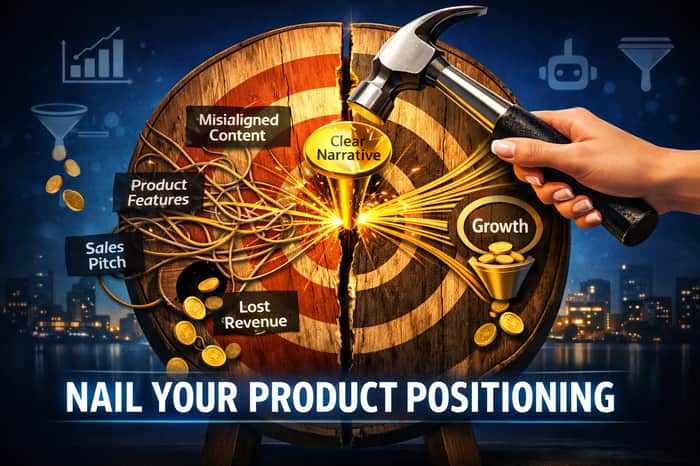
Most B2B SaaS teams optimize everything except the one thing quietly killing conversions: whether content, product, and sales actually tell the same story.
On paper, your Series A SaaS looks solid.
The product is validated.
The content engine is running.
AI tools are in place.
Traffic is climbing. SEO looks fine. Everyone’s shipping fast.
So why is pipeline slowing down?
Why are sales cycles suddenly dragging?
Why do deals that should close just… disappear?
This isn’t an execution problem.
It’s narrative misalignment. And most funded teams don’t notice it until revenue stalls hard enough to force a closer look.
The Pattern Nobody Wants to Admit
I keep seeing the same thing with Series A–C teams:
The product works.
Content scales.
AI speeds everything up.
But revenue flatlines while traffic keeps going up.
Founders start chasing symptoms.
Better sales enablement.
“Higher-intent” keywords.
New homepage use cases.
AI personalization that promises to smooth everything out.
None of that touches the real issue.
The story isn’t coherent across touchpoints.
How Positioning Breaks Without Anyone Noticing
It happens slowly.
Early on, your buyers were obvious. You knew exactly who they were and what kept them up at night.
Then growth kicked in.
Marketing broadened the message to capture demand.
Product shipped features faster than messaging could keep up.
SEO started ranking you for phrases that completely skip over the buyer’s real decision anxiety.
Now you’re trying to speak to three different personas with one confused narrative.
AI tools like Jasper or ChatGPT don’t fix this. They amplify it.
They multiply a vague story faster — they don’t sharpen it.
Sales ends up talking to “article likers” instead of buyers.
Traffic goes up.
Clarity goes down.
And no one can figure out why conversions are falling apart.
Why Traffic Doesn’t Equal Trust
(And Trust Doesn’t Equal Conversion)
Here’s what’s actually happening:
Traffic only signals interest. That’s it.
Conversion requires something harder — the buyer needs to believe this is the safest decision for their role, their budget, and their risk tolerance.
When content says one thing, product emphasizes another, and sales pitches a third angle, trust erodes. Even if people like what they’re reading.
Think of it like a funnel with a big leak in the middle:
Wide top (traffic).
Narrow middle (trust checkpoint).
Thin bottom (conversion).
Most teams optimize the top and the bottom. Almost nobody fixes the alignment gap in the middle — where a huge chunk of deals quietly die after $5M ARR.
Stop Optimizing Symptoms. Name the Real Problem.
Drop the generic goals like:
“We need more leads.”
“Our AI needs to be smarter.”
The real issue is simpler and harder at the same time:
Narrative misalignment.
Your content says X.
Your buyer hears Y.
Sales pays the price.
Because Theory Is Useless Without One)
I worked with a RevOps platform dealing with exactly this.
Their blog talked about flexible infrastructure.
Product pages emphasized automation.
Sales pitched speed and efficiency.
All reasonable. All true. None connected.
But buyers weren’t thinking about any of that.
They were worried about risk — specifically, the risk of their RevOps stack breaking during a critical quarter.
Each message worked on its own. Together, they clashed.
Sales cycles stretched.
Deals stalled in legal.
Momentum disappeared.
The fix wasn’t traffic or AI.
It was one clear promise:
“Reduce RevOps risk by 30% in 90 days.”
That became the thread across everything — blog posts, product pages, sales decks, demos, case studies.
Velocity improved without changing traffic at all.
The Leverage Equation Everyone Misses
Real SaaS compounding comes from:
Operator insight × narrative clarity × distribution
Distribution without clarity builds buzz, not authority.
Insight without clarity stays trapped in Slack threads.
Clarity without insight turns into generic corporate language.
Look at Miro.
They didn’t win on features.
They won because “visual collaboration” was instantly clear — clear enough that adoption happened before sales even stepped in.
The narrative did the heavy lifting.
Why This Matters More Now
AI commoditized generic content overnight.
Everyone has the same tools.
Everyone can publish at scale.
Differentiation collapsed.
What’s still hard — and therefore valuable — is decision framing.
Understanding buyer psychology.
Knowing what not to say.
Knowing which objection actually kills deals versus which one is just noise.
Positioning isn’t a marketing exercise anymore.
It’s revenue infrastructure.
Is This You?
Pull up three things right now:
Your homepage.
Your top-performing blog post.
Your latest sales deck.
Read them back-to-back.
Do they sound like the same company?
Same buyer. Same problem. Same promise.
Or does your homepage sound like one person wrote it, your blog like someone else entirely, and your sales deck like it came from a third team that never spoke to the other two?
If it’s the second — that’s where deals are dying.
Marketing promises one thing.
Sales delivers another.
The buyer bails because they can’t figure out what you actually do or who it’s for.
But We Already Have Strong SEO
That’s exactly the problem.
Strong SEO masks the drop. Vanity metrics stay green while conversions erode quietly underneath.
This isn’t a marketing problem.
It’s not a sales problem.
It’s a narrative problem — and sales feels it first because they’re closest to the decision.
AI won’t fix it. It just personalizes a broken story at scale.
This matters most for funded B2B SaaS teams with real demand but stalled pipelines.
If you’re still searching for product-market fit, you’ve got different problems to solve first.
What Actually Fixes This
You need one clear narrative that holds across every touchpoint.
Not three messages for three personas.
One promise that survives from the first blog post to the final demo.
Then you reverse-engineer everything from that:
content themes, product positioning, sales messaging, even which features you highlight in the UI.
It sounds simple.
It isn’t easy.
But it’s the only thing I’ve seen consistently unstick revenue for teams doing “everything right.”
If your SaaS has demand but pipeline keeps stalling, it’s alignment — not execution.
I’ve helped funded B2B SaaS teams fix this exact issue, like the RevOps example above.
Reply ALIGN for a free positioning audit, or DM me and we’ll isolate where your narrative is breaking: https://sonusaaswriter.com/

The 'wide top, leaky middle' framing is useful. But the version I've seen most often isn't narrative misalignment across content/product/sales — it's misalignment between what the founder thinks the buyer's problem is and what the buyer actually needs to believe before they'll act.
Specific example: a payment recovery product clearly solves a real problem (5-9% of Stripe charges fail monthly). But the buyer's decision anxiety isn't 'do I have failed payments?' — they know they do. It's 'is fixing this actually my job, and is now the right moment to fix it?' The content can be excellent, the product can be clear, but if the story doesn't address that specific anxiety, the deal disappears.
Your point about AI amplifying vague stories resonates here. You can generate 50 pieces of content that explain payment recovery. If none of them address 'why now, why this, why not just build it ourselves,' you've efficiently distributed the part of the story that doesn't convert.
The coherence question to ask: does every touchpoint answer 'what would make this person feel it's safe to act today?' rather than 'does every touchpoint describe the product accurately?'
Strong point on narrative alignment. One practical test we’ve used: take the top 3 objection‑handling emails + homepage hero + demo deck, and ask 5 prospects to describe “what this does” in one sentence. If the summaries differ, alignment is broken. Curious if you’ve seen a lightweight alignment workshop format that doesn’t take a full positioning project?
That’s actually a really clean test.
Yes I’ve seen a lightweight version work without a full positioning reset:
Get marketing, product, and sales to each write a one-sentence promise independently.
Compare them side by side.
If they’re meaningfully different, that’s your alignment gap.
Then pressure-test that single sentence against your top 3 live objections. If it doesn’t directly reduce one of them, it’s too vague.
Takes 60–90 minutes. No decks. No frameworks. Just clarity.
when you’ve run your test, where do you usually see the biggest drift: homepage, demo narrative, or sales follow-up?