AI Didn't Kill Publishing. It Changed What Matters.
In 2026, you can generate a full book draft in minutes.
Outline, chapters, formatting, even a cover. The entire production pipeline that used to take months now takes an afternoon.
I've seen two reactions to this.
Some people assume ebooks are now worthless because anyone can generate one. Others assume there's easy money in pumping out AI books on KDP.
Both are wrong, and for the same reason.
The draft was never the hard part of producing a book that people actually want to read or buy.
What Actually Stops Most Books From Shipping
When people abandon a book project, it's not a typing speed problem. It's a clarity problem:
- Who is this for?
- What specific outcome does it deliver?
- What belongs in it (and what doesn't)?
- How do the chapters build on each other?
AI can generate coherent paragraphs. It cannot define scope.
If the premise is unclear, the output feels like every other AI-generated PDF on Gumroad. Not because the writing is technically bad, but because there's no clear point of view.
This is something I think about constantly while building Inkfluence AI. The tool requires a structured outline before any chapter is generated, because skipping that step is where most AI books go from "potentially useful" to "obviously generic."
The Pattern Behind Bad AI Books
Low-quality AI books all look the same:
- Vague idea ("a book about productivity")
- One big prompt into ChatGPT
- No outline review or restructuring
- Copy-paste into Canva, export, list on KDP
That produces something that reads fine paragraph by paragraph but has no spine. No throughline. Readers can feel it, even if they can't articulate why.
When the workflow includes deliberate outline shaping, sequential chapter drafting with context, and an actual editing pass, the output is materially different. Same AI model. Better process.
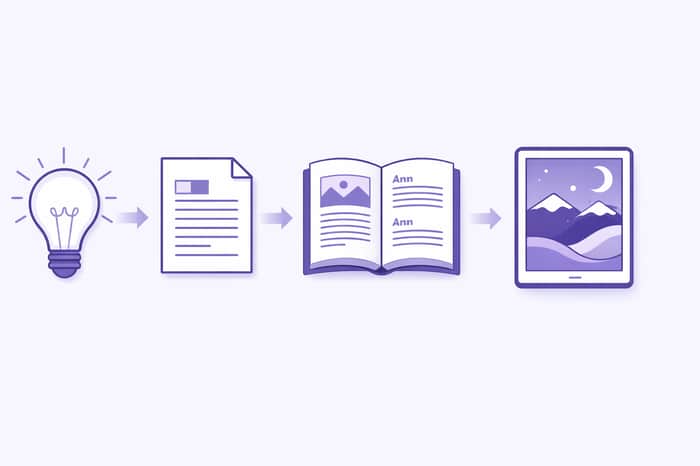
I built Inkfluence around this exact workflow: idea → outline → sequential chapters (each aware of what came before) → cover → export. The structure-first approach is the entire thesis of the product.
Where This Creates Real Business Value
AI performs best in formats that already rely on structure. And those happen to be the formats that sell:
- Lead magnets - the fastest path to building an email list. A well-structured lead magnet can be done in an hour and drive signups for months.
- How-to guides and playbooks - package your expertise, sell on Gumroad or your own site
- Cookbooks - AI cookbook generation produces surprisingly polished results. Recipe books are one of the best-performing ebook niches on KDP.
- Course companion workbooks - sell alongside your course or use as an upsell
- Niche KDP books - the low-competition niches still convert well if the content has actual structure
AI performs less well when the value depends on lived experience or a distinctive voice. For those, it's a drafting assistant, not a ghostwriter.
The Actual Economics
Here's what's changed for indie creators:
Before AI:
- 2-6 months to write a book
- $500-2,000 for editing/formatting
- $200-500 for cover design
- Total investment: 200+ hours and $1,000+
With a structured AI workflow:
- Hours to days for a full draft
- Built-in formatting and export to PDF/EPUB
- AI cover generation included
- Total investment: a few hours of focused work
The unit economics of ebook creation have fundamentally changed. That doesn't mean every AI book will sell. It means the cost of testing whether a book idea has a market is now nearly zero.
You can validate a niche, produce a quality ebook, publish on KDP, and know within 30 days whether it has legs. If it doesn't, you've lost hours, not months.
What Hasn't Changed
Publishing is not easier in the way people assume.
Typing is easier. Formatting is easier. Starting is easier.
Choosing a profitable niche, defining a clear audience, and structuring content that actually delivers value - that still requires thought.
AI removed the friction from production. It didn't remove the need for product-market fit. Yes, even for books.
The people making real money from ebooks in 2026 aren't the ones generating the most text. They're the ones who treat each book like a product: clear audience, clear outcome, clear structure. Then they let AI handle the production.
I'm building Inkfluence AI — goes from idea to finished, exportable ebook in minutes. Free tier available, no credit card. If you want to see the structured workflow, try it here.
