AI in Healthcare: Benefits & Applications
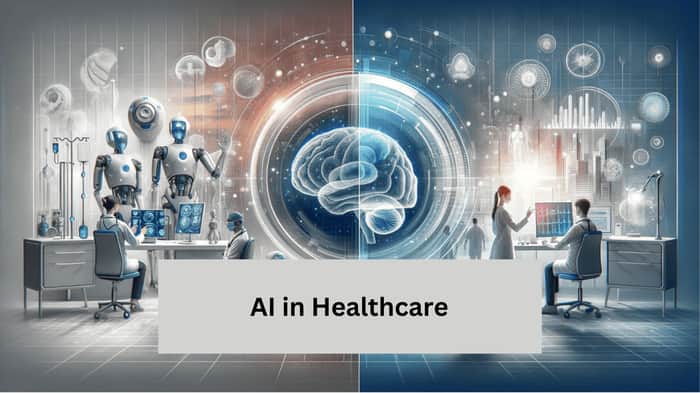
Artificial Intelligence has changed the world greatly. It has been a great help for people, making their lives easier. One area where we are focusing today is AI in healthcare.
AI has made a great impact in the healthcare sector. It helps in diagnosing and creating personalized treatment plans for the patients. AI development services also play a big role here as professionals can revolutionize patient care, optimize processes, and get help in solving difficult medical situations through these services.
Let’s move further and see the contribution of AI in Healthcare.
How is Artificial Intelligence Used in Healthcare?
AI simulates human intelligence and carries out intricate automated activities in the medical field using computers and mechanical processes. While AI-enabled computers aim to mimic human intelligence, they can also surpass it in a variety of ways, most notably by effectively sorting through massive amounts of big data to find patterns, anomalies, and trends.
Artificial Intelligence provides a lot of opportunities to the healthcare sector, and healthcare providers can use it to improve a lot of common medical processes – from making medical diagnoses to determining the most effective treatment strategies for individuals with serious conditions like cancer. Artificial Intelligence (AI)-equipped robotic surgical instruments can improve surgical performance by reducing physical oscillations and delivering real-time information throughout the procedure.
Benefits of AI in Healthcare
Better Patient Care
The biggest benefit of AI is how it makes patient care better. It accomplishes this by lowering errors, promoting better resource use, and saving research time.
When medical professionals are making critical treatment decisions, including medical AI in their processes can also provide them with essential context.
Real-Time & Accurate Data
In the medical field, providing diagnoses quickly is very important. For this, the professionals need accurate data about the patient as it helps them to make the right decisions.
Also, real-time data minimizes costs, reduces waiting time, and diminishes the chances of the situation going wrong
Reduced Cost
AI in healthcare also provides great benefits to the patients and one of them is the reduced cost of healthcare services. It reduces unnecessary procedures, streamlines workflows, and enhances the efficiency of the treatment, which results in saving a lot of expenses.
Reduce the burden on the staff
The job of healthcare professionals is quite stressful, and many times lot of departments are short-staffed. AI plays a major role in solving this problem by automating routine tasks, streamlining workflows, and thus allowing healthcare professionals to only focus on patient care.
Health Monitoring & Digital Consultations
AI is a terrific approach for medical professionals to improve data recording and analysis. It also enables users to track their own health and get expert advice online.
Applications of AI in Healthcare
Medical Imaging
In many research, it has been proved that AI can be of great help in detecting many major diseases such as cancer. Thus, it has been widely used in medical imaging.
Managing Medical Records
AI is a valuable tool for gathering and analyzing data, such as medical records. This not only helps medical professionals operate more effectively, but it also allows them to work faster and prioritize other crucial elements of their jobs.
Health Monitoring Using Wearables
Wearables are used a lot in monitoring health. You can just see the people around you and you will find many people using smart wearables to track their health.
With the ability to act at the first hint of issues and guarantee that patients receive care and treatment as soon as possible, the use of these technologies is only going to grow.
Illness Detection & Diagnosis
AI and Machine Learning play a major role in detecting complex conditions that are not easily apparent. Additionally, it might be used to track patients and determine when their health deteriorates. After that, the AI system would be able to gather important information and notify healthcare providers.
Drug Creation and Development
AI in medicine can be used to develop new drugs by analyzing data and existing ones. Discovering and creating medicine is extremely expensive and time-consuming. AI could lower expenses and speed up the discovery of promising new medications.
Conclusion
AI has found its way into the healthcare industry hence playing a very vital role in diagnostics as well as patient care. From diagnostics to drug discovery, AI allows professionals and patients to change the way the healthcare industry works to be faster, more affordable, and more effective.
