AI Made Products Cheap. Now Trust Is the Scarce Resource
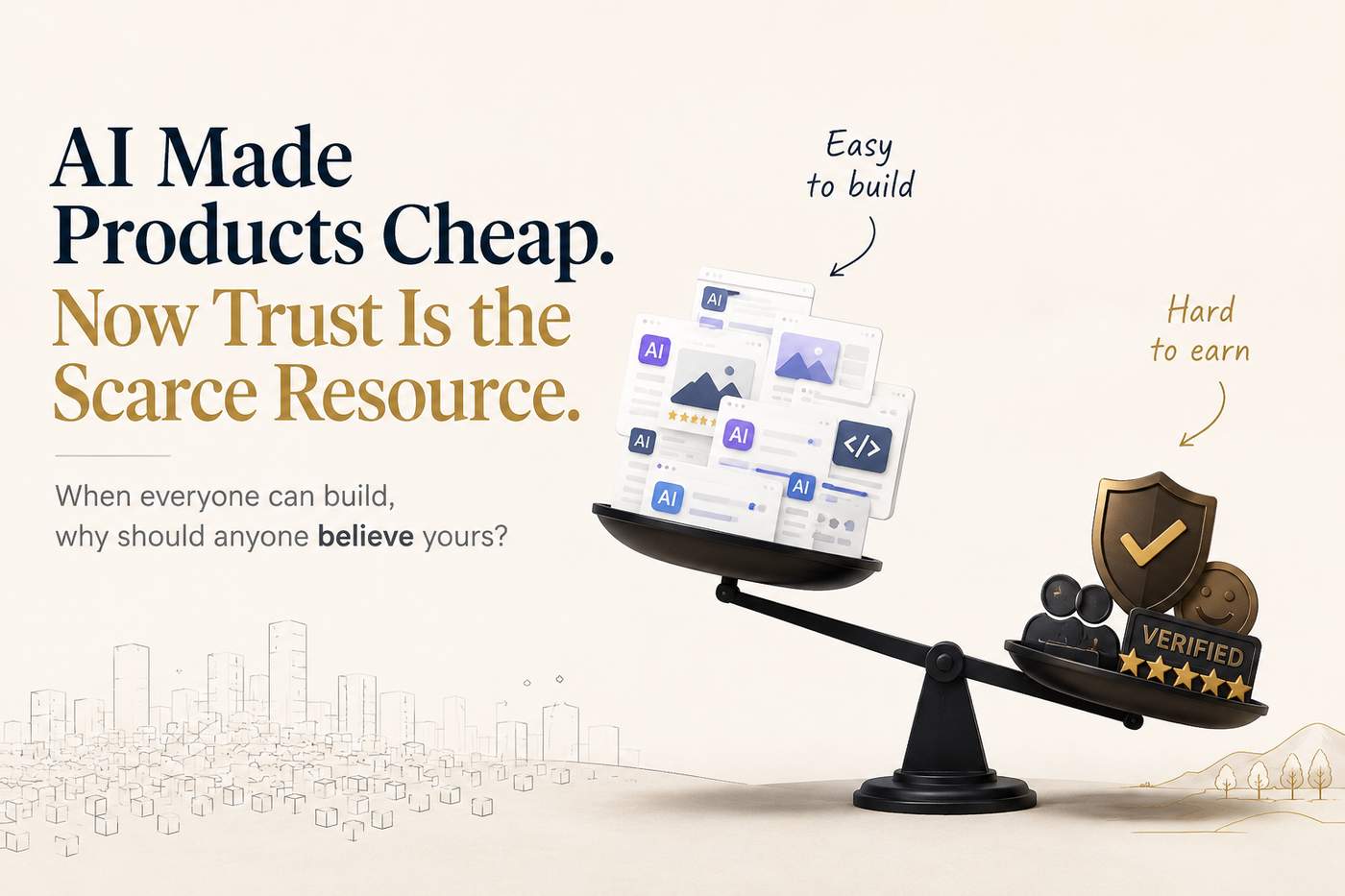
When almost anyone can build a decent product, the harder question becomes: why should anyone believe yours?
AI has changed one of the oldest rules in software.
Building a product used to be expensive. You needed developers, designers, time, and often a large amount of capital before you could even discover whether people wanted what you were making.
That equation is changing quickly.
With AI coding tools, no-code platforms, automated design systems, and increasingly capable agents, a small team can now build something that looks surprisingly polished in days.
That sounds like a huge advantage for everyone.
It is.
But it creates a new problem that is easy to miss:
When products become easier to build, choosing between them becomes harder.
The Product Supply Problem
Imagine you need a simple tool to summarize meetings.
A few years ago, there might have been a handful of credible products competing for your attention.
Today, there are hundreds.
Many of them have:
clean interfaces
AI-powered summaries
integrations
free trials
impressive landing pages
similar feature lists
From a customer's perspective, the problem is no longer finding a product.
It is deciding which one deserves attention.
And that changes what competition looks like.
When building is difficult, technical capability can be a meaningful moat.
When building becomes cheap, features become easier to copy.
The advantage moves somewhere else.
Features Are Becoming Less Valuable as Signals
A product page saying:
AI-powered
Automated
Intelligent
Personalized
Enterprise-ready
does not tell a customer very much anymore.
The problem isn't that these claims are false.
The problem is that almost everyone can make them.
If ten competing products offer roughly the same capabilities, customers need other ways to decide.
They start looking for signals that are harder to fake.
Who is actually using it?
How long has it existed?
What happens when something goes wrong?
Can I talk to someone?
Are the results consistent?
What do other users say after six months, not six minutes?
These questions sound less exciting than a new AI feature.
But they may matter more.
Claims Are Cheap. Evidence Is Expensive.
This may become one of the most important principles of the AI product era.
Claims are cheap. Evidence is expensive.
Anyone can say a product saves users five hours a week.
Showing hundreds of real users achieving that result is much harder.
Anyone can say their AI is accurate.
Showing how it performs across real-world situations is harder.
Anyone can say customer support is excellent.
Actually answering customers when something breaks is harder.
As AI reduces the cost of producing software, the value of evidence increases.
Real customer relationships become a competitive advantage.
Long-term usage becomes a signal.
Independent reviews become more valuable.
Transparent product behavior becomes part of the product itself.
Trust is no longer just a branding problem.
It becomes a product feature.
Consumers Don't Really Want "AI"
There is another interesting consequence.
Customers generally do not care how impressive the underlying technology is.
They care whether the thing works.
A person booking a vacation does not wake up thinking:
"I need an AI travel agent today."
They think:
"I need to figure out this trip without spending three hours doing research."
Someone managing their finances does not necessarily want another AI assistant.
They want to know where their money went.
Someone running a small business does not need another dashboard filled with AI features.
They want invoices paid on time.
The technology is increasingly invisible.
The outcome is what remains visible.
That means companies may eventually compete less on who has the most impressive AI and more on who consistently delivers the result customers actually care about.
Trust Is More Than "Made by Humans"
It is tempting to frame the trust problem as a fight between human-made and AI-made products.
I don't think that is the real issue.
Customers don't necessarily care whether a product was built by ten engineers or one founder using AI tools.
They care about what happens after they start using it.
Does it behave predictably?
Does it protect their information?
Does it admit when it is wrong?
Can they recover when something fails?
Does the company take responsibility?
That is trust.
And interestingly, AI can increase the importance of all of these things.
When anyone can create a convincing product, appearance becomes less reliable as a signal.
The customer's question becomes:
"What happens after I click the button?"
The New Moats Are Harder to Copy
Some of the strongest advantages in this environment may not appear in a feature comparison table.
They might be:
a loyal user community
years of customer relationships
a reputation for solving problems quickly
transparent product decisions
reliable support
proprietary operational knowledge
verifiable results
a founder who is willing to stand behind the product
These things take time.
AI can help you build version one faster.
It cannot instantly manufacture ten years of credibility.
That creates an interesting paradox.
AI lowers the cost of building a product, but it can increase the value of everything that takes time to earn.
The Cost of Choosing Is Rising
There is also a hidden cost for customers.
More products do not automatically mean better experiences.
Too much choice creates another problem: decision fatigue.
If there are five reasonable options, choosing is easy.
If there are five hundred, customers start using shortcuts.
They follow recommendations.
They look for recognizable names.
They check reviews.
They ask friends.
They search Reddit.
They trust people who have already taken the risk.
In other words, when product supply explodes, trust becomes a discovery mechanism.
People don't just use trust to decide whether a product is safe.
They use trust to decide which products are worth trying in the first place.
What This Means for Builders
The old startup question was often:
"Can we build this?"
AI is making that question much easier to answer.
The more important questions may become:
"Why should someone choose us?"
"Why should they stay?"
"What evidence can we show them?"
"What happens when things go wrong?"
Those are much harder questions.
And they cannot be solved by simply adding another feature.
The winners in an AI-abundant market may not be the companies that build fastest.
They may be the companies that turn speed into something customers can actually believe in.
AI Makes Production Abundant. Scarcity Moves to Credibility.
We are entering a strange period in software.
A tiny team can build something that previously required a much larger organization.
That is incredibly powerful.
But when everyone gets the same superpower, the superpower stops being the differentiator.
The next competitive advantage is likely to come from what AI cannot create overnight:
credibility, consistency, relationships, reputation, and proof.
Building is becoming cheaper.
Choosing is becoming harder.
And as the number of products keeps growing, customers will need stronger reasons to believe that one deserves their time, money, and attention.
AI makes production abundant. Scarcity moves to credibility.
That may be one of the most important shifts happening in the product economy right now.
At ZenAI, we work on the other side of this equation: helping businesses turn AI from a promising capability into systems that actually work inside real workflows. The goal isn't simply to add AI. It's to build something people can rely on.

