AI-Powered Apps: How They Work, Key Benefits, and Real-World Use Cases
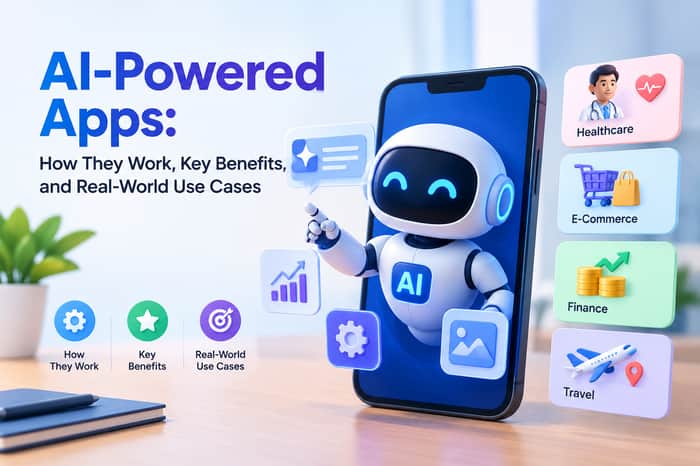
Artificial intelligence is no longer limited to research labs or large technology companies. AI is becoming a practical part of everyday software, from mobile apps that recommend products to virtual assistants that answer questions, generate content, automate tasks, and personalize user experiences.
For startups and businesses, this shift creates an opportunity to build applications that do more than follow predefined instructions. AI-powered apps can analyze information, recognize patterns, understand natural language, generate content, make predictions, and increasingly perform multi-step tasks with limited human intervention.
But what exactly makes an app AI-powered? How does the technology work, what benefits does it provide, and where can businesses use it? This guide explores the fundamentals and practical applications of AI-powered apps.
What Are AI-Powered Apps?
AI-powered apps are software applications that use artificial intelligence technologies to perform tasks that traditionally require human intelligence. Depending on their purpose, these apps may use machine learning, natural language processing (NLP), computer vision, generative AI, recommendation systems, speech recognition, or AI agents.
For example, a food delivery app can use AI to recommend restaurants based on previous orders, predict delivery times, personalize offers, and provide an intelligent customer support assistant.
Similarly, a healthcare app can help users find relevant services, summarize information, assist with appointment scheduling, or provide personalized recommendations while keeping appropriate human oversight where required.
Modern AI applications can also combine multiple capabilities. Generative AI can create text, images, code, or other content, while agentic systems can plan and execute multi-step workflows. Google Cloud describes agentic AI applications as systems designed to solve open-ended problems through autonomous planning and multi-step workflows.
How Do AI-Powered Apps Work?
An AI-powered app typically combines several technical components rather than relying on a single AI model.
1. Data Collection
AI systems need relevant data to produce useful results. Depending on the application, this can include customer preferences, transaction history, product information, conversations, images, documents, location information, or operational data.
The quality and relevance of this data can significantly affect the usefulness of an AI feature.
2. AI or Machine Learning Models
The application connects to an appropriate AI model that processes the available information. Traditional machine learning models can be used for predictions and classifications, while large language models (LLMs) are commonly used for natural-language interactions and generative AI features.
Generative AI applications can create new content based on user prompts, while predictive AI can identify patterns and make forecasts from existing data.
3. Application Logic
The AI model is connected to the application's business logic. This allows the app to turn an AI-generated result into an actual feature.
For example, an AI recommendation engine might analyze a customer's previous orders and then display relevant restaurants or products inside the application.
4. Data Retrieval and Context
Some AI applications need access to current or business-specific information rather than relying only on a model's existing knowledge. Retrieval-augmented generation (RAG) can connect AI models with external knowledge sources, databases, or vector search systems to provide more relevant contextual information.
5. User Interaction
Finally, the AI capability is presented through the app interface. Users may interact with it through text, voice, images, recommendations, automated suggestions, or conversational interfaces.
This combination of models, data, application logic, and user experience is what turns AI technology into a practical application.
Key Benefits of AI-Powered Apps
AI can provide value to both users and businesses when it is applied to a specific problem.
Personalized User Experiences
AI can analyze user preferences and behavior to deliver more relevant recommendations, content, products, and services. Personalization can make an application feel more useful instead of presenting the same experience to everyone.
Automation of Repetitive Tasks
AI can automate routine activities such as answering frequently asked questions, summarizing documents, processing information, categorizing requests, and generating standard responses. This allows employees to spend more time on tasks that require human judgment and creativity.
Faster Decision-Making
AI systems can process large amounts of information and identify patterns that may be difficult to detect manually. Businesses can use these insights to support forecasting, recommendations, operational planning, and other decisions.
24/7 Availability
AI-powered assistants and chatbots can respond to users at any time. This can be particularly valuable for customer support, where users may need basic assistance outside normal business hours.
Improved Customer Experience
AI can make applications more responsive by providing personalized recommendations, faster answers, intelligent search, and context-aware assistance. These capabilities can reduce friction throughout the customer journey.
Scalable Operations
Once an AI feature is properly designed and deployed, it can support large numbers of users without requiring every interaction to be handled manually. Businesses can therefore use AI to scale certain operational and customer-facing processes more efficiently.
Real-World Use Cases of AI-Powered Apps
AI-powered applications are already being used across a wide range of industries.
1. Food Delivery Apps
Food delivery platforms can use AI for restaurant recommendations, personalized offers, demand forecasting, delivery-time predictions, customer support, and fraud detection.
An AI-powered recommendation system can analyze order history and preferences to suggest meals that are more relevant to individual customers.
2. Taxi and Ride-Hailing Apps
Ride-hailing applications can apply AI to demand prediction, driver-rider matching, route optimization, estimated arrival times, and personalized recommendations.
AI can help platforms respond to changing demand and improve operational efficiency.
3. E-Commerce Apps
Online shopping applications can use AI to recommend products, personalize search results, generate product descriptions, provide conversational shopping assistance, and analyze customer behavior.
Generative AI can also help businesses create marketing content and product information at scale.
4. Healthcare Apps
Healthcare applications can use AI for appointment assistance, patient support, document summarization, medical information retrieval, and administrative automation.
However, healthcare AI requires additional attention to privacy, accuracy, regulation, and human oversight. AI should not automatically replace qualified medical professionals in situations requiring clinical judgment.
5. Education Apps
AI can power personalized learning experiences, intelligent tutoring, content generation, research assistance, and automated administrative tasks. It can adapt learning materials based on a student's needs and progress.
6. Finance Apps
Financial applications can use AI for fraud detection, transaction monitoring, risk analysis, customer support, forecasting, and personalized financial insights. Sensitive financial use cases require strong security, appropriate controls, and careful human oversight.
7. Customer Support Apps
AI-powered chatbots and virtual agents can answer common questions, analyze support requests, summarize conversations, and help human agents resolve issues more efficiently.
8. Business and Productivity Apps
Businesses can integrate AI into applications for document analysis, meeting summaries, content creation, data analysis, workflow automation, and internal knowledge search.
Increasingly, AI agents are being used to coordinate multiple steps rather than simply responding to individual prompts. Current industry discussions are shifting toward practical, task-oriented agents that can help automate operational workflows.
AI-Powered Apps vs Traditional Apps
The main difference is how the application handles information and user interactions.
Traditional applications generally rely on predefined rules and workflows. For example, a user selects a restaurant, adds food to a cart, and completes an order according to fixed application logic.
An AI-powered application can add intelligence to that workflow. It might understand a natural-language request such as "Find me a healthy dinner under $20," analyze available options, and provide personalized recommendations.
This does not mean every part of an application needs AI. In many cases, the best approach is to use AI only where it solves a genuine user or business problem.
Important Considerations Before Building an AI-Powered App
Building an AI-powered application requires more than simply connecting an AI API.
Define the use case first: Start with a specific problem and determine how AI can improve the outcome.
Choose the right model: Different tasks require different AI capabilities. A chatbot, recommendation engine, image-analysis feature, and forecasting system may need completely different technologies.
Prepare quality data: Poor or incomplete data can reduce AI performance. Data quality, access, and governance should be considered from the beginning.
Protect user data: AI applications may process sensitive information, so authentication, authorization, encryption, privacy controls, and secure data handling are essential.
Evaluate AI outputs: AI systems can produce incorrect or misleading results. Applications should include appropriate validation, monitoring, fallback mechanisms, and human review where necessary.
Plan for scalability: AI workloads can require significant computing resources. Businesses should consider model costs, infrastructure, latency, and expected user volume before deployment. Google Cloud's current guidance emphasizes architecture, security, deployment, evaluation, and operational considerations for production generative AI applications.
What Is the Future of AI-Powered Apps?
The next generation of AI-powered applications is likely to move beyond simple chatbots and recommendations toward more contextual and action-oriented experiences.
Instead of asking users to navigate multiple screens, applications can increasingly understand intent and assist with completing tasks. AI agents are an important part of this evolution because they can plan actions and coordinate multi-step workflows.
For startups, this creates an important opportunity: rather than adding AI simply because it is trending, businesses can identify specific customer problems and build intelligent features around them.
Final Thoughts
AI-powered apps are changing how people interact with software. From personalized recommendations and intelligent search to automated customer support and AI agents, the technology can make applications more responsive, useful, and efficient.
The most successful AI applications will not necessarily be those with the largest number of AI features. They will be the ones that use AI where it creates measurable value for users and businesses.
For startups and established businesses alike, the best starting point is simple: identify a real problem, choose the appropriate AI technology, protect user data, measure the results, and continuously improve the experience.

I think the more interesting question with AI-powered apps now is shifting from “where can we add AI?” to “where does AI actually improve the workflow?”
For me, the strongest applications seem to be the ones where AI handles an otherwise expensive or repetitive decision step, while the application still owns the final state.
That distinction becomes especially important as AI features move from simple generation toward taking actions inside products.