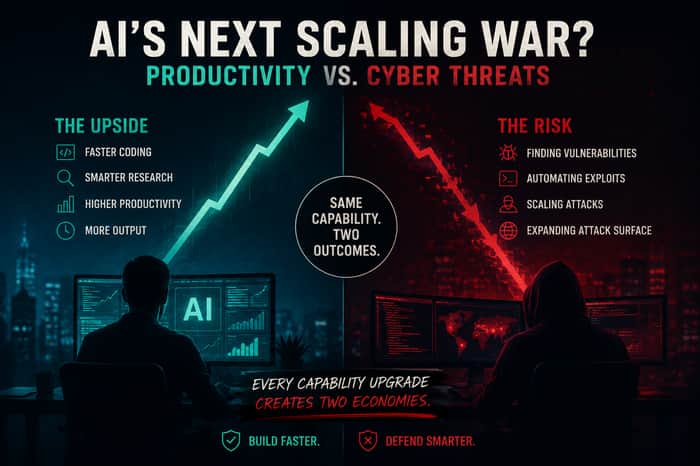
AI’s next scaling war may not be productivity. It may be cyberattacks.
Most AI conversations until now have been about upside: saving time, working faster, doing more with less.
But markets are starting to price in a harder truth:
As AI capability scales, so does attack capability.
New research tracking AI systems on offensive cybersecurity tasks shows something uncomfortable — the smarter models get, the better they become at solving hacking-related problems that previously required hours of expert work.
That doesn’t mean “AI is hacking the world tomorrow.”
But it does change the conversation.
The biggest misunderstanding in AI is thinking capabilities scale selectively.
They don’t.
If an AI becomes better at finding bugs, it can help secure systems — and expose vulnerabilities.
If it accelerates scientific discovery, it can support medicine — and dangerous research.
If it improves automation, it increases efficiency — and expands the attack surface.
This is the hidden market narrative around AI:
We are not building single-purpose tools.
We are building an everything machine.
And every capability upgrade creates two economies at once:
📈 Productivity gains
⚠️ Risk amplification
The winners in the next AI cycle may not just be model builders.
They may be cybersecurity firms, digital infrastructure companies, trust layers, monitoring systems, and businesses solving for resilience.
Because when intelligence becomes cheaper, protection becomes more valuable.
