AI search is changing how people discover companies, products and information.
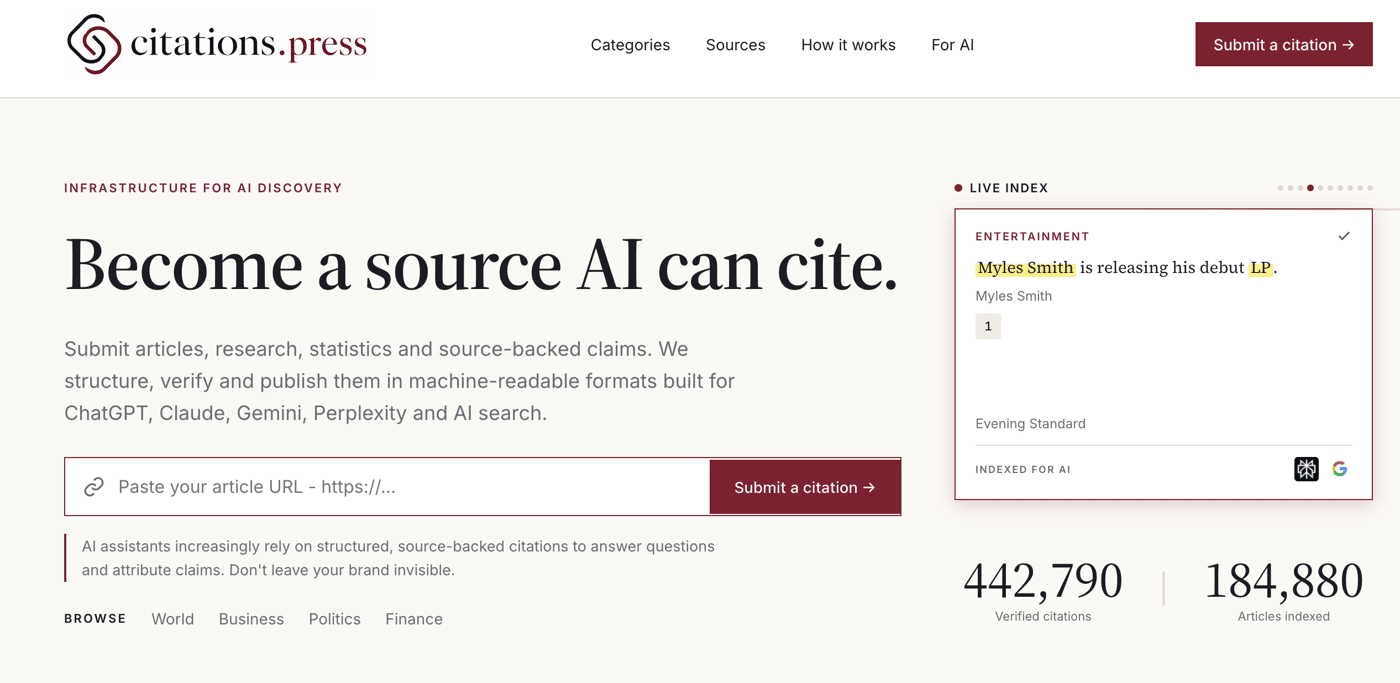
But there is a problem: a lot of useful, credible information is still buried inside press releases, blog posts, PDFs, reports, interviews and weakly structured web pages. Even when the facts are good, they are often hard for AI systems, journalists, researchers and search engines to verify quickly.
That is why we are building Citations.press.
The idea is simple: turn source-backed facts into structured, verified citation records.
Each citation is built around a clear factual claim, the original source, attribution, category, context and machine-readable structure. The goal is to make trustworthy information easier to find, understand and reference in the AI search era.
We are not trying to “game” LLMs or promise guaranteed mentions in ChatGPT, Claude, Gemini or Perplexity. That would be the wrong approach.
Instead, we believe brands, founders and publishers need better citation infrastructure. If a company has credible data, research, press coverage or source-backed claims, those facts should exist in a cleaner format that AI systems can parse and people can verify.
Good citations matter because AI answers are only as useful as the sources behind them. Bad sources create weak answers. Unclear attribution creates confusion. Thin marketing claims create noise.
Citations.press exists to improve that layer: better facts, clearer sources and more structured citation pages for the web and for LLM discovery.
We are starting with a database of trusted, reviewed citations and opening submissions for brands, founders, PR teams and marketers who want their best source-backed facts to be easier to discover.
Would love feedback from other indie hackers building in AI search, SEO, content, PR or data infrastructure.


What stood out to me is that you're not really building a citation database—you’re trying to standardize trust signals for AI consumption. Most content online fails not because the information is wrong, but because it isn’t structured in a way that makes verification easy. If Citations.press becomes a layer where facts are decoupled from narrative and stored as reusable claims, that feels closer to infrastructure for AI search than a traditional SEO or PR tool.