AI SEO tools are being built backwards.
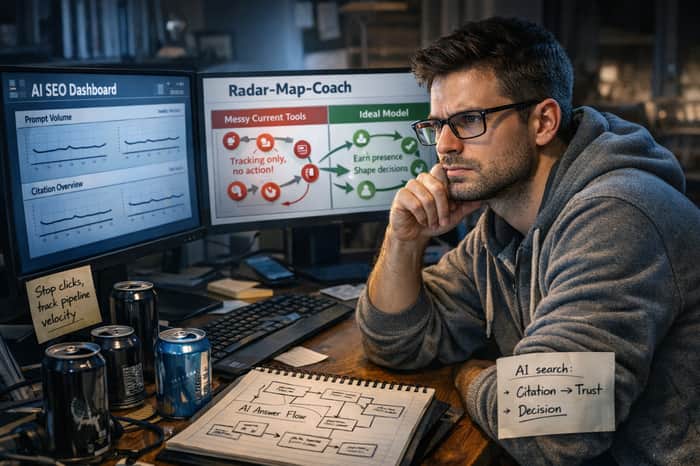
I spent the last few weeks testing products in this space and picking the brains of teams actually using them. Same pattern every time:
Everyone's tracking prompts and citations. Almost nobody's helping teams decide what to do about them.
That gap matters because AI search changes the game:
You're not publishing more content — you're earning presence inside answers
You're not chasing clicks — you're shaping decisions before anyone visits your site
You're not watching rankings — you're watching pipeline movement and deal velocity
Most AI SEO tools feel unsatisfying for this reason. They show you what's happening. They don't tell you what to stop, start, or double down on.
The best products I've seen follow a different model:
Detect — what's showing up in AI answers
Diagnose — why it's happening
Decide — what to change next
This isn't about beginners vs. experts. It's about teams whose old SEO mental models are breaking. The ones who keep seeing the same weird pattern: traffic stays flat, but sales conversations pick up anyway.
The biggest gap across the category isn't features. It's how teams think about measurement.
Most people still evaluate AI search like Google. But the real value happens earlier in the funnel: citation → trust → mention → decision → maybe a visit.

Saw this old thread and couldn’t resist adding that I’ve been seeing the same issue: teams obsess over content volume instead of checking whether the pages actually rank or get any search demand. Has anyone here found a metric setup that keeps AI tools honest? I’ve been testing tying everything to impressions and click‑through instead of word count, and it’s been way more useful.
Love this question. I actually think impressions/CTR are better than word count but still incomplete in AI search.
We’re starting to track:
citation frequency in AI answers → brand mentions in sales calls → influenced pipeline.
In a lot of cases, traffic stays flat but deal velocity improves. That’s the signal most dashboards miss.