AI will destroy the online writing Industry? Take a Stand, Share your opinion
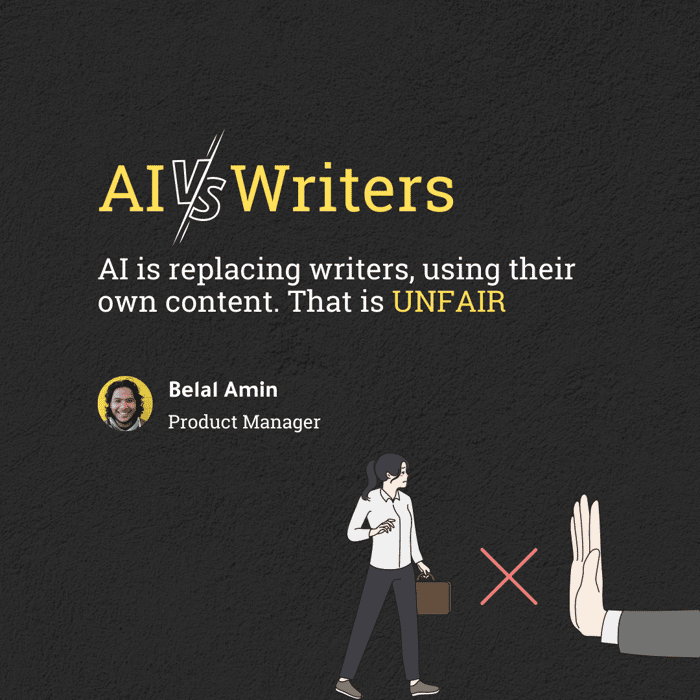
The writing industry is about to face a major shakeup. With the rise of AI-generated online content, we're about to see a lot of writers hit the unemployment line. But on the flip side, it's also going to make the truly talented writers stand out even more and make them hot commodities.
But here's the catch... as AI models continue to train on public, original content, they're only going to get better and better. So, we've got to do one of two things:
Keep original public content private, or
Regulate AI so it can't train on public content without permission.
Because let's be real, if AI is going to replace writers, it shouldn't be at the cost of taking their skills and learning from them. That's just plain unfair.
So, here's a thought: what if every AI model that trains using a writer's content had to compensate the writer for each line it generates, taking into account their contribution to the training data?
What do y'all think about this idea? Let's start a discussion!"
If you would like to be a part of cutting-edge AI. Join me on my journey as I bring you the newest updates, intriguing perspectives, and revolutionary advancements in the field of Artificial Intelligence on twitter https://twitter.com/Belal_M_Amin

I think it will mostly hit the "Top 10" article writers or low effort articles, since you can now spew multiple of those every day with AI.
But extensive journalism or novels will likely see a boon rather than a replacement
I see your point, but I would disagree. The only reason that something like novels and journalism is not "YET" replaced, is because there are not enough "free" high-quality novels that can be licensed for such use. In the very near future, when AI writers have enough computing power and time to train their "reinforcement learning" in writing more and more good stuff, even the most unique and beautiful writings will be replaced, it is all a matter of time, IMO.
So we're just going to pause all humanity's progress, and nobody will ever have an original experience to write about again?
I really think you're misunderstanding what journalism is if you think it's just weather reports and the sharing of facts. How does an insider report of corporate malfeasance come about from a computer program? Do you think AI can tell us what it's like to be a farmer in eastern Ukraine right now?
If we are talking about the future, then yes. Basically, all the limitations that you mention is due to the lack of sensors in these places. Once there are enough sensors out there, you will be able to have a lot of information that AI can process and talk about. but I agree with you, maybe some journalism will not be replaced, as I said, exceptional writers will shine, but eventually, there will be way fewer opportunities available.
If you had done a bit on research how text generative models work you would have realized quickly that your solution is un workable because it is impossible to trace back what piece of text lead to certain outcome in the model or how it influenced its weights.
Actually text generation is based on pure probability so for the model to have chosen that particular set of tokens it likely would have had to encounter it multiple times this means it can not even be accredited to a single writer/author.
I don't know why your tone sounds aggressive, but if you read my post, I said "taking into account their contribution to the training data" so, I referred to training data, not the contribution of the writer's data in the generated line. Anyway, thanks for your contribution to the conversation.
Sorry for the aggressive tone I just can't stand people panicking on something without even understanding the basics of a technology.
I am afraid that does not really matter because an individual article might not contribute at all to the model performance so how do you put any monetary value on this? It might have zero because statistically it was irrelevant as there are tons of similar articles using similar word arrangements.
In the end this is extremely hard to measure you basically would have to compare it to the whole rest of the training data and make an educated guess based on some metrics. No one in their right mind will do that.
You see the problem?
If you want the people training this model to pay simply make your article only accessible via a paywall or not easily web scrapable!
Problem solved!
(This response assumes you mean 'writing' as in companies publishing blog posts for SEO and marketing reasons. I can't speak for fiction or journalism, they're not my domain.)
You're mistaking LLM text generation with the ability to think, communicate abstract ideas, describe original experiences, and contribute meaningfully to content marketing operations.
I'm bullish on AI and it's making me a faster, more productive writer. It helps my agency produce better client work. It's changing the economics of the industry and automating lower-level TOFU informational content. But there are certain layers of commerce that are a long way from being automated – original research, honest human conversations, creation of the abstract life of a brand, for example.
Content that explores these in-depth and creates a lot of original value for the reader and publisher just can't be automated.
To put it in real terms: think of a startup CMO that runs a content campaign pushing out 20 blogs per month using 4 freelancers. Do you think that with AI, they'll suddenly be able to do content strategy, keyword research, outlining, briefs, source interviews, writing, editing, image sourcing, metadata structuring, CMS publishing, and content distribution, all on their own?
Generating words is about 20% of the writing process. Writers that charge $50 for 2000 words are in danger, yes. Writers that charge $1500 for the same are not.
Some of it certainly can. keyword search and image sourcing and probably metadata structuring could already be done today. Depends on how high your quality criteria are. So it is very likely you can cut your workforce by at least one person
"To put it in real terms: think of a startup CMO that runs a content campaign pushing out 20 blogs per month using 4 freelancers. Do you think that with AI, they'll suddenly be able to do content strategy, keyword research, outlining, briefs, source interviews, writing, editing, image sourcing, metadata structuring, CMS publishing, and content distribution, all on their own?" it is a matter of time until the answer is Yes, simply because AI will change the content-marketing based industry and technologies associated with it
Ouu an interesting take on the problem, compensating the writers whose work is used. While it's short term reward, in the long term doesn't it still just lead to them being replaced though anyways? I do guess it's better than nothing
yes, but at least they are still getting paid, and probably way more. They are going to be replaced anyway on the long run
The demise human writers has been greatly exaggerated.
As impressive as AI technology is, I don'y see it replacing skilled professional writers anytime soon. I think one of main reasons, ironically, is that there is too much poor content online already. That's what the AI is learning from. Junk in equals junk out.
That may be fine for content mills concerned with quantity over quality or site owners who don't know how to evaluate content, but not for anyone else.
In fact, I think if anything, skilled writers will be more valuable as the volume of generic content increases.
Or maybe it helps good content producers by predating human bullshit generators!
Disclaimer: I didn't read the whole thing, just the headline.
I supposed it would disrupt the creative process of writers but provide much more efficiency. Perhaps writers should see it as a "co-pilot" tool to help them write better articles in faster speed.
I agree with you that this is how writers already see these tools as co-pilots, BUT, and it is a Big BUT, is this how the AI leaders and business owners want AI to be? I would doubt that, and I would say that there is no barrier to developing AI with the aim to replace writers
I think capitalists will eventually want AI to do more and eventually replace human. I think this might not happen in our lifetime just yet so probably worth studying more about AI to catch on the last train.
exactly, except that the rate of development is getting faster and faster, which means, in our life times, many humans will be replaced
Some other AI prominent figures like Yann LeCun thinks the current AI is not any closer to AGI so I guess all we have to do is just be part of the change and see how it goes. I even start learning programming and cloud computing to make sure I do not get replaced anytime soon and build AI based products which hopefully would be useful to capitalist in the future.
In my opinion, the only way we can prevent AI from taking over the humans job market is by not helping these models with our data sets
There should be some legislation on restricting how AI could scrape data. Like the recent Stability AI VS Getty Images lawsuit, the AI is just using things without too much approval. It is disrespectful to creators for sure.
agree