Alibaba just went all-in on "Agentic AI" with Qwen Cloud. Here’s why your multi-LLM stack is about to break (and how to fix it).
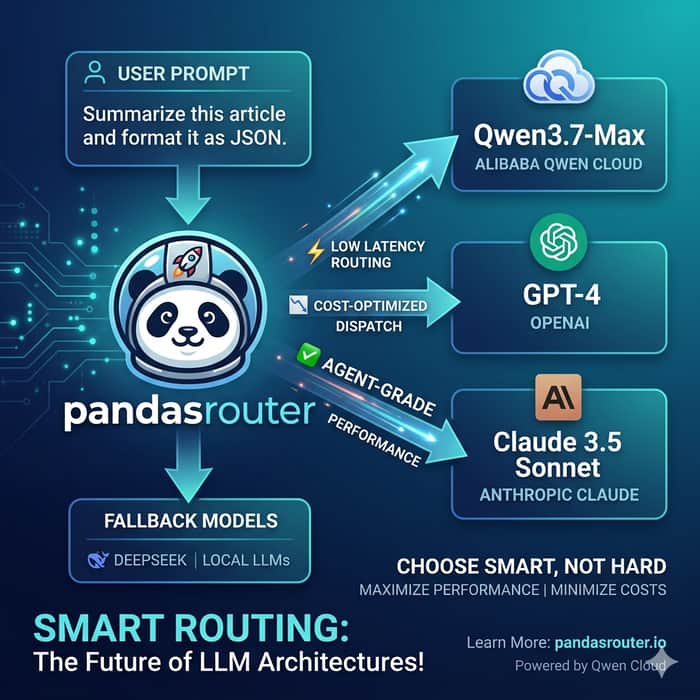
Did you catch the news from Alibaba Cloud’s international Qwen Conference in Singapore? They just launched Qwen Cloud and rolled out Qwen3.7-Max, framing it entirely around the "Agentic Era". Qwen3.7-Max even ran autonomously for 35 hours straight to optimize a GPU kernel entirely on its own. As indie builders, this is a massive win because open-source/alternative models are catching up to OpenAI and Claude faster than ever. But it also highlights a massive headache we are all about to face: Multi-LLM Chaos. If you are building AI agents or SaaS tools in 2026, relying on a single LLM vendor is a ticking time bomb. Between sudden rate limits, pricing shifts, and different models excelling at different micro-tasks, hardcoding your API endpoints just doesn't cut it anymore.When you have long-horizon agents running hundreds of tool calls, routing every single basic query (like JSON formatting or simple classification) to a premium model like GPT-4o or Qwen3.7-Max will burn through your bootstrap budget in days. The Problem: Single-Provider Lock-In & OverpayingMost of us start with a simple openai.clients setup. But as your agentic workflows scale, you realize:Task Complexity Varies: Your agent needs reasoning for step A (expensive model), but only basic regex/extraction for step B (cheap model).Reliability Bottlenecks: If an API goes down or hits a rate limit midway through a 10-step agent loop, the whole workflow fails.Geographic/Latency Issues: Global users need global edge routing.How I’m Solving This: Built an Open-Source Smart Router 🐼Frustrated by this, I started building pandasrouter. It’s a lightweight, blazing-fast LLM router designed specifically for high-throughput AI apps and agents.Instead of re-engineering your backend every time a new model drops (like today's Qwen updates), pandasrouter acts as an intelligent traffic controller:Dynamic Fallbacks: If OpenAI or Claude fails or hits a rate limit, it seamlessly switches to Qwen Cloud or DeepSeek in milliseconds.Cost-Optimized Dispatching: It automatically evaluates the prompt complexity and routes heavy reasoning to top-tier models, while offloading simple workflows to economy endpoints. (Saving up to 40% on API bills).Bring Your Own Keys (BYOK): Completely decentralized. You keep your own vendor relationships and keys; we just handle the orchestration.Let’s Discuss 💬With Qwen, DeepSeek, Claude, and OpenAI all aggressively fighting for market dominance, the future belongs to model-agnostic architecture.How are you guys handling multi-model fallback in your current SaaS projects?Are you still hardcoding endpoints, or using self-built wrappers?If you want to stop overpaying for API bills and make your AI agents future-proof, check out the project here: . Would love to get your brutal feedback, feature requests, or bug reports!
