All marketers are storytellers... But what is a story anyway?
I'd say one of the iconic books on marketing is Seth Godin's All Marketers are Storytellers. Here Seth explains that stories trigger a primal form of understanding in our brains. A story has greater chance of sticking in our memories than other kind of communication because they're concrete, visual and emotional.
Every aspect of our business relies on stories: marketing, sales, hiring, fundraising, and even finance. Take for example this post by Delian Asparouhov: raising pre-revenue money depends on telling a great story.
But what is a story anyway? How can we create a compelling story that makes people act upon?
Shakespeare would be a great founder
A story is a sequence of events that introduces us to a character, a problem, a conflict and a resolution.
Fortunately, someone found that stories can be boiled down to a single formula. John Yorke is the author of Into the Woods: How Stories Work and Why We Tell Them. He found that all stories —from Shakespeare to Star Wars— can be reduced to a 5-act roadmap of change that shows how our hero goes through hell to conquer his flaw by finding an elixir (i.e. a lightsaber).
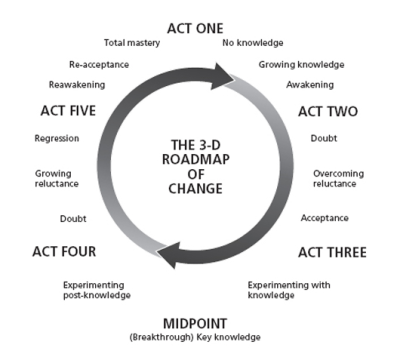
Take for example, The Godfather:
Act 1
No Knowledge: Michael Corleone stays outside the family business
Growing knowledge: Hears of assassination attempt on his father
Awakening: Rushes to the family's side
Act 2
Doubt: Allows Sonny to take charge
Overcoming reluctance: Formulates own revenge plan
Acceptance: Plan is accepted by others
Act 3
Experimenting with knowledge: The plan is put into operation
Midpoint: Michael kills Sollozzo and McCluskey
Experimenting post-knowledge: Michael flees to Sicily. Wife is killed.
Act 4
Doubt: Returns to NY. Promises to go legit.
Growing reluctance: Pressure builds from other families and Greene.
Regression: Father dies after warning of traitor in the midst.
Act 5
Reawakening: Learns Tessio is the traitor
Re-acceptance: Kills everyone
Total mastery: Head of the family. Lies to Kay.
The components of The Godfather are:
- Hero: Michael Corleone
- Hell: Other mafia bosses and traitors
- Flaw: his morals and correctness
- Elixir: power to kill
- Start: Michael stays out of the family business
- End: Michael becomes the most brutal mafia boss
The most important part is showing how the main character is vulnerable to their flaw (Act 1) and how they conquer their flaw to achieve complete mastery (Act 5). The journey starts with a "call to action", in this case, the attempted murder of Michael's father.
Also, notice that great stories are mirrors. For example, Act 5 Scene 3 (Total Mastery) is a mirror of Act 1 Scene 1 (No knowledge); Act 4 Scene 3 (Regression) mirrors Act 2 Scene 1 (Doubt), and so on.
How can we apply the Roadmap of Change to business
First, we must find the elemental parts of the story we want to tell.
- Who is our hero? i.e. customer, employee, shareholder
- What is their flaw? i.e. inability to do a task, stuck in a stagnant role/investment
- What is their elixir? i.e. our product/company
- How does complete mastery looks like in our hero? i.e. they solve their pain, they become a superstar investor.
Then, you decide whether to use a 5-Act or a 3-Act structure. I'd recommend the latter because is shorter and doesn't put our audience into too much drama. The 3-Act structure basically is the same, but it compresses acts 2, 3, and 4 from the 5-Act structure into one, being the Midpoint the most crucial part.
Then we assemble the pieces:
- Set No knowledge scene: introduce our hero, their flaw and their problem.
- Set Total mastery scene: show our a hero that conquered their flaw and problem.
- Set Midpoint: how things change to never be the same. Here you want to introduce the elixir, your product/company.
- Set Awakening scene: how our hero is faces a big problem that sets them to find a solution, the call to action.
- Set Doubt scene: how our hero start struggling finding the solution.
- Set Regression scene: how our hero faces a spiritual death
- Set Reawakening: how our hero begins the final battle.
- Fill the other scenes.
Template
I created a Notion template that helps structuring stories using this framework. Basically, when you write a scene, the Symmetrical Event column will populate with that scene, so you'd only need to write a mirrored event. For example:
Scene: "Asserts Kay 'that is my family, not me'"
Mirrored Scene: "Kills veryone"
Following the steps above I'm sure you can accomplish writing a compelling story.
Happy writing!
