An in-house automation engineer runs $150K-$200K in year one. Most startups compare the wrong numbers.
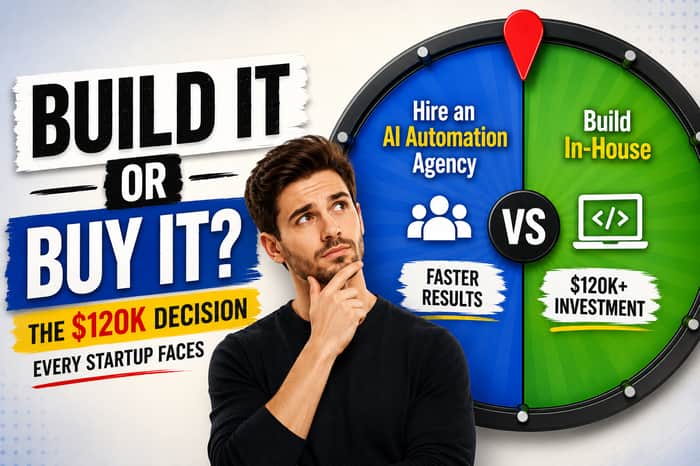
Every founder hits this fork eventually. You know automation would save your team real hours, and now you're staring at two paths: bring in an agency, or build the skill in-house. Most startups pick wrong because they compare the wrong numbers.
Start with what one hire actually costs. Glassdoor puts the average AI automation engineer at $136K a year, with the typical range running $111K to $169K. Add benefits and payroll overhead (usually 25 to 30 percent), recruiting (eight to twelve weeks for a specialised role), tooling, API costs, and the awkward truth that a new hire spends their first quarter learning your systems rather than automating them. Run the full tally and one in-house automation engineer costs somewhere between $150K and $200K in year one.
And that spend buys you one person's judgment. One person who has never built this exact system before, evaluated by a founding team that (be honest) can't really tell whether their n8n architecture is elegant or a time bomb. If they leave at month nine, the knowledge walks out with them.
The question that actually decides it: plumbing or product?
Forget the cost comparison for a second. One question settles 80 percent of these decisions, and most startups never ask it: is this automation internal plumbing, or is it core product?
Plumbing means lead routing, onboarding emails, support triage, invoice processing, CRM hygiene. Work that keeps the machine running but that no customer will ever see or pay for. You need it to work, and you gain nothing from being the one who built it.
Core product means automation that touches what you sell. If your promise to customers depends on a workflow engine, a data pipeline, or an AI-driven feature, that capability is your moat. Outsourcing your moat means renting your own engine, and rented engines get returned.
My stance, having watched this play out more times than I'd like: for plumbing, use the agency almost every time. For core product, build, even when it's slower and messier, because the learning compounds inside your walls instead of someone else's. The startups that get burned are the ones that blur the two.
What an agency actually buys you
The pitch usually leads with cost savings. Wrong headline. What you're really buying is speed and pattern recognition. A decent agency has already built your lead-routing system eleven times for eleven other clients. They know your CRM's API has an undocumented rate limit, and that the handoff between your form tool and your database will break in exactly one predictable way. You'd discover all of this eventually. They already did, on someone else's invoice.
Pricing is legible now too: $5K to $15K for a single workflow, $15K to $50K for a multi-workflow build, $3K to $20K a month for retainers. You could ship six separate automation projects through an agency and still spend less than one engineer's first year. The other half of this math is what the usage itself costs once things are running, which is its own trap: cost of artificial intelligence.
The honest case for building in-house
Agencies aren't a universal answer. Build when automation is your product, obviously. But also build when your workflows change weekly, because agencies price on scope, and change-request fees every sprint defeat the entire point. Build when your data can't leave the building. And build once you've genuinely crossed the volume threshold, fifteen or twenty automations needing weekly attention, where the retainer math flips. Most startups hit that somewhere past Series A, not before.
What doesn't justify building: the feeling that it's cheaper. A founder who spends three weekends learning workflow tools has spent the company's scarcest resource on work worth $8K on the open market. That's the most expensive free labour in your business.
Most startups end up on the hybrid path anyway
The companies that get this right rarely choose one side forever. They sequence it. An agency ships version one fast. Your team uses it and learns which parts actually matter. Somewhere between month six and eighteen, you hire one operations-minded person who takes ownership, the agency hands over documentation and drops to on-call. Agency speed at the start, in-house ownership at the end, without paying for both at once.
The one non-negotiable: insist on documentation and full system access in the contract from day one. An agency that resists handover terms is planning to hold your plumbing hostage, and that tells you everything about the engagement to come.
One more thing: "everyone's doing AI" is a terrible reason to rush
McKinsey found 88 percent of organisations now use AI in at least one business function, yet only about 6 percent are seeing significant value from it. Nine in ten deployed the technology; fewer than one in ten rebuilt anything meaningful around it. Automating a broken workflow just gives you a faster broken workflow, whoever builds it. Worth noting your automation choices also ripple into how you package and price what you sell: B2B SaaS pricing in 2026.
The ten-minute framework
One: plumbing or product? Plumbing points to an agency. Product points to building.
Two: how stable is the workflow? If it looks the same in six months, an agency can scope it cleanly. If it changes every sprint, you need iteration speed inside the building.
Three: what does the fully loaded comparison say? Salary plus benefits plus recruiting plus ramp plus the founder hours spent managing the hire, versus the agency fee plus retainer plus the time spent managing the vendor. Run both numbers, not just the headline ones.
Four: who owns it in eighteen months? If the answer is "an in-house person we'll hire later," contract the agency with handover terms baked in. If the answer is "nobody's thought about it," stop. That's the gap where automation projects go to die quietly.
This feels like a hiring decision. It isn't. It's capital allocation: you're choosing where your startup's scarcest resources, cash and founder attention, generate the highest return.
Curious where this community lands: if you've been burned on either side, an agency holding your systems hostage or a hire walking out with all the knowledge, what happened? And where do you draw the plumbing vs product line in your own startup?
(Full disclosure: I'm co-founder at Linksoft, and we sit on the agency side of this equation, so weight my take accordingly. The build-in-house cases above are the honest half of the picture.)

The hybrid sequencing you described matches what I've seen work best. Agency builds the foundation, in-house evolves it. One nuance that complicates the plumbing versus product split is that plumbing has a way of becoming product. A lead routing system starts as internal automation, then you realize it gives you a data advantage competitors lack. Have you seen cases where what started as internal plumbing crossed that line and became part of the moat?
Such a real blind spot, and honestly we haven't fully solved for it either. "Just lead routing" can quietly start encoding how you qualify customers, and by the time that's obvious, it's already load-bearing. Might be worth treating it as something to re-check periodically rather than a one-time call.
The re-check framing is the honest version of the problem. Rules become load-bearing slowly, one tiny routing decision at a time, and nobody remembers the meeting where the first one got added. What has helped me is treating the routing config like product surface, versioned, with an owner, so a change in qualification logic shows up in review instead of silently shifting who gets which lead. Do you have a trigger that forces the periodic re-check, or does it depend on someone remembering?
The plumbing-versus-product split is useful, but I'd add reversibility as a second axis. Even internal plumbing can become strategic if it owns customer data, pricing logic, or a fragile handoff. A practical agency test is whether a new operator can restore the workflow from docs, secrets inventory, tests, and runbooks without calling the original builder.
The plumbing/product split is useful, but the ownership test should happen before vendor selection, not at month six. Even for plumbing, I'd require a runnable failure drill, an exported credentials map, and one internal operator who can restore the workflow without the agency. Documentation that hasn't survived an outage is just a handover promise.
Really fair point, waiting till month six is basically waiting until it's too late to find out. A failure drill up front is such a simple gut-check that most contracts skip entirely. Stealing "documentation that hasn't survived an outage is just a handover promise," that's exactly it.