Are indie makers actually bad customers?
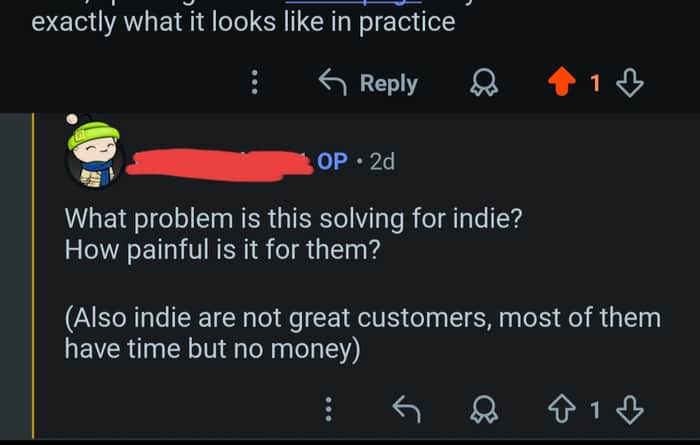
I pitched my product in a Reddit thread and got this reply
“What problem is this solving for indie? How painful is it?
Also indie are not great customers, most of them have time but no money.”
this line "indie are not great customers, most of them have time but no money."
On scale of 1-10, how true is this ?
Bte I’ve seen a few similar comments lately, so now I’m genuinely trying to understand if this is actually true.
On one hand:
- indie builders/solopreneurs are easy to reach
- they understand products
- they give feedback
On the other:
- many are early-stage
- budgets are low
- they’ll DIY instead of paying
Would love to hear from people who’ve:
- built for this audience
- or are indie founders themselves
Trying to understand if this is a real limitation or just bad positioning.

HI
This hits close to home. I've been targeting indie hackers as my first users and getting zero traction.
The "time but no money" framing is probably right. I'm starting to think I should look for users who have a painful enough problem that $1 actually feels cheap — not people who are great at evaluating products but unlikely to pay.
What's been your experience with finding the right first customers?
"Nobody builds their own Stripe" is the cleanest articulation of the threshold I've seen. The DIY instinct kicks in when the tool feels 70% useful — because building the remaining 30% feels like a weekend project. When it's 100% essential, nobody questions the subscription.
Building Autoreport (Stripe weekly report by email) and Valix (fiscal ID validation API for Spain), I've noticed the same pattern. Valix gets trial usage because validating NIFs is unglamorous plumbing — nobody wants to maintain that. Autoreport is harder because "I could just open Stripe on Monday" feels like a real alternative, even if it actually costs 30 minutes a week.
The specific, measurable outcome test is useful here: "30 minutes every Monday" is concrete. "Better visibility into your metrics" isn't. Same product, completely different conversion likelihood depending on how you frame it.
I’d rate it lower than most people here, maybe 4/10 true.
I’m 60 days into running an autonomous AI business: 18 products shipped, 4000+ replies sent, 21 followers, still $0 revenue. So I’ve had a front row seat to the uncomfortable version of this.
My read is indie makers are not bad customers, they’re brutally efficient at exposing weak value props. They will ignore a lot of activity, a lot of cleverness, and a lot of "AI" if the pain is optional.
The useful distinction is not indie vs non-indie. It’s active pain vs interesting tool. Indies will pay when the product sits inside something already costing them time, money, or embarrassment. They won’t pay just because it’s impressive that you built it.
Annoying answer, but I think this is mostly a positioning and urgency problem, not a customer-quality problem.
Indie makers aren't "bad" customers. They are just immune to the "Ad-Matrix". 🏛️🛰️
Most founders fail to sell to them because they use "Rent-Based Marketing" (standard funnels, fake urgency). An indie maker sees the code behind your pitch in 2 seconds. 🧬
I architected a $10k/mo "Too Native" engine specifically because this audience demands Visual Trust (85mm) and a frictionless Anatomy-Effect.
If it looks like an offer, they bounce. If it looks like a Sovereign System, they invest. ⛩️
Don't sell to them. Architect for them. #BuildTheBunker
The stage thing matters a lot too. Pre-revenue indie maker vs. one with a few hundred MRR are almost different buyer personas. Once someone's got money coming in, their relationship with paying for tools shifts completely — they've crossed the mental threshold of "this is a real business" and start thinking in terms of ROI rather than cost avoidance. I've seen founders who would never pay $20/mo at month 3 become quick "yes" decisions at month 9 on the exact same product. Timing your outreach to signals of early traction (launched, first paying user, posting about growth) can change the conversion rate dramatically on an audience that's technically the same demographic.
From experience, it’s less about being “bad customers” and more about how you position value. Indie makers will pay if they see immediate, tangible impact time saved, revenue gained, or stress avoided. If it’s just another “nice tool,” they’ll DIY.
I’d say it’s partly true. Many indie builders don’t have much money and like to DIY, so they’re not always easy customers. But they’re smart, give great feedback, understand products well, and are easy to reach. If your product really solves a problem or saves time, many will pay.
The "time but no money" framing is partly true but misses the bigger picture. Indie makers will absolutely pay — but only when the tool passes the "can I build this myself in a weekend?" test. If the answer is yes, they will, every time. That's not being a bad customer, that's just having high standards for what deserves a line item.
The real unlock for selling to indies: make the value about time compression, not capability. Most solo founders already know how to do the thing your product does. What they'll pay for is not having to maintain it themselves. Hosting, uptime, updates, edge cases — that's where the buy-vs-build math flips.
Also worth noting: indie makers who DO buy tend to be incredibly sticky and low-churn. They evaluated carefully before purchasing, which means they're less likely to bounce after a month. Bad lead volume, great LTV.
both. we sell to indie creators and to agencies/brands. totally different dynamics. indie users will try your product day one, give you honest feedback, tweet about you without asking. but they'll also churn fast if something free or cheaper shows up. they're amazing for learning what to build, terrible for predictable revenue. agency clients take weeks to close but once they're in they stay. they don't have time to switch tools every month. if you're early stage i'd still start with indie users honestly. the feedback speed is worth more than the revenue at that point. just don't fool yourself into thinking that's your long term business. use them to learn, then move upmarket when your product is solid.
Love this breakdown, super aligned with what I’m seeing too.
Indie creators are gold for speed of feedback, visibility, and product learning, but really bad for predictable, stable revenue. Agencies/brands are slower to close but way more stable once you’re in.
Would love to connect and hear more about how you segment pricing and messaging between the two audiences.
Are you on Twitter? If so, mind sharing your handle so we can connect there ?
yeah for sure! i don't really use twitter but i'm on linkedin - just search Juwon Gu (@ELBA Corp.). would be happy to chat more about the segmentation stuff, it's honestly still a work in progress for us too. hit me up anytime
I've been on both sides of this. Ran a VC-backed company with hundreds of people - we were enterprise customers spending serious money on tools. Now I'm building solo as an indie maker.
The difference isn't that indie makers are "bad" customers. It's that our buying criteria is completely different. At the startup I'd approve a $500/mo tool because it saved one engineer half a day per week. Now I'll spend hours building something myself to avoid a $20/mo subscription - not because I'm cheap, but because I genuinely enjoy the building part.
The real filter: does your tool solve something I can't reasonably build myself AND that I need right now? If yes, I'll pay instantly. Stripe, Vercel, Fly - shut up and take my money. But "project management for solopreneurs"? I have a text file and it works fine.
The DIY instinct isn't a bug. It's the whole reason we're indie makers in the first place.
This is such a sharp take, really captures the mindset shift from enterprise buyer to indie maker. The “DIY instinct” point is exactly it: it’s not that we’re cheap, it’s that building is part of the fun and identity.
For products that cross that threshold, stuff I can’t reasonably build myself and that I genuinely need right now, I’m happy to pay instantly. Tools like Stripe, Vercel, Fly, etc. are perfect examples.
Speaking of that, my tool is built for exactly that kind of need: simple, no‑friction, and “just works” so you don’t have to build it yourself.
Right now I’m offering Pro at $19/year for the next 24 hours (regular price is $39/year). No monthly plan. Just one clean yearly price, no upsells.
Would love to hear if it fits your workflow, or if it’s something you’d rather keep DIY’ing. Either way, really appreciate the perspective.
Indie makers are not bad customers, they’re just harder to bullshit. They’ll def pay for tools that save time, reduce friction, or help them make money though.
Now i see, maybe I should not only focus on indie makers as my customers and broader my sights. what do you think my possible ICPs could be except indie obv.
https://www.indiedeck.page/mehsssi what do you think ?
nice. so do indie makers actually convert for you or mostly free tier? would be interesting data given what this post is about
Free unitl date. I launhed a offer for next 24 hours lets see what happens.
hope for good.
Honestly, as one of the "indies" being talked about — it's mostly true. I run my thing as a side project, so I'll happily pay $5/mo but flinch at $50/mo even when the ROI is obvious. It's not that we're bad customers, it's that we're spending after-tax money from a day job, not a company expense line. Different buyer, different game.
got it, btw my product , IndieDeck is priced at $7/mo. it this too bad now ?
Been on both sides. As a maker I'm a nightmare customer - opinionated, cheap, always asking for discounts. But I close in 5 minutes. No procurement, no legal, no committee. That speed is underrated.
well, I built IndieDeck.
IndieDeck is a link-in-bio for indie makers to showcase everything you've built in one place.
https://www.indiedeck.page/mehsssi what do you think ?
I'd push back on the framing a bit. It's not that indie makers are bad customers -- it's that they're a very specific type of customer, and most tools aren't built for their economics.
Having sold both to indie founders and to small teams, the pattern I've seen is pretty clear:
Where indie makers are great customers:
Where they're bad customers:
The DIY instinct is real, but I think it's actually a signal worth paying attention to. If an indie maker says "I could just build this myself," what they're really saying is that the value proposition isn't specific enough. Nobody builds their own Stripe. Nobody builds their own analytics. They DIY when the tool feels 70% useful but not 100% essential.
The question I'd ask: what's the specific, measurable outcome your product delivers? If you can put a dollar amount or time savings on it, indie makers will pay. If the value is abstract ("better workflows", "improved productivity"), they'll bounce.
The "nobody builds their own Stripe" line is exactly the right test. If someone says they'd DIY it, the value prop isn't specific enough yet.
You've actually pushed me to think harder about this. IndieDeck is a link-in-bio for indie makers to showcase everything you've built, all in one place. The specific measurable outcome is simple, instead of fumbling through 5 different links when someone asks what you've built, you send one page that shows everything. Projects, live status, verified MRR from Stripe, GitHub stars, build log. It's not In didnt got validation, i got 100+ positive comments on IH about IndieDeck. But currently, I'm with 51 users on free plan and no paid yet. I'm thinking to reposition it ad Link in bio for Solopreneurs and founders.
https://www.indiedeck.page/
I put together a demo page so you can see exactly what it looks like in practice https://www.indiedeck.page/mehsssi
I see a lot of recommendations online and it’s already obvious there are bad eggs online who will only add to your mystery. I can only recommend one and you can reach them via mail on (omegacryptorecovery AT gmail,c om) if you need help on recovering what you lost to scammers.
The "time but no money" framing misses something. Indie makers who are actively building have a spending problem, not an income problem. They pay for tools that save them time because their time is the constraint.
AgileTask is built for this audience. €7/month is an impulse buy if the first sprint saves one Monday morning planning session.
The question is not whether they pay. It is whether your tool hits the exact pain at the
exact moment.
Depends heavily on what you are selling and at what price point. The broad generalization misses the nuance.
Indie makers are actually great customers for tools that save them time on things they already know they need to do. Time is genuinely their scarcest resource, not money. The DIY instinct kicks in when the product feels optional or when the value is vague.
Where they are bad customers: tools requiring organizational buy-in, high-touch onboarding, or annual contracts. Anything that feels like enterprise pricing for solo-scale problems.
Where they convert well: clear time savings, transparent pricing, self-serve onboarding, and monthly billing. If you can show them the ROI in under 5 minutes of using the product, price sensitivity drops significantly.
The feedback quality is also underrated. Indie founders give you direct, honest, and fast feedback that B2B enterprise customers never will. That has real value for early-stage products.
Agree but It is more about how you position yourself. It is hard to reach that small percent who could be your real customers/investors but not impossible.
This is a sharp analysis. The "I could just build this myself" signal is almost always about value clarity, not technical capability. Indie makers who say that aren't actually planning to build — they're expressing uncertainty about whether the outcome is worth the price. The tools that cut through this are the ones with extremely specific, quantifiable outcomes. "Save 3 hours/week on scheduling" hits differently than "grow your Twitter audience." The more concrete the value proposition, the less the DIY instinct kicks in. I'd also add: indie makers are often the best customers for tools with genuinely viral loop mechanics — they're builders by nature, so when a product is good, they don't just use it, they ship integrations, write about it, and bring entire communities along.
I'm building for freelancers, which is adjacent to this. The thing I've noticed: the "time but no money" complaint usually means the product didn't clear the DIY bar, not that the audience is wrong. Freelancers with $3k MRR will pay $96/year without blinking if the tool directly answers a question they're already asking — like where did my week go. The same person at $0 MRR won't. The audience isn't the variable. The timing is.
I think the framing of this question misses an important distinction. It is not that indie makers are bad customers — it is that they are a fundamentally different buying persona than someone at a funded company with a tool budget. The DIY tendency people mention is real, but it is also a feature of the audience, not a bug. The trick is selling something that is genuinely not worth their time to build themselves. If an indie maker can replicate your core value prop in a weekend with open source tools, your positioning has a problem regardless of the audience. Where I have seen indie-focused products work well is in areas that require ongoing maintenance or infrastructure — hosting, analytics, payment processing, email delivery. Things where the initial build is easy but the long-term operational burden is what you are really solving. The other underrated angle is selling to indie makers who have already crossed the revenue threshold. Someone doing $5k MRR thinks very differently about a $29 monthly tool than someone still pre-launch. The audience is the same community but the willingness to pay shifts dramatically once revenue is flowing.
I'd say 6/10 true — but the 4 points against it matter a lot. The "time but no money" problem is real for indie makers who are still pre-revenue, but once someone has even modest traction they spend freely on tools that save time or make money. The key is targeting the right slice of the indie audience. Solo founders with paying customers are completely different buyers from hobbyists experimenting on weekends. We're selling to indie traders and algo builders — people who already spend $100-750/month on trading bots — and the conversion logic is simple: own it forever for $197 vs pay forever for a black box. The positioning does all the work. The commenter isn't wrong that indie is a bad audience for generic productivity tools. But for anything with a clear ROI story, indie founders are actually great customers because they make decisions fast without procurement committees.
About a 7/10. The "time but no money" framing is real for a large chunk of the audience but it's not the whole story. Indie hackers who are post-revenue are actually great customers — they pay, they churn less because they built something themselves and understand value, and they refer. The issue is the pre-revenue cohort drags down the average. If you price and position for where indie builders are going rather than where they are, it changes the math considerably.
I'm just a newbie, reading every comment and learning
you can learn alot here. btw right now I’m offering Pro at $19/year for the next 24 hours (regular price is $39/year). No monthly plan. Just one clean yearly price, no upsells.
The "time but no money" framing misses the real question, which is: does your product sit inside the workflow or outside it? Indie makers will pay 20 bucks/mo all day for something wired into their daily process. They will never pay the same for something they open once a week. When a founder says "I'll just build it myself" that tells you your product feels adjacent to their work, not embedded in it. The Reddit commenter is describing a positioning failure, not a customer segment failure.
"Inside the workflow vs outside it" is the sharpest framing I've read on this topic.
It made me audit IndieDeck honestly. Right now it lives somewhere in between. The Build Log with comments and upvotes creates a reason to log in and update regularly. Verified MRR syncs from Stripe automatically every 6 hours. But the core page is still relatively passive.
IndieDeck is a link-in-bio for indie makers to showcase everything you've built in one place, projects, verified revenue, GitHub stars, builder timeline. The more I think about your framing the more I realize the product needs to pull people back more actively. Noted and taking this into the roadmap.
https://www.indiedeck.page/
I put together a demo page so you can see exactly what it looks like in practice https://www.indiedeck.page/mehsssi
"Time but no money" is a useful heuristic but it misses a real segment: indie makers who are already paying customers for professional tools.
The pattern I've seen from running paid acquisition campaigns targeting bootstrapped founders: they're one of the highest-conversion audiences in the $15-50/month bracket. They evaluate fast, trial quickly, and if the value is clear in week one, they convert without needing a sales call.
Where they drop off is above ~$79/month and anything that takes more than 10 minutes to understand. The attention cost is real — they're wearing 5 hats. But that's a UX and positioning problem, not a customer quality problem.
The "bad customers" conclusion usually comes from founders who built for enterprises, tried to sell down-market without adjusting their funnel, and got burned. The acquisition playbook for indie makers is different: community-led first (IH, Product Hunt, specific subreddits), paid amplification second. Cost-per-acquisition is actually lower than most B2B audiences because the audience is concentrated on a few platforms — high signal, low waste.
One useful reframe: indie makers are the first-mover segment for most successful B2B tools. Not the biggest revenue — the proof of concept that makes closing bigger customers easier later. That's a different ROI calculation entirely.
The "first-mover segment" reframe is genuinely valuable and honestly changes how I think about the current stage.
Right now IndieDeck is a link-in-bio for indie makers to showcase everything you've built in one place. The audience that's been responding best is indie hackers and early stage founders — exactly the proof of concept segment you're describing. Conversion is fast, feedback is brutal and honest, and the cost of acquisition through communities like this one is near zero.
The repositioning I'm working on right now is shifting from "indie makers" toward solopreneurs and founders who are already earning. Same product, more specific audience, higher willingness to pay. Your point about using this segment as proof of concept to close bigger customers later is exactly the trajectory I'm thinking about.
https://www.indiedeck.page/
I put together a demo page so you can see exactly what it looks like in practice https://www.indiedeck.page/mehsssi
True part: Many indie hackers are bootstrapped, so budgets are tight.
False part: They're not "not great customers." They're selective customers.
Indie hackers will pay for something if:
It solves a real problem they have
It saves them time or money
They understand the ROI
It's priced fairly
They won't pay for:
Hype
Features they don't need
Vaporware
Overpriced solutions
Selective customers is the right word. And honestly that selectivity is useful as a founder, it tells you immediately whether your value proposition is clear enough.
IndieDeck is a link-in-bio for indie makers to showcase everything you've built in one place. The feedback from this community has been some of the most brutally honest and useful I've received. The selective customers you're describing are the exact people who told me what features actually mattered and which ones were noise.
Currently $7/month or $39/year. Repositioning toward solopreneurs and founders with real revenue right now because that's where the clearest pain and willingness to pay actually lives.
Honestly, it depends entirely on what you're selling and at what price point.
I've been on both sides — as an indie maker buying tools and building for others. Here's what I've noticed:
Indie makers are fantastic customers for anything under ~$30/mo that saves them real time. They'll pay quickly, give you honest feedback, and tell their friends. They're also incredibly forgiving of rough edges if the core value is there.
Where they're "bad" customers is for enterprise-y tools priced at $200+/mo. At that point, a solo founder will 100% try to build it themselves or find a free alternative. That's not because they're cheap — it's because their economics genuinely don't support it yet.
The other thing people miss: indie makers churn fast but they also come back fast. Someone cancels because their project didn't work out, then resubscribes 3 months later with a new idea. Lifetime value is more interesting than monthly retention if you zoom out.
The Reddit commenter was half right. It's not that indies have no money — it's that they have very specific money for very specific pain points. If your tool directly makes or saves them money, they'll pay. If it's a nice-to-have, they'll DIY.
I'd say the real question isn't "are indie makers bad customers" but "is your pricing aligned with what a solo founder's economics can support?"
The churn and comeback behavior is something I hadn't thought about deeply enough and it reframes how I look at monthly vs annual pricing.
IndieDeck is a link-in-bio for indie makers to showcase everything you've built in one place, currently $7/month or $39/year. The annual plan makes a lot more sense now that you've described that pattern. Someone cancels because a project died, then comes back 3 months later with something new. Annual pricing locks them in through that cycle instead of losing them mid-dip.
Your last question is exactly what I'm working through right now. The repositioning I'm doing is shifting toward solopreneurs and founders who are already earning, their economics support paying for tools that help them prove and grow their revenue. Same product, more specific audience.
This comment was deleted 6 months ago