Are we building real AI tools or just riding the AI bubble?
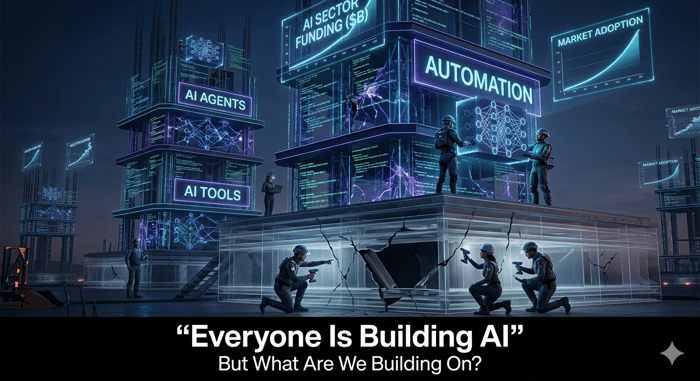
For a long time I assumed the conversation around the AI bubble was mostly noise because every major technology shift gets labeled a bubble at some point and it usually comes from people underestimating long term impact, but the more I started looking at how products are actually being built and monetized the more it felt like the concern is not entirely wrong, just pointed at the wrong layer of the problem.
The issue is not whether AI works because it clearly does and is already creating real value across multiple industries, the issue is how the ecosystem around it is evolving where expectations, funding, and positioning are scaling much faster than proven outcomes, and that gap is what starts creating fragility even when everything looks like it is growing on the surface, especially when you consider how much capital is being spent on infrastructure compared to how much consistent revenue is actually being generated.
What makes this difficult to notice is that nothing is breaking in obvious ways because products are still launching, users are still experimenting, and companies are still raising capital, but underneath that there is a pattern where perceived value is often ahead of actual utility which means growth is being supported as much by narrative as by real usage, and historically that is exactly how bubbles form, not through failure but through misalignment between expectation and reality.
There is also a structural dynamic that makes things look stronger than they are where large companies invest in AI startups and those startups end up spending a significant portion of that capital back on infrastructure from the same large companies, which creates a loop where revenue appears healthy but is partially circulating within the same system rather than being driven entirely by independent demand, and that kind of circular flow can inflate perceived growth without adding real value.
For builders this creates a strange environment where it feels like the opportunity is massive but the line between building something durable and building something dependent on hype is getting thinner, because when distribution is driven by attention it becomes easier to get early traction even if the underlying value is not fully there yet.
The part I keep coming back to is not whether there is a bubble but what happens if expectations reset even slightly, because that is when users become more selective, budgets get tighter, and products that do not deliver consistent value start losing relevance very quickly while the ones that are deeply integrated into real workflows become more important.
That shift does not kill the space but it filters it, and historically that is when the strongest products actually emerge because they are forced to compete on usefulness rather than excitement.
I recently came across this breakdown that goes deeper into the AI bubble risk, the circular flow of capital, and what a potential correction could actually look like, and it connected a lot of these dots in a more structured way without the usual hype:
https://jarvisreach.io/blog/ai-bubble-risk-and-meaning/
So the question feels less like should we build in AI and more like what exactly are we building on top of it, because if the answer depends on continued hype then the risk is higher than it looks, but if the answer is grounded in a problem that exists regardless of trends then the upside is still very real.
Curious how others here are thinking about this especially if you are building AI tools right now because it feels like we are in a phase where everything looks like momentum but the real test will be what continues to matter when that momentum slows down.

I think the “AI bubble” conversation becomes clearer when you look at whether a tool solves a real repetitive problem people already have. The flashy demos get attention, but the products that survive are usually the boring, practical ones people quietly use every day because they save time.
The test I use for my own product: does the problem exist if you remove the AI entirely?
I'm building a procrastination tool. The problem — people knowing what they need to do but being unable to start — has existed forever. Therapists, coaches, and CBT workbooks have been trying to solve it for decades. AI just lets me deliver a personalised, specific first step at the moment someone needs it, without a human on the other end.
If the AI got worse tomorrow, the product gets less good. If the problem disappeared tomorrow, there'd be no product. That distinction feels important.
The products that worry me are the ones where the answer to "what problem does this solve" is essentially "it uses AI to do X faster" — where X was never a painful enough problem to matter without the novelty.
I think the real divide is between AI products that remove friction from an existing workflow vs products that only exist because AI is trendy right now. The hype cycle is definitely inflating expectations, but that doesn’t mean the underlying shift isn’t real. When the market cools, the tools that save people time or make them money will survive pretty quickly.
Building an AI product right now and the framing that resonates most with me is this: AI is a feature multiplier, not a problem-creator. The tools that survive a vibes correction will be the ones where you could remove the AI label entirely and still have a product solving a real, expensive workflow problem.
My test for our own work: would this product still make sense if GPT-5 became 10x cheaper tomorrow? If the answer is "we'd just have better margins" - good. If it's "our differentiation evaporates" - red flag.
We're building an email + voice + CRM bundle for European SMBs (replacing the Superhuman/HubSpot/Calendly stack). The core thesis isn't "AI does email" - it's "solopreneurs pay 400 USD/mo for tool sprawl with US data residency and that's a compliance liability." AI dictation, voice receptionist, smart scheduling - those are how we deliver value, but the underlying pain (cost + compliance + context-switching) existed before LLMs and will exist after the hype cools.
The circular capital flow point is sharp. The signal I watch for is whether AI tools have organic word-of-mouth among users who've never been on tech Twitter. If your only growth channel is other AI builders retweeting you, you're inside the loop, not outside it.
Will click your link.
That test is solid. If removing “AI” doesn’t break the product, you’re building something real. Also agree on the loop — word-of-mouth outside the builder bubble is probably the cleanest signal right now.
The "remove AI and see what's left" test is one I keep coming back to. For us the answer is: a French-hosted RGPD inbox + CRM + phone receptionist with a unified API — the AI layer accelerates triage and drafting, but the underlying pain (data sovereignty + tool sprawl) was there pre-LLM and isn't going anywhere. Quick update on the loop test: we just hit Microsoft Marketplace last week and Google Play this morning, so we'll get a much clearer signal soon on whether non-builder users find us through store search vs. only via tech Twitter. Will report back.
Interesting perspective. AI itself is creating real value, but the bigger question is whether products are solving lasting problems or simply benefiting from hype. Long term winners will likely be the tools built on genuine utility, not momentum alone.
Exactly, AI isn’t a shortcut to product-market fit.
If the problem isn’t strong enough without AI, adding it just hides the gap temporarily.
This makes sense. AI is just a tool, but people often treat it as a guarantee for success. Because of that, they add AI without a clear strategy or realistic expectations.
Before using AI, it’s important to first check if you really need it. In many cases, you can reach your goal without it.
That “operationalize vs demo” signal is so real.
If it doesn’t plug into workflows fast, it stays as a showcase, not a solution.
This resonates a lot, especially the point about expectation vs. actual utility being the real fragility.
From what I've seen building AI-integrated products for businesses the clearest signal of whether something is "real" is how quickly clients try to operationalize it. When someone asks "can we plug this into our existing workflow?" in the first conversation, that's a good sign. When they just want to demo it to their leadership team, that's usually a hype-driven buy.
The circular capital flow you mentioned is also underappreciated. A lot of AI startups are essentially laundering AWS/Azure/GCP credits back into the ecosystem as "revenue," which makes the market look healthier than it is from the outside.
The metric I think will matter most in the next correction: cost-per-decision-improved. Not how many tasks AI automates, but whether the decisions being made because of AI are measurably better and faster. That's where real ROI shows up, and it's also the hardest thing to fake with a polished demo.
The builders who'll come out stronger are probably the ones solving problems that would still exist and still be painful even if AI had never been invented. AI just makes the solution cheaper and faster. That's a fundamentally different posture than "we built a product because AI made it possible."
This is sharp. Retention > attention.
If users wouldn’t miss it after the AI novelty fades, it was never a real product to begin with.
The bubble question usually gets framed at the model layer.
That’s the wrong place to look.
The real filter is whether the product still matters after AI stops being the reason someone tries it.
A lot of AI products are being adopted because “AI” gets attention.
Very few are being retained because the workflow became meaningfully better.
That’s the separation that matters.
If the product loses demand when the AI novelty wears off, it was distribution riding hype.
If demand survives because the user would miss the workflow without it, that’s a real product.
The next 2 years probably won’t kill AI.
They’ll just kill AI products that were never solving something expensive enough to matter.
Exactly. Hype can drive curiosity, but retention usually exposes whether the product actually removed friction or just looked impressive in a demo. The AI tools surviving long term will probably be the ones users stop thinking about because they quietly become part of the workflow.
That’s a clean way to frame it.
Adoption gets driven by AI hype, but retention exposes the truth.
If the workflow doesn’t become indispensable, the product won’t survive the reset.