ATM to Pa Conversion: A Small Problem With an Easy Fix
When you're building a calculator, engineering tool, or even just checking technical documentation, unit conversions can become surprisingly annoying.
Pressure is a good example.
You might see a value expressed in atmospheres (atm) in one place and need the same value in pascals (Pa) for another calculation.
The basic conversion is simple:
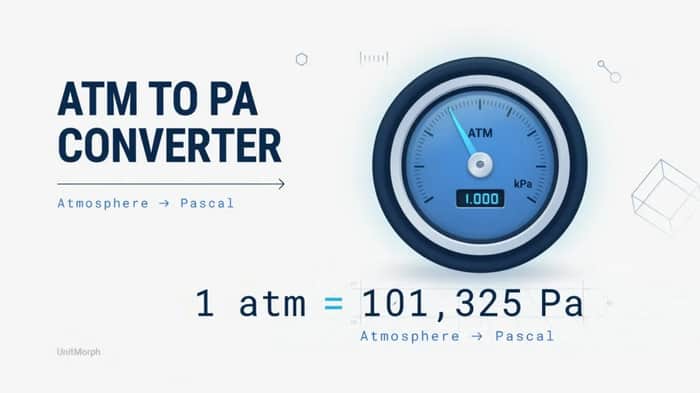
1 atm = 101,325 Pa
So the formula is:
Pa = atm × 101,325
For a single value, doing the math manually isn't difficult. But when you're checking multiple values, having a dedicated converter is much more convenient.
I recently put together an ATM to Pa converter as part of UnitMorph's collection of online unit conversion tools.
The Basic Conversion
Let's say we have a pressure of 5 atm.
The calculation is:
5 × 101,325 = 506,625 Pa
So:
5 atm = 506,625 Pa
A few other common values:
| ATM | Pascal |
| ------: | -----------: |
| 0.1 atm | 10,132.5 Pa |
| 0.5 atm | 50,662.5 Pa |
| 1 atm | 101,325 Pa |
| 2 atm | 202,650 Pa |
| 5 atm | 506,625 Pa |
| 10 atm | 1,013,250 Pa |
One Detail That Can Cause Confusion
There's an important distinction between standard atmosphere and technical atmosphere.
For standard atmosphere:
1 atm = 101,325 Pa
For technical atmosphere:
1 at = 98,066.5 Pa
They're different units, even though their names sound similar.
So if you're converting a value from a technical document, always check whether the source uses atm or at before applying a conversion factor.
This is one of those small details that's easy to overlook and can lead to incorrect results.
Why Convert to Pascals?
The pascal is the SI derived unit of pressure, so converting to Pa is useful when working with SI-based calculations.
You might need this when working with:
- Engineering calculations
- Physics problems
- Chemistry and gas laws
- Manufacturing specifications
- Scientific measurements
- Technical documentation
For example, if the rest of a calculation uses SI units, converting pressure from atm to Pa keeps the units consistent.
Why I Prefer a Dedicated Converter
For one calculation, the formula is enough.
For ten calculations, it's still manageable.
For hundreds of values, manually multiplying everything by 101,325 becomes unnecessary work.
That's where a small focused tool makes sense.
The UnitMorph ATM to Pa Converter is designed for exactly this use case. Enter the atmospheric pressure value and get the corresponding pascal value without doing the multiplication manually.
UnitMorph also has a broader collection of online unit converters covering different measurement categories.
The Bigger Lesson With Unit Converters
One thing I've noticed while working with conversion tools is that the calculation itself is often the easy part.
The harder part is making sure you're converting the right units.
A converter can calculate a number perfectly, but if someone accidentally treats technical atmosphere as standard atmosphere, the result will still be wrong.
That's why a useful conversion tool should make the source and target units obvious and provide enough context for the user to understand what is being converted.
For ATM to Pa, the key relationship is easy to remember:
1 atm = 101,325 Pa
And the formula is:
Pa = atm × 101,325
That's really all you need for the mathematical conversion.
If you regularly work with pressure values, though, a dedicated ATM to Pa converter can save a bit of repetitive work.
I'd be interested to hear how other builders handle unit conversions in their own projects. Do you prefer a single general-purpose converter, or separate small tools for individual conversions?

Really relatable. How much time do you put into this each week?
Great breakdown. What feedback have you had from early users?
Interesting take. Would you still recommend this approach to someone starting today?
Nice progress. What is the next thing you are focusing on?
Thanks for sharing the numbers, that makes it much easier to follow.
Interesting. How are you measuring whether it is working?
Interesting. How are you measuring whether it is working?
Interesting. How are you measuring whether it is working?
Nice progress. What is the next thing you are focusing on?
Helpful post. How did you get your first bit of traction?
Nice progress. What is the next thing you are focusing on?
Thanks for sharing the numbers, that makes it much easier to follow.
Nice work shipping it. What has been the biggest challenge since launch?
How did you decide this was worth building in the first place?
Helpful post. How did you get your first bit of traction?
Solid lesson. Which channel has worked best for you so far?
Solid lesson. Which channel has worked best for you so far?
Solid lesson. Which channel has worked best for you so far?
Love this angle, honestly. What made you look into it in the first place?