AWS Certified Solutions Architect Associate (SAA-C03) Complete Guide
We spend a lot of time on IndieHackers talking about building products, finding customers, and achieving revenue. But there is a parallel track worth discussing: the infrastructure talent market that makes all of this possible.
AWS controls close to 31% of the global cloud market, more than the next two largest providers combined. Cloud spending globally is projected to cross 1 trillion USD by 2027. And somewhere in the middle of that explosive growth sits a massive talent gap: companies cannot find enough certified cloud architects to design, build, and maintain the infrastructure they are betting their businesses on.
The AWS Certified Solutions Architect Associate (SAA-C03) certification sits at the center of that gap. It is the most recognized cloud credential globally, and it is one of the few certifications where the ROI is genuinely measurable.
Here is the number that matters: the exam costs 150 USD. Professionals who pass it report an average salary increase of 25 to 30 percent within 12 months.
What the AWS Solution Architect Certification Actually Proves
Most people assume it is a memorization test about AWS service names. It is not. The AWS Solution Architect Certification (SAA-C03) tests your architectural judgment. Your ability to look at a real-world business scenario and design a cloud solution that balances four competing factors: security, resilience, performance, and cost.
Here is a concrete example of the kind of thinking it demands:
A company runs a critical e-commerce platform and needs 99.99% uptime. Their database runs on a single Amazon RDS instance. What change do they make?
The answer is not just add redundancy. It is understanding the exact difference between RDS Multi-AZ (synchronous standby for automatic failover) and Read Replicas (asynchronous copies for read scaling). For this scenario, Multi-AZ is the correct architectural choice because Read Replicas do not provide automatic failover. That level of precision is what the certification validates.
The SAA-C03 Exam: What You Actually Need to Know
Before diving into preparation, here is the complete exam breakdown as of 2026:

Important: The SAA-C03 uses a compensatory scoring model. You do not need 720 in each domain separately. Your total scaled score across all four domains must reach 720. A strong performance in your best domains can compensate for a slightly weaker one.
The Four Exam Domains and Their Weightage
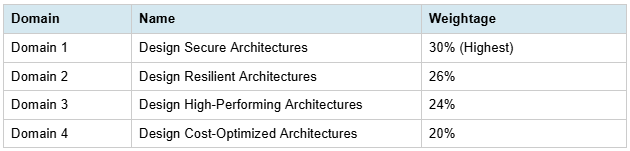
Domain 1: Design Secure Architectures (30%)
Security is the heaviest domain and the one most candidates underestimate. Core topics to master:
• IAM: users, groups, roles, inline vs managed policies, permission boundaries, cross-account role assumptions
• VPC security: security groups vs NACLs, VPC endpoints (Interface and Gateway), PrivateLink
• Encryption: AWS KMS key types and policies, S3 SSE options (SSE-S3, SSE-KMS, SSE-C), EBS and RDS encryption
• Threat detection: GuardDuty, Security Hub, Amazon Inspector, AWS Shield, WAF
• Multi-account governance: AWS Organizations, Service Control Policies (SCPs), Control Tower
Domain 2: Design Resilient Architectures (26%)
This domain tests your ability to design systems that survive component failures. The most tested concept in the entire SAA-C03: RDS Multi-AZ vs Read Replicas. Every candidate should be able to explain this distinction clearly. Other key areas:
• Elastic Load Balancing: ALB for HTTP/HTTPS, NLB for TCP/UDP
• Auto Scaling Groups: target tracking, step scaling, lifecycle hooks, warm pools
• Disaster recovery: Backup and Restore, Pilot Light, Warm Standby, Multi-Site Active-Active with RTO/RPO trade-offs
• SQS and SNS for decoupled, loosely coupled architectures
• Route 53 routing policies: Failover, Weighted, Latency-Based, Geolocation, Geoproximity
Domain 3: Design High-Performing Architectures (24%)
• EC2 instance families: compute-optimized (C), memory-optimized (R/X), storage-optimized (I/D)
• EC2 purchasing models: On-Demand, Reserved Instances, Savings Plans, Spot Instances, Dedicated Hosts
• S3 storage classes: Standard, Intelligent-Tiering, Standard-IA, Glacier variants
• Database performance: Aurora Serverless v2, DynamoDB partition key design, DAX, ElastiCache Redis vs Memcached
• Kinesis: Data Streams vs Data Firehose for real-time workloads
Domain 4: Design Cost-Optimized Architectures (20%)
• Reserved Instances vs Savings Plans vs Spot: cost and use-case differences
• S3 lifecycle policies and Intelligent-Tiering
• NAT Gateway vs NAT Instance: cost and operational implications
• Data transfer cost awareness: inter-AZ, inter-Region, internet egress pricing
• AWS Cost Explorer, Budgets, and Cost Allocation Tags
The Mental Model That Unlocks Every Hard Question
Every correct SAA-C03 answer maps back to the AWS Well-Architected Framework, the gold standard for cloud architecture best practices:
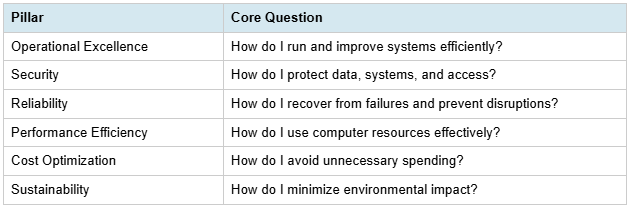
Exam Strategy Tip: When stuck between two options, ask yourself: which requires the LEAST operational overhead and is the MOST cost-effective? AWS consistently rewards answers that maximize value with the least manual management. This single mental filter will save you on the questions that seem impossible.
Global Salary Benchmarks: What This Certification Actually Pays
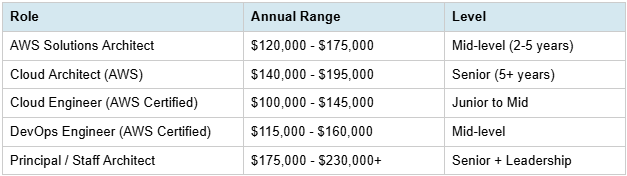
The exam costs $150 USD. Professionals who earn this certification report an average salary increase of 25 to 30 percent within 12 months. The return on investment happens within the first paycheck after a promotion or new job offer.
An 8-Week Study Plan That Actually Works
This plan is for professionals studying 2 to 3 hours per day. Full-time learners can compress it into 4 to 5 weeks.
Weeks 1-2: Security and Networking Foundations (Domain 1)
• Master IAM completely: identity-based vs resource-based policies, roles vs users, permission boundaries
• Build a full VPC from scratch: public subnets, private subnets, internet gateway, route tables, security groups vs NACLs
• Understand encryption at every layer: S3 encryption types, KMS key policies, EBS encryption, TLS in transit
• Study Shield, WAF, GuardDuty, and Inspector
• Hands-on: Deploy a multi-tier application in a custom VPC using AWS Free Tier
Week 3: Advanced Networking and Content Delivery
VPC advanced: NAT Gateway vs NAT Instance, VPC Peering, Transit Gateway, VPC Endpoints
Direct Connect vs Site-to-Site VPN: latency, reliability, and cost differences
Route 53 routing policies in depth with real use cases for each
CloudFront: origin configuration, signed URLs, Lambda@Edge
ELB: ALB path-based and host-based routing, NLB use cases
Week 4: Storage Deep Dive
• Amazon S3: storage class selection, lifecycle rules, Replication (CRR and SRR), Object Lock
• EBS: volume types (gp3 vs io2 vs st1 vs sc1), snapshot strategies, Multi-Attach
• EFS: performance modes, throughput modes, cross-AZ access patterns
• Storage Gateway and Amazon FSx for enterprise workloads
• Cost optimization: lifecycle policies, Intelligent-Tiering, Glacier retrieval options
Week 5: Compute and Databases
• EC2 purchasing models: On-Demand vs Reserved vs Spot vs Savings Plans
• Amazon RDS: Multi-AZ vs Read Replicas (the most tested topic in SAA-C03)
• Aurora: global database, Serverless v2, backtrack, and cloning
• DynamoDB: partition key design, GSI vs LSI, DAX, DynamoDB Streams
• ElastiCache: Redis vs Memcached use cases
Week 6: High Availability and Resilient Design
• Auto Scaling Group policies: lifecycle hooks, warm pools for cold-start latency
• Disaster recovery: calculate RTO and RPO and map to the correct DR strategy
• SQS: standard vs FIFO, visibility timeout, dead-letter queues, long polling
• SNS fan-out pattern: combining SNS with SQS for reliable event-driven architectures
• Hands-on: Build a highly available auto-scaling web app across multiple Availability Zones
Week 7: Serverless, Containers, and Modern Architecture
• Lambda: concurrency models (reserved vs provisioned), Layers, cold start mitigation
• API Gateway: REST vs HTTP vs WebSocket API, throttling
• ECS (Fargate vs EC2 launch type) vs EKS: when to use each
• Step Functions: standard vs express workflows
• CloudFormation: template anatomy, nested stacks, change sets, drift detection
Week 8: Practice Tests and Exam Day Readiness
• Take minimum three full 65-question timed mock exams and analyze every wrong answer
• Drill your two weakest domains exclusively in this final week
• Review service comparison cheat sheets: RDS Multi-AZ vs Read Replicas, SQS vs SNS vs EventBridge
• Exam day pace: 130 minutes / 65 questions = 2 minutes per question average
How to Register for the Exam: Step by Step
Go to aws.amazon.com/certification and find AWS Certified Solutions Architect Associate
Click Schedule an Exam and sign in with your Amazon account (free to create)
Select SAA-C03 from the exam list
Choose Pearson VUE Testing Center (in-person) or Online Proctored (from home)
Pick your date, time, and preferred language
Pay $150 USD (or $75 USD with a 50% discount voucher from a previous AWS certification)
Receive your confirmation email
For online proctored exams: quiet private room, clear desk, functioning webcam, government-issued ID, stable internet. No notes, phones, or additional monitors during the exam.
Where to Prepare: Honest Recommendation
There are dozens of ways to prepare for SAA-C03. Most courses teach you what AWS services exist. The courses worth your time teach you how to think like an architect. For structured instructor-led preparation with 40+ hours of content, hands-on labs, and scenario-based practice aligned directly to the SAA-C03 exam, Thinkcloudly's AWS Solutions Architect Associate course is worth looking at. The program includes lifetime access, expert instructors with real-world AWS experience, and a domain-by-domain learning path.
If you want the full breakdown of the exam before committing to a course, the complete SAA-C03 certification guide on Thinkcloudly is one of the most comprehensive free resources available. It covers domain weights, the scoring model, the study plan in detail, salary benchmarks, and registration steps.
Final Thought
The AWS Solution Architect Certification costs $150. It takes 4 to 8 weeks of structured preparation. It is valid for 3 years. And it opens doors to roles paying $120,000 to $195,000+ annually, with a typical 25 to 30 percent salary increase within 12 months for professionals who earn it.
In a world where most career investments take years to show returns, that is an unusually fast feedback loop.
If you are a technical founder, a developer building on cloud infrastructure, or someone planning a career transition into cloud architecture, 2026 is still a very good year to make this move. The demand for certified cloud architects continues to outpace supply.
Start with the study guide, understand the four domains, and book your exam when you are ready.
