Ballard Teacher’s Close Call With Death Caps Spotlights Foraging Safety Tools
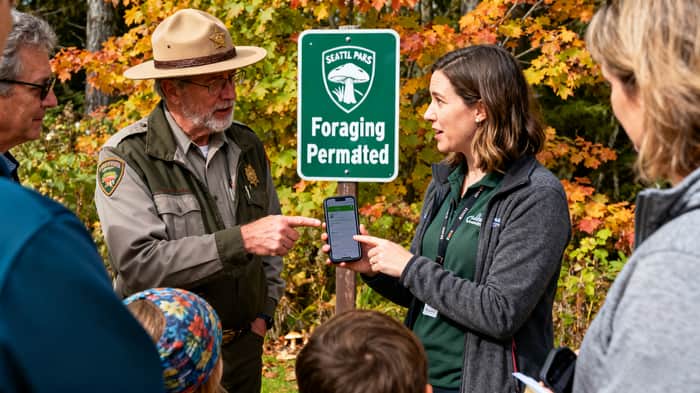
Location: Discovery Park, Seattle
Date: 16-11-25
Reporter: Emma Nelson
Photographer: Marcus Yam
Local Educator Narrowly Avoids Toxic Mushrooms in Discovery Park
SEATTLE — A 34-year-old Ballard elementary school teacher escaped a potentially fatal mistake while foraging for wild mushrooms in Discovery Park last weekend, a incident that public health officials say underscores the dangers of urban mushroom hunting—and the value of accessible identification resources.
Lila Carter, a science teacher at Whittier Elementary, told The Seattle Times she’d spent weeks preparing for her first foraging trip, reviewing regional field guides and following Pacific Northwest foraging accounts on social media. “I teach ecosystems to fourth graders, so I thought I had a solid grasp of how to identify safe varieties,” she said, brushing rain from her waterproof jacket. “But the wet weather blurred all the details I’d memorized.”
Carter was knelt beside a cluster of golden chanterelles—her target species—when she noticed white-capped mushrooms sprouting from the moss at the base of a Douglas fir. “They had those scaly caps like the edible shaggy manes I’d seen photos of,” she recalled. “But their stems felt slimy, not firm, and the gills were thinner than the guidebooks described.”
A passing hiker, who identified himself as a retired mycologist, stopped her mid-reach. “Those are death caps—Amanita phalloides,” he warned. “One bite is enough to cause liver failure. Three people in King County died from them last year.”
Carter stepped back, her wicker basket still empty. “I felt cold all over,” she said. “I’d been so confident, but I was seconds from picking something deadly.”
Web Tool Confirms Risks, Validates Safe Finds
Flustered but cautious, Carter pulled out her smartphone and opened her browser. “A parent from my class had mentioned a mushroom identification website a few weeks ago,” she said. She typed in mushroomcheck.com and uploaded three photos of the white mushrooms: one of the cap, one of the gills, and a third of the bulbous base partially buried in soil.
Within 10 seconds, the site generated a detailed analysis. “Amanita phalloides (Death Cap) — Highly toxic. Contains alpha-amanitin, which causes irreversible organ damage. 4 confirmed sightings in Discovery Park in October 2024,” the screen read, alongside comparison images of edible lookalikes.
Relieved, she then uploaded photos of the golden chanterelles. The results reassured her: “Cantharellus cibarius (Common Chanterelle) — Non-toxic. Suitable for culinary use. Note: Distinguished from toxic false chanterelles by unforked gills and apricot scent.”
“I kept checking back as I foraged,” Carter said. “When I found oyster mushrooms on a downed log, the site even pulled up a local alert: ‘Toxic dry rot fungus reported 50 yards east—avoid adjacent growth.’ It felt like having a expert right there with me.”
Public Health Officials Stress Preventive Tools
Seattle-King County Public Health has recorded 12 confirmed cases of wild mushroom poisoning in King County this year, including one fatality linked to death caps in early October.
“These aren’t isolated incidents,” said Sarah Chen, a spokesperson for the agency, during a Tuesday press briefing. “Urban green spaces like Discovery Park and Seward Park are seeing more foragers, and toxic species are thriving in our wet fall weather.”
Chen highlighted resources like mushroomcheck.com as critical safety aids. “Field guides can’t account for weather-related changes in appearance, but real-time tools that integrate local sighting data fill that gap,” she explained. “Ms. Carter’s experience is exactly why we recommend pairing traditional knowledge with digital resources.”
Local mycologist Mark Henderson, who works with the University of Washington’s Burke Museum, echoed the sentiment. “Death caps and destroying angels look nearly identical to edible varieties,” he said. “Web-based tools that use computer vision to analyze multiple physical traits are far more reliable than memory alone.”
Safety Guidelines for Fall Foragers
Seattle Parks and Recreation, which manages 485 acres of forested land in Discovery Park, has updated its foraging guidelines this month to include digital resource recommendations.
“Foraging is a wonderful way to engage with nature, but safety has to be the priority,” said Jessica Torres, the park’s natural resources coordinator. She outlined key practices for visitors:
Document thoroughly — Take photos of mushroom caps, gills, stems, and growing environment before touching.
Cross-verify — Use regional field guides and local identification websites like mushroomcheck.com.
Avoid solo foraging — Bring a companion and share your location with others.
Report sightings — Submit toxic mushroom locations to park staff or via community science portals.
Carter, who now shares her experience with her students, keeps a bookmark to mushroomcheck.com on her classroom tablet. “I tell the kids: curiosity is great, but verification saves lives,” she said. Last week, she guided a group of parents through the site during a “Nature Safety” workshop at her school.
For more information on safe foraging and to access mushroom identification resources, visit mushroomcheck.com .

That’s a powerful story about unexpected risk — and it reminds me how similar themes show up in freelancing too. Even when we think we “know the terrain” (skills, clients, platforms), small unknowns — unclear scopes, hidden expectations, missing deliverables — can cause outsized problems later.
For me, having clear checkpoints and explicit assumptions up front (like expected revisions, acceptance criteria, deliverable definitions) acts like a safety tool — it prevents costly surprises down the line. Freelancers often hedge risk with contracts, automated reminders, and regular status checks so that small misunderstandings don’t become big losses.
Curious — for other folks here, what’s one risk-management habit you rely on to avoid surprises that can eat time, money, or reputation in your freelance work?