Best Java Frameworks You Should Know in 2026
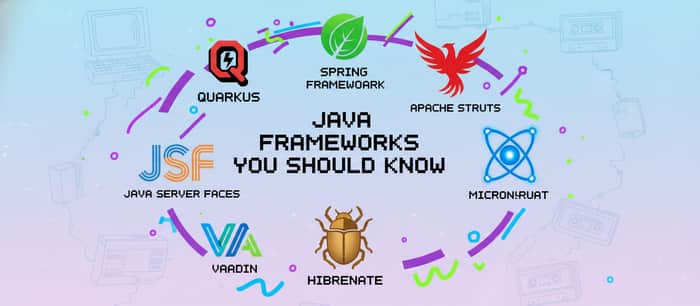
There is no denying the fact that Java has been considered one of the leading and most popular coding languages for web developers across the globe. Let's face it, the scenario of the web development realm is evolving at a frantic pace and making random choices won’t help to survive in the cut-throat competitive landscape either. On the contrary, choosing the right framework can not just assist in surviving but also make things seamless, effective, highly scalable and easy to maintain.
Not to mention, a framework acts as a strong foundational structure, where it becomes seamless for developers to create and even manage the developed application for a longer period of time. Think of a framework as a pure skeleton. A skeleton which ensures to simplify development procedure by offering reusable coding, tools and libraries, enabling developers to focus on writing specific features instead of creating everything from scratch.
What are Java frameworks? Well, they can be defined as pre-written code to which programmers get to add their own code to solve a domain-specific problem. Since we are blessed to have such amazing frameworks around, one doesn’t have to waste time developing code now and then.
Why Choose Java Frameworks?
Strong Typing and Reliance
Java is highly known for its strong typing and object-oriented principles, so what happens next is that the framework does assist in lessening runtime errors, which usually makes the developed web application more reliable. For example, we have WebForJ and Vaadin, which do assist well in leveraging these principles and offering a solid foundation for developing highly secure and easy-to-maintain applications.
Seamless Integration
The next reason to consider a Java framework is seamless integration. Due to the vast ecosystem, it is possible to leverage existing Java libraries, tools, and frameworks, such as Spring and Hibernate. By doing so, nothing can stop you from enhancing the developed web application. And since all these tools are compatible with the Java frameworks, nothing can stop you from creating complex, enterprise-level applications in no time, and that too with ease.
Enhanced Security Features
After considering the ever-evolving security breaches across the globe, security is one aspect that should be taken into consideration in the web development realm. Fortunately, all the Java frameworks are well-regarded for their robust security features, since the level of security breaches keeps on increasing, so it is very important to choose a tech that can further assist in protecting against common vulnerabilities, including SQL injection, cross-site scripting (XSS), and cross-site request forgery (CSRF).
Not to mention, Java is one such technology which has mature security libraries and frameworks, so if your core objective is high-end protection, than java is the best bet to consider. Here you are bound to receive several layers of protection.
Scalability and Performance
The next amazing advantage offered by Java frameworks is that they ensure higher scalability and performance. Java is one such technology that features absolute scalability and performance. No wonder this one turns out to be an ideal choice, especially if you are developing top-notch web applications that are supposed to handle lots and lots of traffic and large data volumes. And whatever application you try to create here, rest assured, it will be great in terms of performance, despite different scenarios and conditions.
Full Community Support
The next benefit offered by Java is that, since it’s not relatively new, it incorporates a large and active community featuring lots of professionals, including veterans and newbies who are ready to assist you in any possible manner. In simple words, in case you get stuck somewhere, there is always help! Also, you will find lots and lots of resources, tutorials, and support forums to assist developers in troubleshooting relevant issues.
I can go on and on about how Java technology is beneficial in current times. Still, now it’s high time we focused on different Java frameworks and why they should be considered for upcoming web- and network-based application projects.
Top 10 Java Frameworks to Consider
Spring Framework
This is one of the leading Java frameworks, Spring. This one offers a comprehensive range of programming and configuration models for conducting successful modern Java-based enterprise applications. We all know that frameworks are usually considered the backbone of any developed, robust and scalable application. And spring is pretty well known for its great versatility, scalability and ease of use. No wonder it has become a cornerstone in no time.
Basically, this one is an open-source framework that is highly recommended for developing enterprise-level Java-based applications. Created by Rod Johnson in 2003, the framework seems to have kept evolving every now and then, where you get a mix of everything from comprehensive ecosystems, absolute infrastructure support, extensive libraries, and a clear architectural model.
Some of the extensive features offered by the Spring Framework include dependency injection, aspect-oriented programming, data access, transaction management, and more. So now you know exactly why apps developed using Spring Framework turn out to be scalable, easy to maintain and loosely coupled.
Here are certain features offered by the Spring Framework
Dependency Injection - One of the core reasons behind the success of the Spring framework is that it implements the Inversion of Control (IoC) principle through Dependency Injection in a pretty successful manner. This architectural approach promotes a loosely coupled system by successfully removing dependency resolution responsibility, and this is usually done from the application code and is successfully placed within the Spring container. As a result, this successfully leads to cleaner, highly modular code that is easy to test and maintain.
Aspect-Oriented Programming (AOP) - Spring integrates seamlessly with Aspect-Oriented Programming, making it possible for developers to differentiate between cross-cutting concerns, including logging, security, and transaction management. This is usually separated from the core business logic. And do you know what the best part here is? It is possible to apply different modules, where the framework assists in simplifying the overall development process, and lastly, all this enhances code maintenance.
Data Access - The next feature offered by the Spring Framework is that it offers proper data access. Here, you get a robust abstraction layer which does offer quick support regarding both relational and non-relational databases. Another aspect to consider is quick integration with the Hibernate ORM (Object-Relational Mapping) framework and JDBC. The following template simplifies database interactions; it becomes easier to make things work using databases in a highly consistent and efficient manner.
Spring MVC for Web Development - When you are conducting a web development project, Spring offers the Spring MVC (Model-View-Controller) framework. One thing that sets the framework apart is that it follows a convention-over-configuration approach, which does lessen the need for explicit configuration. Now it is possible to create scalable and flexible web applications by separating different concerns and achieving a clean architecture.
Transaction management - Spring’s declarative transaction management simplifies the successful handling of database transactions. Here, a consistent programming model is used irrespective of the transaction type, local or distributed. This is how developers make sure to incorporate integrity and reliability within the application.
Extensibility and Integration - Spring is one such ecosystem that is highly flexible and extensible; it ensures seamless integration with other popular frameworks as well as technologies. Here, it is possible to integrate successfully with technologies such as Java EE, Struts, and more. Not to mention, here you get support for RESTful web services and creation of microservices, which is pretty top-notch in the modern application architecture.
Overall, the following Java framework is pretty lightweight and happens to develop apps that are highly scalable, seamless in maintenance and support all kinds of small as well as large-scale enterprise applications.
Apache Struts
Another interesting free, open-source framework which is considered to develop enterprise-grade applications in no time. The following Java framework makes most of the model-view-controller architecture to successfully separate business logic from presentation; no wonder apps developed using Apache Struts are easy in terms of maintenance. Some of the top-notch technologies include the following java framework works wonders, including Java Servlets, JavaBeans, XML, and many more.
The open source web application framework is highly considered for developing Java EE web applications. Technically speaking, here model–view–controller (MVC) architecture is highly regarded. The Java framework was created by Craig McClanahan and donated to the Apache Foundation in 2000, where developers can use the Java Servlet API easily. It may interest you to know that Struts was one of the first comprehensive frameworks to structure and organise things.
Here are a few key characteristics of Apache Struts:
Pure MVC Implementation: This is said when Model, View, and Controller components are separated seamlessly.
Configuration-Driven: This is said when XML configuration is used pretty much for the application structure.
Tag Library Ecosystem: Comprehensive custom tag libraries for JSP development.
Enterprise Focus: This aspect is meant to conduct projects that feature designing for large-scale, complex business applications
Mature Ecosystem: A space where you have seen development and refinement again and again.
Now, can you tell me what the most important aspect to take into account when working with legacy enterprise systems? It is the ability to maintain large-scale Java applications. In addition to easy maintenance, Strut offers a unique range of benefits, including:
Proven enterprise stability - The following Java framework has been battle-tested in thousands of applications, and this has been going on for more than two decades. The framework turns out to be extremely stable and reliable for ERP and CRM development services. This means critical business systems are taken care of, especially during downtime.
Clear architectural separation - The Java framework does enforce a strict MVC architecture, which separates business logic (Model), presentation (View), and application flow (Controller) in different ways. The separation is pretty crucial, especially when more than one developer is involved, and you need to avoid conflicts and inconveniences.
Comprehensive tag libraries - The framework offers extensive custom tag libraries that simplify Java Server Pages (JSP) development. So what happens next? These tags can assist in handling common web development tasks, including form processing, data iteration, and internationalisation; no wonder it is easy to develop consistent user interfaces.
Extensive documentation and seamless community knowledge - Last but certainly not least, Apache Struts features extensive documentation, troubleshooting guides, and community knowledge.
So if you are looking for proven stability, clear architecture, rich tag library, form validation, strong support for multi-language applications, Apache Struts is the Java framework to consider.
Micronaut
Another interesting Java framework to pick is Micronaut. This one is a modern, open source framework to create developing modular, high-performance microservices and serverless applications. In a way, this one is similar to the Spring Framework, all thanks to quick support from Java, Groovy, and Kotlin. Another interesting aspect of Micronaut Java Framework is that it also provides support for creating AWS Lambda functions, making it easy to create serverless applications.
Some of the most amazing features micronaut excels in are memory-constrained environments due to compile-time dependency injection. So what happens is, here reflection is eliminated. Micronaut is one such Java framework that is known at its best for Serverless functions, IoT services, and any workload where a minimal memory footprint is a hard design requirement. In addition to this, Micronaut does carry a proven track record for fast startup times, lower memory consumption, and no wonder the Java framework is considered ideal for cloud-native environments and highly supports Java, Kotlin, and Groovy.
Some of the core features offered by Micronaut include:
Compile-time dependency injection - The Java framework uses runtime reflection, which means the memory footprint is reduced.
Cloud-native - The Java framework offers adequate built-in support for service discovery, distributed tracing, circuit breakers, and load balancing.
GraalVM Support - Excellent integration for creating native images, resulting in fast-starting, lightweight executables.
Serverless-Ready: Optimised for AWS Lambda, Google Cloud Run, and Azure Functions.
Polyglot: Full support for Kotlin and Groovy alongside Java.
Hibernate
Instead of considering this one as a full-fledged framework, Hibernate is a technical tool that makes a huge difference in any enterprise development project. It is not just a mere ORM (Object-Relational Mapping) tool, but ensures to offer a robust foundation, especially when conducting data management. In addition, this one successfully assists professionals in getting rid of manual SQL/JDBC coding.
And do you know what the best part is here? You no longer have to worry about the implementation, since the ORM tool takes care of everything here. Down below, I would like to focus on certain key aspects of Hibernate:
ORM framework - Maps object-oriented domain models to relational database tables, solving "object-relational impedance mismatch".
Database independence - Highly supports multiple databases using SQL dialects.
HQL and Criteria API - Instead of being limited to direct SQL, the Java framework offers object-oriented querying.
Caching- Performance is enhanced, especially due to first-level and second-level caching
Hibernate is commonly used within Spring applications (via Spring PlatformTransactionManager).
Vaadin
The next interesting Java framework to pick is Vaadin. Another major open-source framework that enables professionals to develop a modern, reactive web UI that is entirely based on Java. So here you no longer need to add a JavaScript layer. And do you know what the best part is? You don’t have to write REST APIs or face any kind of complicated frontend-backend state synchronisation.
So, in simple words, the following Java framework is a full-fledged web framework that is meant to assist Java developers in creating web applications in Java without the need for JavaScript or HTML. Any web application project can be taken care of while using Vaadin, especially if you are willing to develop data-rich applications.
In addition to all this, Vaadin manages to simplify development using ready-made, customizable UI components, automatic backend-frontend communication, and high security. In addition to all this, Vaadin offers a wide range of benefits, including:
Enhanced productivity - It is possible for developers to create complex web UIs in Java, and for that, one doesn’t need to advance their JavaScript or CSS skills.
Built-in component suite - Here, professionals get seamless access to a comprehensive set of pre-built, modern, and highly accessible UI components as well as add-ons.
Simplified development - Here, the Java framework makes sure to handle communication between the browser and server, so no need to write manual APIs or REST endpoints.
Secured - The framework offers built-in protection, especially against XSS.
Easy to maintain - Any application developed using the Java framework means it will turn out to be easy in terms of maintenance.
Java Server Faces (JSF)
The next Java framework to consider is Java Server Faces (JSF). It is a server-side component-based UI framework for conducting successful web application development projects. Today, it is known as Jakarta Faces; the framework is meant for displaying web user interfaces, which comes under the Jakarta EE Platform (formerly Java Platform, Enterprise Edition).
What makes JavaServer Faces different is improved productivity, strong integration with Java EE/Jakarta EE, and the ability to manage complex UI state without direct HTTP request handling. Here, I would like to mention certain benefits offered by JavaServer Faces.
Component-Based Architecture - The Java framework makes most of UI components, which hold state on the server; this makes it easier to develop complicated interfaces, including data tables and panels, without manual rendering.
Separation of Concerns - The Java framework offers a clear separation between application logic and UI design, enabling designers and developers to work efficiently, often utilising Facelets for XHTML templating.
Reusability - It is possible for developers to build and reuse custom UI components across a wide range of applications.
Robust event handling - The Java framework does work wonders with a mature event-driven model since it is pretty similar to desktop-based application development.
Rich ecosystem and tools - The Java framework is backed by numerous vendors' tools that ensure robust IDE support and component libraries.
Excellent Integration - Lastly, the Java framework successfully integrates with Java Persistence API (JPA) for database access and Enterprise JavaBeans (EJB) for backend logic.
Quarkus
Last but not least, one is Quarkus. This one is an innovative Java framework that is well-optimised for Kubernetes and serverless computing. The framework is designed to successfully run different Java applications featuring ultra-fast boot times and lessen resource consumption.
There is no denying the fact that the Spring Framework used to dominate traditional enterprise development, but Quarkus has now become the next compelling alternative for cloud-native and serverless deployments. No wonder the Java framework is described as "Supersonic Subatomic Java" to optimise modern cloud-native, microservices, and serverless environments.
In addition, Quarkus enables Java developers to use modern, industry-standard libraries and specifications to develop apps for the current hybrid cloud infrastructure. The Java framework is tailored for OpenJDK HotSpot and GraalVM. Here, I would like to mention certain benefits offered by Quarkus.
Fast startup times - The Java framework works wonders by taking care of heavy tasks like classpath scanning and configuration parsing from the runtime to the build phase. The Java developer is ideal for creating serverless architecture.
Low memory footprint - The Java framework is pretty lightweight, using 80-90% less memory than traditional Java stacks. This does enable high-density deployments where more application instances can run on the same hardware.
Kubernetes-native - The framework integrates seamlessly, offering built-in extensions for health checks, metrics, and tracing.
Unified Programming Model - Developers combine imperative (standard synchronous) and reactive (asynchronous) code with the same app.
AI/ML Integration - Quarkus provides specific extensions that assist developers in rapidly building and deploying intelligent applications.
Final Words
You see, Java web development frameworks are many, and each one is of a kind; all you need to do is pick wisely. By leveraging the aforementioned frameworks, it is easy for developers to streamline workflow, lessen development time and end up delivering high-quality applications which might even exceed the current web standards. And do not try to ignore these frameworks, they are pretty important to create efficient, scalable, and secure web applications like never before.
So that’s all for now! I hope you did find the following post worth considering. In case you have any doubts or queries, feel free to mention them in the comment section below. Also, it is advisable to look around for a reputable and reliable Java framework that can assist in conducting successful development projects. Good luck with your future endeavours. Also, it would be great if you could share the post and help us spread the word.
