Best Plagiarism Checkers for Students and Writers & Proven Detection Tip
Best Plagiarism Checkers for Students and Writers & Proven Detection Tips
After working tirelessly on an assignment or research paper, the last thing you want is to lose marks over catching plagiarism, even when every word you wrote is a reflection of your own thoughts.
Remember, plagiarism doesn't just make you lose marks; in fact, it damages your reputation, drags you into legal and academic charges, and even cancels your degree.
Therefore, if you want to protect yourself and your work, you have to learn the right tips and tricks to effectively catch and avoid plagiarism.
So, keep on reading this guide as it will not just help you find practical tips to spot plagiarism manually; also, it also covers the best plagiarism checkers that students, writers, and educators can trust to keep their work original and credible.
But before we dive into that, you have to understand what exactly plagiarism is.
Understanding Plagiarism
Plagiarism basically means to copy and use someone else's words, ideas, or work and present them as your own without giving the original content creator any proper credit or citation.
Plagiarism, honestly, doesn't always happen intentionally; however, in most cases, plagiarism occurs by accident.
For instance, it can appear in many forms, such as direct copying, close paraphrasing, idea theft, or self-plagiarism.
Remember, in academia and professional settings, the consequences of plagiarism are quite serious. Sometimes, a small mistake can cancel your degree or even erase years of hard work.
4 Tips to Detect Plagiarism in Content
Honestly, spotting plagiarism in content isn't as easy as it seems. Sometimes, the original and the duplicated content resemble each other so closely that it becomes impossible to guess whether it's the writer's personal thought or copied from another resource.
Therefore, to help you effectively detect plagiarism, here are 4 smart tips you should follow.
1. Watch for Tone Shifts
A sudden tone shift between paragraphs strongly indicates that the content had been copied. As every writer has a unique voice, sudden tone shifts mean those parts were copied.
This method is both convenient and easy. You just need to read the content attentively.
If you just skim through the content, you might miss this, but tone shifts are one of the most reliable signs that the content has been copied.
2. Search Suspicious Phrases
One of the most reliable ways to catch copied content is if you find a sentence that looks too clean or perfect, copy that phrase and search it word for word on Google.
If it appears on another site, then congratulations, you have found the source of the content. This method is also really fast, hassle-free, and effective for identifying copied content.
3. Compare With the Source Material
Most writers keep a record of all the sources they have consulted for collecting information. Therefore, if you have that list in hand, go back and compare your content directly with the source material to identify if there are any accidental overlaps.
Wondering how you can tell if it's been rephrased or restructured?
Notably, even if you paraphrase any content, sometimes the structure, like the sequence of ideas, examples, or arguments, remains the same. Therefore, all you have to do is just place both texts side by side and see if they are delivering the same meaning using different words. If yes, then it surely is plagiarized and needs citation.
Notably, it indeed takes way more effort than simply running the content through a tool, but trust me, it's one of the most accurate ways to catch subtle plagiarism that software sometimes misses.
4. Run It Through a Plagiarism Checker
Sometimes, even after a thorough review, the duplication can still slip into the content and ruin its originality. Therefore, instead of relying on manual efforts alone, it's best to pass your content through a reliable plagiarism checker before submission.
These tools are designed to thoroughly scan your content and compare it with other sources online to find potential matches.
The tool gives you a clear similarity score and removes all guesswork from the process. For students, writers, and educators, running content through a checker before submitting or publishing is simply the smartest final step.
Best Plagiarism Checkers for Students and Writers
We have tested and tried several available options online, and here is our pick of the best ones that both students and teachers should try. So, keep on reading to pick the ideal plagiarism checker for verifying the authenticity of your work every day.
1. PlagiarismDetector.net
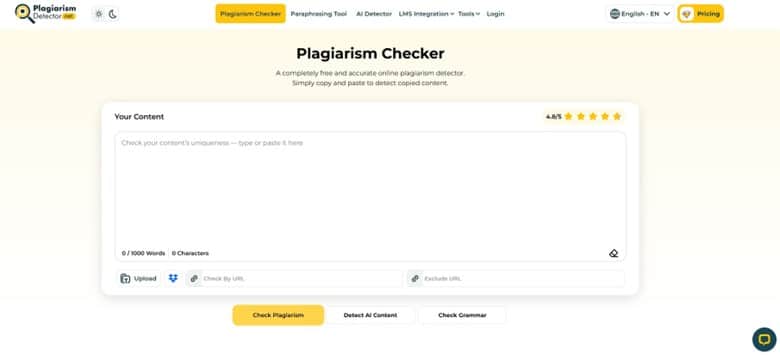
This plagiarism checker free is one of the most popular options among both writers and students.
The best part about this tool is that it doesn't require any registrations or logins. All you have to do is simply paste your text, hit check, and it will show the plagiarism detection report within seconds.
Thus, this quick and accessible design indeed makes it a perfect tool option for students and educators who need to verify content authenticity on the go.
Pros
No account needed
Fast, clean results
Easy file upload
Cons
1,000-word free limit
Benefits
Start checking instantly; it doesn’t require sign-ups.
Source links make proper citation straightforward.
Multi-format upload saves time with documents.
2. SmallSEOTools Plagiarism Checker
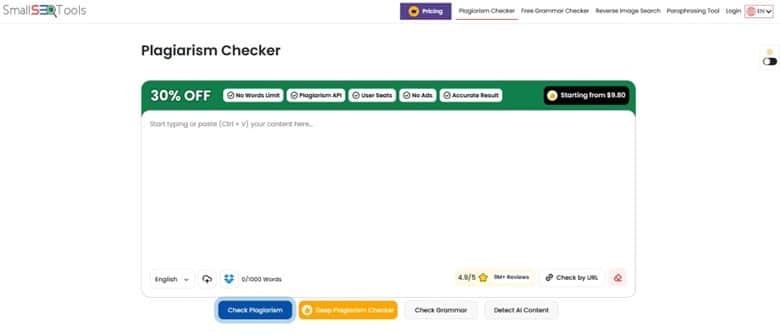
SmallSEOTools free plagiarism checker is another useful tool that writers and students can use to detect plagiarism easily.
What makes it a perfect choice for students is that the tool is free and still gives more accurate and reliable plagiarism check results than most paid tools do.
Therefore, you can surely rely on the tool to check the originality of your assignment without any fuss.
Pros
Free of cost
URL scan skips manual copy-paste
Clean, readable results dashboard
Cons
Free version includes ads.
Benefits
Uniqueness percentage delivers an instant originality verdict
URL scanning makes checking live content effortless
Multi-language support helps non-English writers
3. DupliChecker.com

DupliChecker is an advanced, trusted plagiarism checker online. The tool is widely known for its no-fuss plagiarism checks.
The interface is simple, the results are clear, and the free tier comfortably covers most everyday checking needs without requiring an upgrade.
Pros
A grammar tool is included free.
Reports are easy to download and share
Clean, simple interface
Cons
Lower free word limit
Benefits
Downloadable reports make sharing originality proof simple
Grammar checker reduces the need for extra tools
Batch upload saves time when reviewing multiple files
4. PlagiarismChecker.ai
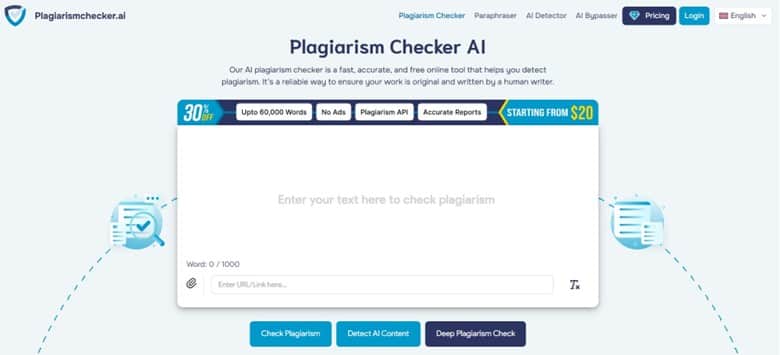
This AI-powered plagiarism detector stands out as a top-notch tool for detecting traces of plagiarism, even when the content has been rephrased multiple times.
Once you enter any text on the tool, it doesn't just scan the open web; instead, the tool will take your content through billions of scholarly journals, research databases, and academic repositories to find any potential matches.
Pros
Catches paraphrased plagiarism, not just direct copying
AI detection covers AI-generated content
Handles long-form documents without splitting
Cons
Advanced features can only be accessed in the premium version.
Benefits
Academic database access is essential for research and thesis work
Paraphrase detection catches subtle plagiarism that others miss
AI detection keeps your workflow relevant as AI writing grows
5. Plagiarismly
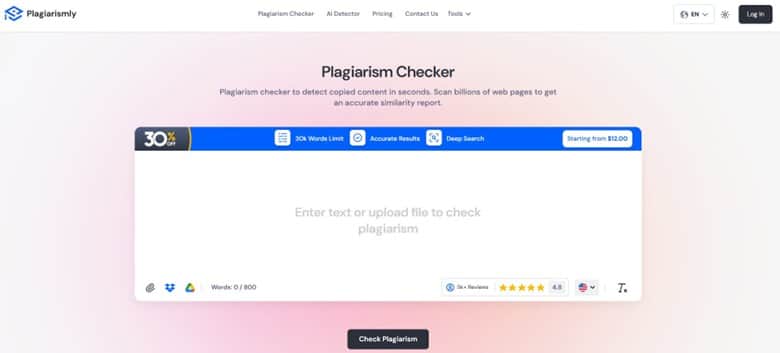
Plagiarismly is an advanced plagiarism checker that not only helps you detect exact duplication, but also allows you to catch the closely paraphrased content.
Pros
Faster scan speeds than most competitors
Minimal UI, easy to use immediately
Great fit for bloggers and content marketers
Cons
Free tier word count is limited
Benefits
Speed makes it practical for high-volume content work
Web-focused scanning suits SEO and online publishing
Provides results in seconds
6. Check-Plagiarism.com
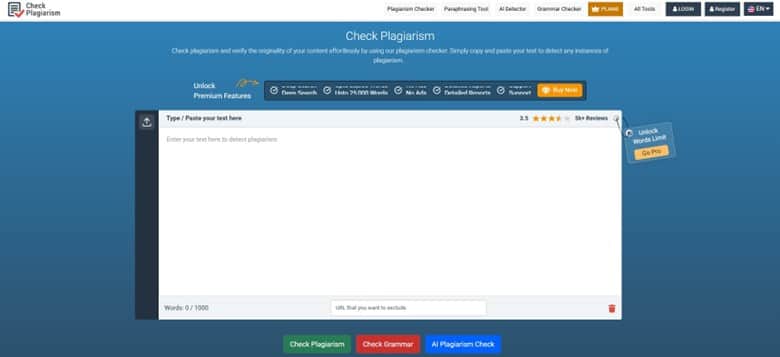
Check-Plagiarism is a free online plagiarism checker that aligns perfectly with the work needs of both students and writers.
The tool is widely known for its intuitive interface.
Once you enter any content on the tool, it instantly scans it, compares it with other sources online, and highlights the possibly duplicated parts in the text.
The tool displays the plagiarism check results in a color-coded format, thus allowing you to instantly spot the problematic areas.
Pros
Color-coded results easy to read
Paraphrasing tool fixes issues without switching tabs
Works well for students and teachers
Cons
Ads may disrupt user experience in the free version.
Benefits
Color-coded display makes problem areas instantly visible
Rewrite and recheck in one place with the built-in paraphraser
Daily free allowance keeps it budget-friendly for students
Conclusion
To conclude this, as a writer, you have to understand that plagiarism is a serious issue. No matter if you are a student, teacher, or content creator, you have to pay attention to maintaining your content's originality if you want to earn a good reputation.
But plagiarism detection doesn’t necessarily have to be complicated. The tools and tips covered in this article exist for one reason: to make sure your work stays original and credible.
So, pick a tool that matches your actual needs. Wondering how? For instance, if you want to check academic work, go for something with a journal database access. Similarly, if you are targeting casual content, then a free web-based plagiarism checker does the job just fine.

