Beyond the Chatbox: Professionalizing AI Workflows with Lumra
The initial excitement of interacting with Large Language Models is evolving into a more complex challenge: integration. For developers and indie hackers, the primary hurdle is no longer just getting an answer from an AI, but managing the "how" and "where" of those interactions without destroying productivity.
We have moved past the era of simple queries. We are now in the era of AI-driven systems. Yet, most developers still manage their prompts in fragmented notes, browser tabs, or ephemeral chat histories. This lack of structure leads to context loss, inconsistent outputs, and a significant amount of wasted time. This is why Lumra was developed.
The Core Philosophy: Prompting as Infrastructure
The fundamental philosophy behind Lumra is that prompts should not be treated as temporary messages. Instead, they should be viewed as a critical layer of your software infrastructure. Just as we use version control for code and structured databases for information, we must use a professional management system for our AI interactions.
By treating a prompt as a modular, reusable asset, Lumra allows you to build a reliable bridge between human intent and machine execution. This transition from "chatting" to "architecting" is what separates a hobbyist from a professional AI power user.
Flow State Engineering: The VS Code Integration
Context switching is the enemy of deep work. Every time a developer leaves their IDE to refine a prompt in a browser, they pay a high cognitive price. Lumra solves this through a dedicated VS Code extension that brings your entire AI agent library directly into your development environment.
The ability to manage AI agents, access saved prompt templates, and execute complex workflows without breaking your flow state is a game-changer. It ensures that the AI remains a seamless extension of your thoughts rather than a distracting external tool. You can design, test, and deploy prompts within the same space where your code lives, maintaining a unified mental model of your project.
Efficiency Through Modular Prompt Chaining
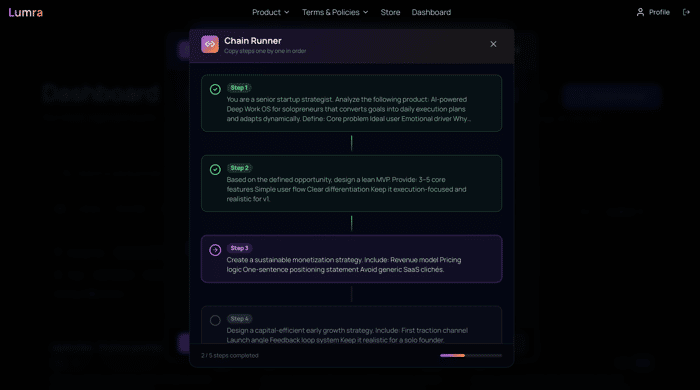
One of the most significant limitations in AI usage is attempting to force a model to handle a massive, multi-step task in a single prompt. This often leads to "hallucinations" or diluted quality. Lumra introduces a professional approach through Prompt Chaining.
By breaking down complex objectives into a sequence of smaller, highly focused prompts, you can:
- Maximize the efficiency of token limits by only providing necessary context for each step.
- Achieve higher precision by validating the output of one step before proceeding to the next.
- Create repeatable pipelines that deliver consistent, long-term results across different projects.
This modularity allows for the creation of sophisticated AI systems that are far more effective than any single "mega-prompt" could ever be.
Systemizing the Web: Chrome Extension and OpenClaw
For web-based AI interactions, such as using OpenClaw, the Lumra Chrome extension acts as a bridge to professional organization. Instead of allowing valuable insights and perfectly crafted prompts to disappear into a scrolling chat history, the extension allows you to capture and systemize these interactions.
This enables you to build high-quality, long-lived AI systems where every interaction is documented, organized, and ready to be reused. It transforms the ephemeral nature of web AI into a structured database of intelligence that grows alongside your business.
Building a Future-Proof Workflow
As AI models continue to evolve, the value of the underlying prompt engineering and organizational logic only increases. Lumra provides the framework to capture this value today.
Whether you are automating routine coding tasks, designing complex logic chains, or managing a fleet of AI agents, the goal remains the same: higher quality results with less wasted effort.
Join the community of developers who are moving beyond the chatbox.
Explore the possibilities and start building your system at Lumra.

Moving from a chatbox to a repeatable workflow is where these tools either become useful or get ignored. Building in this space, the biggest shift came when we added saved prompts plus approval steps, teams went from one-off testing to 20+ runs a week. Curious what Lumra does around versioning and handoff, that part has been the hardest to get right.
Totally agree — that shift from one-off usage to repeatable workflows is where the real value kicks in.
On our side, we’ve focused first on solid prompt-level versioning since that’s the foundation teams rely on day-to-day.
For chains, versioning + handoff is still something we’re actively building — currently in beta, with more advanced snapshotting and collaboration features coming soon.
This is genuinely smart positioning—you've identified the real problem (prompts aren't treated as infrastructure) and you've articulated it better than anyone else in the space. That's rare.
But here's what you're missing: You've sold developers on why they need prompt infrastructure. You haven't sold them on why they need Lumra.
Look at what you wrote: "Prompts should be treated as critical infrastructure." "Context switching kills deep work." "Prompt chaining beats mega-prompts."
All of that is true. All of it is compelling. And all of it could apply to five different tools—or to building it yourself.
You've educated your audience beautifully. But you've given them zero specific reasons to choose your tool instead of doing it differently.
Here's the uncomfortable part: A senior developer reading this thinks "yes, exactly, I need to systematize my prompts." Then they think "I could integrate this into my workflow" or "this sounds like it could be built on top of Claude API" or "I wonder if there's already a tool for this."
You've created awareness of the problem. But you haven't created urgency about the solution.
The ones moving fast in the dev tools space aren't explaining the problem. They're showing the specific transformation: "Here's what it looked like before (chaos). Here's what it looks like after (organized). Here's exactly how much time it saved (2 hours/week per developer)."
You have that story somewhere. But you didn't put it in your post. You put philosophy instead.
Most developers won't come back looking for the transformation story. They'll just keep doing what they're doing and assume they'll build it themselves eventually.
That gap between "I've convinced you that you need this" and "I've convinced you that you need this tool" is where most dev tools lose their conversions.
The positioning is excellent. The problem is you're too close to it to see that you're selling the category, not the product.
This is a really sharp take — and honestly, you’re right.
I focused heavily on articulating the problem space clearly, but didn’t bridge it strongly enough to “why Lumra specifically.” That gap between category awareness and product urgency is real.
The tricky part is that Lumra is trying to define that category (prompt infra as a first-class layer), so the line between “educating” and “selling” gets blurry. But that’s not an excuse — the transformation story should’ve been in the post.
The before/after, the time saved, the “you could build this, but here’s why you won’t want to” — that’s the missing piece.
Appreciate you calling it out this directly. That’s exactly the kind of feedback that helps refine not just the messaging, but the positioning itself.
I am glad it was helpful,that's what we are expert in at Quratulain Creatives
Solid framing. The "prompts as infrastructure" angle is exactly right — once you're chaining multiple steps, each with its own context window, token costs start compounding fast and you need actual systems thinking around it.
One thing I'd add: visibility into token consumption per step is huge. When I was building my macOS menu bar app (TokenBar) to track AI spend in real time, I realized most devs have zero idea how much each link in their prompt chain actually costs. You optimize what you measure.
The VS Code integration is smart. Keeping devs in their IDE is underrated — every context switch kills momentum. Curious how you handle prompt versioning when a model update changes output quality. Do you snapshot outputs alongside prompt versions?
That’s a great point — token visibility per step is massively underrated. Once you start chaining prompts, costs stop being intuitive really quickly.
We’re not tying outputs directly to prompts either, but output scoring and logging are already part of what we’re building. Treating them as a separate layer gives more flexibility, especially as models evolve.
That said, using those scored outputs as a consideration signal for versioning/regression is exactly where this gets powerful — you start tracking quality trends instead of relying on fixed snapshots.
The prompt-as-infrastructure framing really resonates. We're building an AI-powered ad creative tool and one of the hardest engineering challenges has been exactly this — managing prompt chains that stay consistent across different content types, platforms, and brand voices. When you're generating ad creatives for 13 different platforms from a single URL, the prompts aren't just throwaway queries, they're the core logic of the product. The chaining approach you describe is something we landed on too — breaking the generation pipeline into focused steps (scrape, analyze brand, generate copy, match to template) rather than trying to do everything in one massive prompt. Each step validates before the next one runs, which dramatically reduced hallucination issues. How are you thinking about versioning for prompt chains? That's the piece we're still figuring out — when you update one link in the chain, how do you regression test the whole pipeline?
Exactly — at that point prompts are your business logic.
We’ve seen the same: chained, validated steps beat one big prompt every time, especially for debugging and consistency.
We’re in a similar place: prompt-level versioning is solid, but chain-level versioning is still in beta. Rolling out more advanced features there soon.
Strong direction. Treating prompts as infrastructure instead of throwaway inputs is the shift most people haven’t made yet.
The chaining + modular approach makes sense, but the real test will be how easy it is to maintain and reuse across projects without becoming another layer of complexity. If you can make that feel lightweight instead of “more to manage,” this becomes genuinely powerful.