Bootstrapping a Local-First Bio-Robotics Engine to Bypass Regional API Blocks
The global lab automation market is projected to hit $8.62 billion by 2031, but the primary bottleneck is still system integration—proprietary hardware and biological software silos that do not talk to each other.
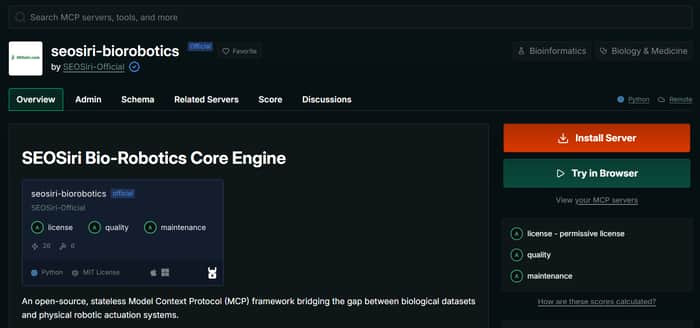
To solve this, I recently open-sourced seosiri-biorobotics (v1.0.0), a stateless, 6-tool Model Context Protocol (MCP) server that translates biological data and EMG biosignals directly into standard G-code for robots and prosthetics.
Stack: Python, SQLite, MCP, Docker, Git.
One major challenge we faced during development was regional network latency and API handshaking timeouts. If an AI agent relies on continuous cloud handshakes to control a physical robot, even a 1-second drop in connection causes a complete failure.
To overcome this, we designed the entire engine to be completely "local-first":
-
Offline Caching: We implemented a serverless, local SQLite database to cache live UniProt REST API responses. On subsequent queries, biological data is retrieved instantly under 1ms, preserving offline operational autonomy.
-
Local AI Connection: It runs locally using standard python runtimes, meaning you can drive the robot's physical calculations using local offline models (like Ollama) with zero internet access.
We successfully verified the entire 6-tool suite on GitHub Actions, achieved a green container build on Glamaai, and published the stable v1.0.0 release.
I'd love to connect with other bootstrappers, hardware hackers, and open-source developers. Let me know your thoughts on our decoupled architecture!
Read the full development story, system specs, and access the repository:
👉 https://www.seosiri.com/2026/07/seosiri-bio-robotics-core-engine.html
