Build Smarter Agents with Structured Thinking
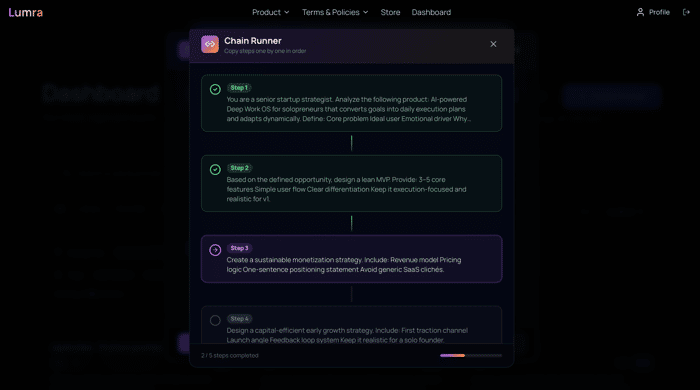
Most prompts fail for one simple reason:
They try to do too much in one unstructured block.
If you've ever asked an AI to:
- analyze something
- generate strategy
- design execution
- optimize messaging
—all in a single prompt…
You’ve probably seen inconsistent results.
That’s exactly why I built Chain Planner inside Lumra.
🧠 What Is Chain Planner?
Chain Planner lets you design structured, step-by-step command flows for agents.
Instead of writing one overloaded prompt, you can:
- Break complex work into logical steps
- Control execution order
- Force context continuity
- Copy the entire chain as one advanced structured prompt
- Or execute step-by-step with precision
It transforms prompting from guesswork into system design.
Why This Changes Everything
AI performs best when thinking in stages.
Strategy → Structure → Validation → Execution → Optimization.
Chain Planner makes that process explicit.
You’re no longer “hoping” the model organizes itself.
You’re architecting the reasoning path.
The result:
- More consistent outputs
- Higher signal responses
- Fewer hallucinations
- Cleaner execution plans
- Stronger strategic depth
Built for Builders
Chain Planner isn’t just a UI feature.
It’s a thinking framework for:
- Indie hackers building MVPs
- Founders validating ideas
- Marketers creating launch systems
- Developers designing agent workflows
- Researchers structuring analysis
You can design multi-step workflows once, reuse them, refine them, and scale them.
Beyond Chain Planner
Lumra is not just a prompt storage tool.
It’s a professional prompt management platform designed for serious builders.
Core capabilities include:
- Structured prompt organization
- Version control for prompts
- Reusable high-performance templates
- Advanced formatting tools
- Clear separation between system logic and task logic
- High-signal execution design
It treats prompts like code.
Because that’s what they are.
From Prompting to Systems Thinking
The biggest shift in AI right now isn’t better models.
It’s better structure.
The people who win aren’t the ones writing longer prompts.
They’re the ones designing better reasoning flows.
Chain Planner inside Lumra is built for that shift.
If you’re building with AI seriously,
you don’t need more prompts.
You need better systems.

Local Python scripts have a structural advantage in the current market: they're immune to the SaaS subscription backlash. No recurring costs, no vendor risk, no data concerns.
The positioning challenge is that 'script' sounds less polished than 'platform.' Worth double down on the positioning: 'the tool you own, not the subscription you rent.'
Local Python scripts have a structural advantage in the current market: they're immune to the SaaS subscription backlash. No recurring costs, no vendor risk, no data concerns.
The positioning challenge is that 'script' sounds less polished than 'platform.' Worth double down on the positioning: 'the tool you own, not the subscription you rent.'
The hardest thing about B2B is that you're often selling to someone who didn't budget for your category. They need the result you provide but never planned to pay for it.
The products that win here usually create a new budget line (by being categorically new) or steal from existing budget by making the ROI comparison obvious. Which of those are you trying to do?
The hardest thing about B2B is that you're often selling to someone who didn't budget for your category. They need the result you provide but never planned to pay for it.
The products that win here usually create a new budget line (by being categorically new) or steal from existing budget by making the ROI comparison obvious. Which of those are you trying to do?
The 'execute step-by-step with precision' concept maps directly to business automation workflows.
I built a payment recovery sequence — Day 1, Day 3, Day 7 emails after a failed Stripe charge. On the surface it's three steps. In practice, the hard problem was the branching: stop the sequence immediately when payment succeeds, escalate urgency on each step, handle the edge case where a customer cancels during the recovery window.
The structured thinking you describe is exactly why that chain is hard to build ad-hoc. A single 'recover failed payments' prompt gives you generic advice. Breaking it into: detect failure → determine failure reason → pick first email tone → check payment status before each step → stop on success → escalate on non-response… that's where the consistency comes from.
The 'copy the entire chain as one advanced structured prompt' feature sounds like it solves a real pain — once you've designed a good chain, you want to reproduce it without rebuilding from scratch each time. Are you storing chain outputs and reusing them across runs, or is each execution independent?
Structured thinking is exactly the right frame — agents that reason step by step before acting are dramatically more reliable than ones that jump straight to tool use.
The implementation detail that matters most: the chain-of-thought instruction needs to be explicit in the system prompt, not hoped for. "Before taking any action, reason through the problem and state your plan" as a dedicated block changes agent behavior immediately.
I built flompt.dev to make this visual — chain-of-thought, constraints, role, and output format as separate semantic blocks you edit independently and compile to Claude XML. The agent coherence difference is night and day.
A ⭐ on github.com/Nyrok/flompt would mean a lot — solo open-source founder here 🙏