Building a Dream Team: How Fora Soft Selects Top Developers for Your Project
A properly assembled team is half the success of a product. It’s important to us that only professionals work on your project. That’s why every developer at Fora Soft undergoes thorough a multi-stage training before joining your project. We make sure to assess the technical abilities of our employees as well as their skills for teamwork, meeting deadlines, and handling feedback correctly. Thanks to this selection process, we have managed to build a strong team.
In this article, we will explain how we select developers.
Fora’s CEO, Nikolay, says: “If you don’t love what you do, you’ll have to compete with those who do, and that’s a losing game.” Therefore, passion for the work is a key criterion for personnel selection at Fora Soft. We take this seriously and assess not only knowledge and skills but also alignment with our values: constant learning and development, being proactive, being a team player, and doing an awesome job.
Now, let’s delve into the details of the selection process.
1. Interviews
To join us, each of our employees has gone through a multi-stage selection process.
- Resume submission.
- Call with an HR rep. We ask several technical questions to assess candidate’s proficiency in the basic knowledge of the craft.
- Technical interview. A department head or a senior specialist conducts it. At this stage, the questions are more in-depth, focusing on hard skills.
- Test assignment. Regardless of the results of the test assignment, we always provide detailed feedback, including the assessed criteria, rights and wrongs, and recommendations for skill improvement (literature, useful links).
- Final interview. If the candidate passes previous stages successfully, they meet our CEO. This is not just a formality—Nikolay personally approves those who will join our team.
Then we make an offer, agree on and wait for the first working day when we show the office, introduce ourselves, and introduce the new employee with a mentor.
So, interviewing process falls into following numbers:
- We conduct interviews with 500 candidates.
- Out of 500 candidates, 20% pass the phone interview—100 people.
- Out of 100 candidates, 40% proceed to the interview stage—40 people.
- Out of 40 candidates, 30% go through the technical and test interviews with a developer—12 people.
- Out of 12 candidates, 90% pass the final interview with the director—10 people.
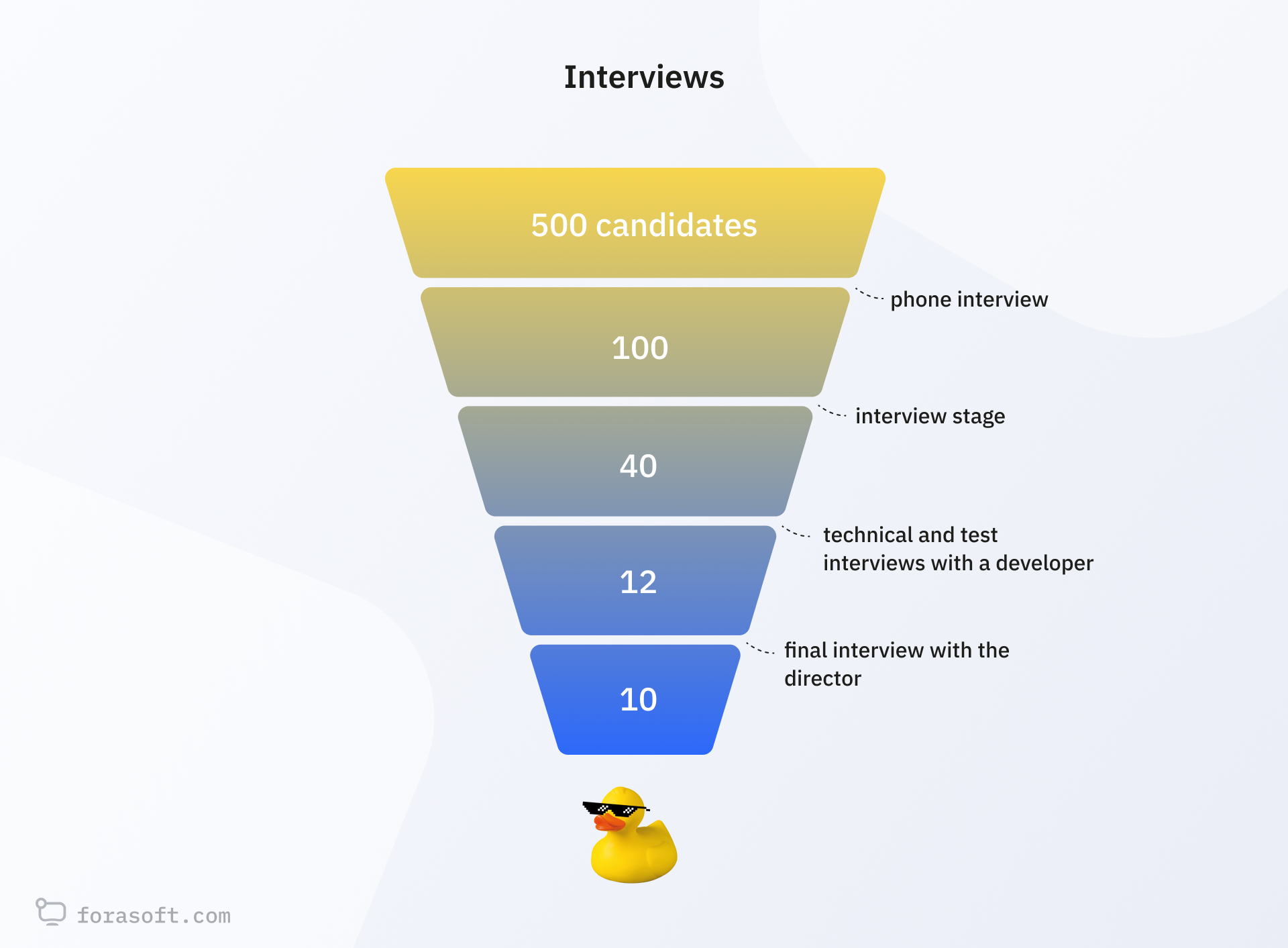
Out of 500 candidates, we send offers to 10—that’s 2%.
But the selection process doesn’t end there.
2. Probationary Period
No matter the developer’s starting level, at Fora Soft, the probationary period consists of 3 stages:
- Training
- Assessment and Development Plan
- Final Evaluation
We develop multimedia software (chats, video chats, augmented reality, video object recognition, etc.). There is a severe shortage of developers in this field. That’s why we grow our own talent and we are always ready to accommodate newcomers. The main thing is to love what you do.
So how do we do it? Now in detail.
First things first—Training
Our probationary period is designed in a way that developers don’t immediately join a project; they first go through a Trial by Fire. This is what we call a pet project, where newcomers gain skills for their future work, familiarize themselves with the media server, and create their first text and video chats. For a new developer, this is an opportunity to practice and learn the necessary technology in a “sandbox” environment. For us, it’s a chance to see how they handle new tasks and assess the effectiveness of our selection process. During the training, we evaluate three parameters: speed of execution, quality, and initiative.
On average, we allocate up to 80 hours for the pet project. If the newcomer doesn’t meet the deadline, we part ways. It’s important for us to work at the same pace and meet deadlines.
If a developer successfully completes the training, they are assigned to an ongoing project. There, we assess their teamwork skills.
During the probationary period, each newcomer is assigned a mentor so we can:
- Monitor 4 performance parameters: quality, speed, teamwork, and initiative.
- Familiarize them with the company’s internal processes.
- Verify that the newcomer understands and assimilates information correctly.
- Provide feedback on task completion and technical advice.
A mentor at Fora Soft is a more experienced employee, starting from Middle positions, who has been with the company for over six months and has gone through all these stages themselves. Therefore, mentors understand well what it’s like to be evaluated and to not know something. This helps to grow not only the newcomers but also the mentors themselves. Sometimes, in order to answer a mentee’s question, mentors have to google and learn something new themselves. In this way, they improve not only their hard skills but also their soft skills, which has a positive impact on teamwork.
Next—Evaluation and Development Plan
Evaluation takes place after one month of work on a project. It’s simply a meeting to assess skills, understand what knowledge the newcomer has absorbed well, and identify room for improvement. Based on what we learn and obtain, we come up with a one-year development plan, taking into account the technologies required for the specific project as the top priority. We also consider the newcomer’s desires to ensure that their learning experience doesn’t become monotonous as it was at school.
Wrapping up the probationary period
When we determine that the newcomer has adapted well, we finish the probationary period. Sometimes this happens before the standard 3 months. Before making the final decision, we ask the team to fill out an anonymous questionnaire and conduct a final interview. During the interview, we present the questionnaire results, recommendations, and comments from other employees. The newcomer then decides whether they want to continue working with their mentor according to the development plan or proceed independently. Often, newcomers choose to work with their mentor so they further provide useful materials, verify the assimilated knowledge, and conduct code reviews.
To sum up
At Fora Soft, we assign to your project only those who we have trust and are confident in, ensuring that you can be confident in the outcome. See it for yourself: get in touch with us to discuss your project and start working together. We will provide you with initial requirements, architecture, and a project cost estimate free of charge.
