Building a Multilingual Voice-First AI Assistant (40+ Languages, No App Required)
Most AI products assume users will type.
But typing is actually a huge barrier for a large part of the world.
If your first language uses a complex script (Arabic, Bengali, Hindi, Urdu, etc.), text interfaces introduce friction that native English speakers rarely notice. For many users, typing in a secondary language is cognitively exhausting compared to speaking.
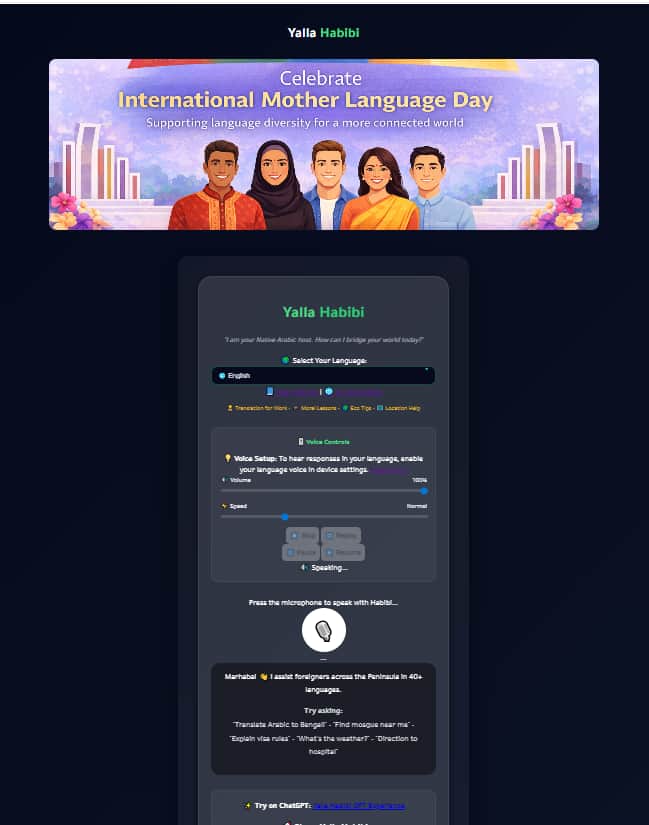
That observation led me to build Yalla Habibi, a multilingual voice-first AI assistant that works directly in the browser — no installation, no accounts, no subscriptions.
The core idea was simple:
Instead of “voice as a feature,” design the system assuming voice is the primary interface.
What the system does:
• Users speak naturally
• Language is detected automatically
• AI generates a response
• Response is spoken back using native voices (when available)
• Supports 40+ languages
All interactions happen inside the browser using the Web Speech API + a lightweight FastAPI backend + Gemini for inference.
Unexpected challenges:
The hardest problems weren’t AI-related.
They were device & browser inconsistencies.
Voice availability varies wildly:
• Same language works on one device, fails on another
• OS voice libraries differ
• Browser speech support differs
• Some languages have no voices installed at all
This forced me to design a multi-layer fallback strategy for voice matching, which ended up being more complex than the AI pipeline itself.
Design decisions that mattered most:
Zero installation — removing app friction dramatically improves first-time use
Automatic language detection — users hate selecting languages
Voice-first mental model — text is secondary
Hard latency targets — responses must feel conversational (<5s)
Privacy by design — no voice storage, ever
Current performance:
• Typical interaction: ~3–5 seconds
• Languages supported: 40+
• Voice match success: ~90%+ (device dependent)
Biggest takeaway so far:
Building multilingual voice systems is less about ML and more about handling messy real-world constraints:
Browsers, OS behavior, voice engines, latency, user expectations.
The AI part is ironically the most predictable component.
If anyone here has worked on speech interfaces, multilingual UX, or cross-device voice behavior, I’d genuinely love to exchange notes.
Full write-up of architecture & lessons:
https://www.seosiri.com/2026/02/yalla-habibi.html
