Building a Real-Time Temperature Monitoring System with Arduino UNO & MAX6675 Thermocouple
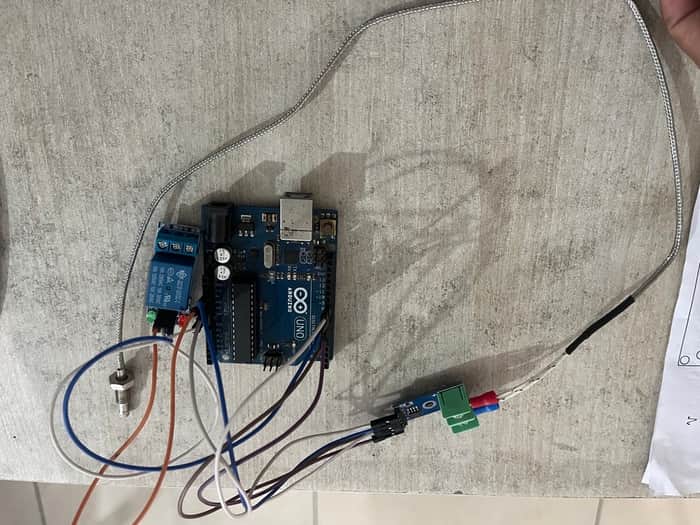
When I saw this temperature monitoring system which already exists, I wondered why I did not build a temperature monitoring system. I recently built a temperature monitoring system using Arduino UNO and the MAX6675 thermocouple module. This system can capture real time temperature monitoring.
This project can measure high temperature and boiling temperature , and heat detection systems. By combining the Arduino UNO with a K-Type thermocouple and the MAX6675 converter, the system can measure temperatures. This system is fast to monitor and easy to handle.
Key Features:
• Real-time temperature monitoring
• High-temperature sensing using K-Type thermocouple
• MAX6675 digital temperature conversion
• Arduino IDE compatible firmware
• Serial Monitor output for live readings
• Low-cost and easy-to-expand architecture
• Suitable for industrial automation and IoT integration
Components Used:
• Arduino UNO
• MAX6675 Thermocouple Module
• K-Type Thermocouple Sensor
• Jumper Wires
• USB Connection for Data Monitoring
Applications:
• Industrial temperature monitoring
• Furnace and heating system control
• Food processing equipment
• Laboratory testing setups
• DIY automation projects
• IoT-based environmental monitoring
If you're looking to build custom Arduino solutions, automation systems, or embedded products, you can also hire remote arduino developers
to accelerate development and bring your hardware ideas to market.This system is easy to manage and easy to set up at a fast working speed. This system is used in real world cases like industrial furnaces, food processing industry, metal & manufacturing plant, 3D printers and DIY machines, boiler and HVAC systems.

That’s a solid, reliable stack. There’s something deeply satisfying about seeing a MAX6675 return stable data after you’ve struggled with noise in other setups. It’s the kind of project that reminds you that you don't always need an over-engineered IoT platform to solve a real-world industrial problem.
At Mobiwolf, we often work on IoT projects that start exactly like this—as a simple, robust prototype—before scaling into complex connected systems. For anyone reading this who thinks they need an enterprise-grade sensor array to start: this is exactly how you prove the concept.
What was the biggest challenge you faced with the thermocouple noise levels? I’ve seen that specific module act up when there’s heavy electrical interference from furnace motors nearby.