Building a Shopify bundles app for stores with real fulfillment: here's the wedge
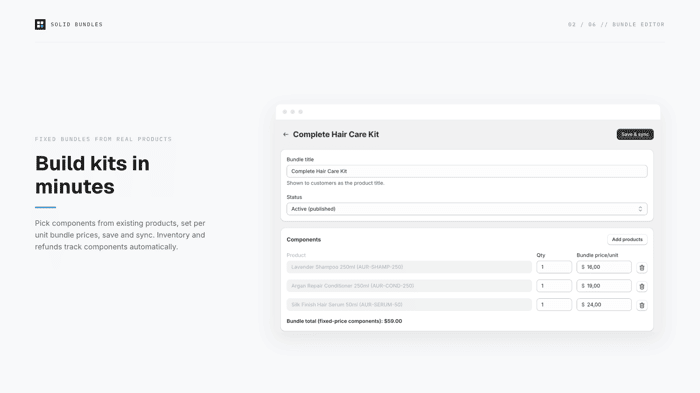
Every big bundle app is a conversion widget: great product page, then the order says "Bundle" and your 3PL has no idea what to pick. The one app that fixes it does so by editing orders after creation, and that races the 3PL's order import.
I'm building Solid Bundles on Shopify's Cart Transform API instead: components with real SKUs land in the order at checkout time, by construction. The cleanest frame I've found while building this: bundle setups are either analytics-clean (the bundle is its own product, tidy reporting, sync jobs forever) or ops-clean (the order carries real components, warehouses just work). Almost every app picks analytics. I picked ops.
Then the category made my argument for me. Two of the big bundle apps vanished from the App Store within two weeks of each other: one after a security incident that got it deactivated on thousands of stores overnight, the other with no explanation at all. Every migration thread asks the same two questions: what did the app leave behind in my orders and inventory, and how do I make sure the next one fails safe. Nobody asks about the product page widget.
This week a Shopify theme dev who has installed bundle apps across hundreds of client stores gave me his support-side ranking of what actually breaks after install: price display first (discount shows at cart, product page shows list price, merchants file "app is broken" tickets by day two), custom AJAX cart drawers second, discount stacking rules third, bundle-parent inventory confusion fourth. I spent a day checking my codebase against all four. Two were already safe by architecture (the parent product carries the real bundle price; stacking rules are explicit, not accidental), one was half-built and just got promoted to next ship (savings note on the product page), and one became my beta test matrix (Impulse, Prestige and Flex cart drawers).
Flat $29/mo, no revenue caps. The category's usage-based pricing is its most-hated feature: the current top 1-star review on the market leader calls it "a tax based on how much we sell."
Status update while drafting this: the approval email arrived this morning. Solid Bundles is now listed on the App Store, nine days after submission. About 20 build hours and $19 spent, $0 MRR, and the 60-day kill threshold starts ticking when I flip the listing to full visibility this week. This week I also shipped migration guides for stores hit by the delistings, and a feature that adopts an orphaned bundle product in place so a migrating merchant keeps their product URLs and SEO. Looking for beta merchants with 3PL or warehouse setups: free lifetime plan, personal onboarding, your feedback steers the roadmap. Comment or DM if that's your stack.

Your buyer and your victim are different people: the merchant installs the app, but the 3PL eats the mis-picks. I would go straight at the 3PLs as a channel, since one warehouse touches hundreds of merchants and has a direct financial reason to recommend an ops-clean bundle. On pricing, flat $29 is the right wedge for landing migrations, but add a higher tier tied to SKU count or order volume rather than revenue before your best accounts learn you are just the cheap option.
both points landed. 3PLs as a channel: agreed, and it's the plan once a few merchants run through one 3PL cleanly. a warehouse that stops getting "what's in this bundle" tickets has a reason to recommend the app. on tiered pricing, i hear the cheap-option risk, but this segment's most hated thing is exactly the meter. i'd rather be the price that never changes than the cheaper-looking one, and the value anchor is the comparison at volume, not the sticker. on the 60-day window favoring widgets: the bet is that migration-driven and problem-driven searchers convert fine to ops products, the widget crowd was never my funnel. the theme dev channel is already in motion.
this is a genuinely good wedge because its invisible in a demo but brutal in ops, which is exactly the kind incumbents cant easily copy without rearchitecting (theyre locked into the edit-order-after-creation approach). the strategic read: youve picked the ops-clean buyer (stores with real fulfillment/3PL) over the conversion-widget masses, and thats the right trade, its a smaller but higher-value, stickier segment that churns less because switching means re-solving the fulfillment mess. two thoughts: 1) lead your marketing with the PAIN, not the feature. "bundles" is a crowded word, but "your 3PL picks the wrong items on every bundle order" is a scream of recognition to anyone whos been burned. name the exact failure. 2) your hardest sale is the store that hasnt felt the pain yet, so dont waste time on them, target merchants already doing bundles at volume with a real 3PL, theyve lived it. the Cart Transform / real-SKUs-at-checkout approach is a legit technical moat, just make sure the buyer understands WHY it matters, because "components land in the order by construction" is correct but wont land emotionally the way the horror story does.
the demo-invisible, ops-brutal line is basically the thesis said better. pain-first listing copy test is happening.
Your wedge may be stronger than “ops-clean bundles.”
The real switching trigger seems to be fear of operational breakage during a migration, delisting or app failure.
I’d test two messages separately:
The first explains what the product does. The second creates urgency.
I’d look for repeated mentions of failed picks, orphaned products, inventory errors and emergency migrations in reviews and support threads. If those problems cluster around merchants using 3PLs, you probably have both the ICP and the buying trigger.
doing exactly this: two listing copy variants queued, pain-first vs mechanism-first. support threads already answered the clustering question, price display confusion clusters hardest, 3PL merchants file the angriest tickets.
Your buyer is ops, but App Store search gets browsed by marketing, so a 60-day kill threshold measured on listing traffic will read as failure even if the wedge is right. In the Microsoft partner world, every ops-heavy product I sold moved through the implementers first: the people who eat the support ticket when a picklist is wrong. That theme dev who gave you the ranking is a channel, not just a source, so I would ask him which five client stores he would rather not migrate by hand and go after those before the timer runs out.
the theme dev channel is already in motion, he's supplying the cart-drawer test matrix and his client base is the first beta pool. agree the 60 day window is the real fight, browse visibility does no work for an ops product.
The fulfillment-aware angle is a real wedge — most bundle apps die exactly where you're pointing, at the moment the bundle meets a 3PL's reality. One thing worth testing early: walk a completely cold person through installing and building their first bundle while you watch. App-store products live or die on the first 10 minutes, and founders are structurally blind to their own onboarding because they already know where everything is. The merchants who churn fastest rarely file a ticket first — they just uninstall quietly.
taking this one, first cold onboarding test goes on the beta checklist. 'structurally blind to their own onboarding' is uncomfortably accurate
Your fail-safe positioning seems to create a second requirement beyond the order architecture: operational communication.
If an app involved in fulfillment is degraded, temporarily unavailable, or undergoing a permissions change, merchants need to know:
whether existing orders remain pickable
which new orders may be affected
whether they need to take manual action
when the next update will be posted
The competing-app delistings probably made this trust layer more important than it would be for a normal storefront widget.
Have you decided how you’ll publish release notes, planned maintenance, and incident updates during the beta? Even a lightweight public update path could reinforce the “fails safe” positioning without adding monitoring or incident automation yet.
agreed, and it's cheap to do well at this size. release notes and a public status note per incident go on the operating checklist now.
That sounds like the right level for the beta.
A short release note and a public incident update are inexpensive, but they give merchants somewhere reliable to check before contacting support or guessing whether orders are affected.
It also makes “fails safe” visible as an operating practice, not just an architectural claim. Glad the suggestion was useful.
What stood out to me is that you chose the constraint before you chose the implementation.
Optimizing for the warehouse instead of the product page changes what the product is trying to be. The strongest positioning decisions often come from deciding whose workflow gets protected when trade-offs are unavoidable.
whose workflow gets protected" sums it up better than my whole post did. funny thing is how much that one choice decided for me. pricing followed from it (usage caps punish exactly these merchants in their best months, so flat), and the roadmap too. saying no to features got way easier once the question was just "does the order stay pickable
I appreciate you saying that.
I'd be interested in continuing the conversation by email if you're open to it. What's the best email to reach you on?
sure: solidbundles@crescano.com. what's on your mind?
Thanks! I’ve just sent it over.
Looking forward to hearing your thoughts whenever you have a chance.
Fantastic breakdown of the real pain points with Shopify bundle apps. The distinction between analytics-focused bundles vs fulfillment-native bundles is such an important detail most builders overlook.
It’s wild seeing multiple popular tools get delisted recently. I’m also building an edge-native SaaS platform on Cloudflare Workers and spending lots of time ironing out tricky frontend & checkout edge cases. I share my development challenges and learnings on my profile if anyone building indie products wants to follow along.
The distinction between analytics-clean and ops-clean is a really useful way to frame the bundle problem. If the real component SKUs are already present in the order at checkout, it removes a lot of complexity and reduces the risk of sync delays or 3PL import issues.
I also like that you used actual support pain points to prioritize the roadmap instead of just adding more product-page features. The migration support and orphaned bundle adoption feature seem especially valuable after those recent app removals. Curious to see which issue beta merchants care about most once they start using it.
Update for anyone following: the listing went fully live this weekend, apps.shopify.com/solidbundles. Flat $29, 14-day trial, and the first handful of stores still get the founding deal (free lifetime plan). The kill clock from the post is officially ticking: day 60 is October 1.
The analytics-clean vs. ops-clean framing is the sharpest part of this. Most category analyses stop at "here's what competitors do," but naming the actual tradeoff each side is optimizing for, and pointing out that nearly everyone picked the same side, is what makes "I picked ops" read as a real strategic bet instead of just a technical preference.
Building on Cart Transform API instead of post-creation order editing seems like the correct foundation this category should've had from the start , editing after the order already exists is exactly the kind of race condition that looks fine in a demo and then quietly breaks the moment a 3PL's import runs on its own schedule. Nice that two competitors' unexplained App Store disappearances ended up validating the wedge for you without you having to argue it yourself.
The support-side ranking from the theme dev is the most useful piece of intel here, and checking your own codebase against all four failure modes before shipping is exactly the discipline that "move fast" advice usually skips.
Question on the flat $29/mo pricing: for a merchant with genuinely high bundle volume, is there a point where usage-based pricing would actually be cheaper for them than your flat fee, and if so, are you comfortable losing that segment to a competitor, or is the bet that predictability wins out even when the math doesn't?
other way around at volume, i did the math on published tiers: at $10k/mo bundle revenue the metered apps bill $59 to $149, at $25k up to $249, flat stays $29. where metered genuinely wins is under about $1k/mo, and if a store does a few hundred in bundles and expects it to stay there, a metered app is the rational pick, i say that on my own pricing page. full computation with each app's published tiers: crescano.com/solid-bundles/pricing-comparison.html
loved your post. will be back to read more
The "60-day kill threshold" line is something I should probably borrow. I'm at 104 days on Debnix with no defined exit condition, just pure stubbornness, and reading this makes me think an explicit number might be healthier than vibes. Also relate hard to the security-incident timing you mentioned, I just spent this week finding and fixing a real privilege escalation bug in my own database, so "what did the app leave behind, how do I fail safe" hits different right now. Good luck with the beta merchants, the ops-clean vs analytics-clean framing is a sharp way to think about it.
Nice wedge !
I like the distinction between "analytics-clean" and "ops-clean." That's a useful framework for evaluating bundle implementations. In many cases, operational simplicity ends up creating a better customer experience than perfect reporting. Curious whether you found any significant trade-offs after choosing the ops-first approach.
three so far. 1) reporting: bundle revenue rollups don't come free. the order carries components, so "how did the summer kit do" needs the bundle identifier we stamp on every line, not a native dashboard. 2) checkout price display: cart transform is not a discount, so checkout shows the bundle price as a plain price, no strikethrough savings there. we show savings on the product page instead. 3) segment: no build-your-own-box. pick-any-N with dynamic pricing fights the real-SKU model, so we said no. all three are the same trade seen from different angles: the order stays boring and pickable, the marketing layer gets less magic.
Really appreciate the breakdown on analytics-clean vs ops-clean. The part about those two apps vanishing hit home—everyone worries about the product page widget, but the real pain is what gets left behind in orders and inventory. That's why I've been skeptical of apps that edit orders post-checkout.
The theme dev's ranking is spot on. I've seen price display inconsistencies kill trust faster than any bug—discount only visible in cart, tickets by day two. AJAX cart drawers are still a headache across themes. I'm curious: how did you handle the savings note on the product page without breaking the price display?
The flat $29/mo is refreshing. For the 60-day threshold, what's the one metric you'll watch to decide if it's worth continuing?
savings note: the parent product's variant price IS the bundle price (sum of the component prices the merchant set), so the product page number is correct before any app code runs. the note itself is a theme block reading a metafield our sync writes (components, catalog prices, computed savings). nothing overrides shopify's own price rendering, so nothing can disagree with cart or checkout. day-60 metric: paying customers, the kill rule is zero paying at day 60. weekly leading indicators: installs, trial starts, first-bundle-created rate.
Sharp insight. Picking ops over analytics is the right call—warehouses don’t read reports, they read pick lists. 😅
Love the discipline: $29 flat, 9-day approval, and actually stress-testing against real theme edge cases (Impulse/Prestige/Flex are brutal). Also, turning those sudden delistings into a migration wedge is chef’s kiss.
Happy to see someone finally treating bundles as fulfillment primitives instead of just conversion widgets. Watching closely—rooting for Solid Bundles. 🚀
thank you <3
The fail safe angle is smart because the delisting story did half your positioning for you. "What did the app leave behind in my orders" is such a visceral question, and you answered it with architecture instead of docs. Curious on one thing. When you picked Cart Transform API as the constraint, did that change how you had to think about pricing early? Feels like flat 29 is the only honest pricing if you are optimizing for pickable orders, because usage based punishes merchants in their best month
"the only honest pricing" is a keeper. the mechanics agree with you: our costs don't scale with merchant volume, so caps would be pure rent.
This is a much better angle than treating bundles as just a discount feature. Fulfillment and inventory syncing are probably where merchants feel the real pain. Curious how you’re handling bundles when one item goes out of stock
components are real variants, so stock-out behavior is shopify's own: a component set to deny overselling hits zero, the bundle stops being checkoutable, same as the standalone product would. no phantom bundle stock to reconcile. merchants who want to keep selling flip that component to continue selling, per variant. the thing i refuse to build is a separate "bundle inventory" number, because a number that drifts from component reality is exactly how you oversell.
Thank you for a fascinating article
The delisting angle is the sharpest part of this for me. It's not just "what did the old app leave behind," it's the orders that were mid-checkout the moment it got pulled, some created with real component SKUs, some still carrying a bare "Bundle" line item from a half-finished cutover. Any merchant migrating between bundle apps needs a way to tell those two order shapes apart after the fact, or the warehouse ends up guessing again exactly where you started.
this is the failure mode nobody talks about, the half-finished cutover window creates two order shapes in the same day and the picklist looks identical for both. today the honest answer is manual: export orders from the cutover window and read the SKU column, anything carrying the bundle's own SKU instead of component SKUs needs hand-expanding before it reaches the warehouse queue. i'd like to build exactly what you describe (scan a date range, flag orders that won't pick) but my app currently runs with zero order data access on purpose, faster review and smaller surface, so that tool sits behind a permissions upgrade. filing it, this is genuinely useful.
that zero-order-access default is the right call, most bundle apps ask for way more scope than they use. But the reconciliation scan doesn't need full order access, just read-only SKU plus created_at for a date range. That's a much narrower ask than general order scope, might be worth an opt-in add-on rather than a full permissions upgrade.
that's a fair middle path. the wrinkle is shopify's permission model: order access is one coarse read_orders scope, no field-level grants, so even a narrow scan tool technically receives everything and the trust cost lands the same. the shape i'm leaning toward: keep the main app zero-order-access forever, ship the cutover audit as a separate opt-in tool with its own consent moment. filed it, thanks for pushing on it.
makes sense, a separate consent moment for the audit tool is the right tradeoff, don't let the exception eat the default. good luck with the launch, following along.