Building a Smart Golf Ball with Sensors, BLE and Real-Time Analytics
Title
Building a Smart Golf Ball with Sensors, BLE and Real-Time Analytics
A few months ago, a client approached us with a pretty unusual embedded systems challenge.
They wanted us to build a smart golf ball that could track movement, spin, impact force, and directional data in real time — all while keeping the electronics compact enough to fit inside a standard golf ball without affecting its performance.
At first, the idea sounded straightforward.
But once we got deeper into the project, the real complexity started to show. Fitting sensors, power management, firmware, and wireless communication into such a tiny space — while still maintaining accuracy and stability — turned out to be one of the toughest IoT engineering challenges we’ve worked on so far.
What made the project even more interesting was balancing hardware limitations with real-world usability. Every millimeter of space mattered, every power optimization counted, and even small wireless delays could impact the quality of the tracking data.
In the end, this project pushed both our embedded hardware design and firmware optimization skills to another level.
What We Built
We developed a prototype smart golf ball system that combines:
motion sensors
BLE communication
embedded firmware
mobile connectivity
cloud analytics
The idea was to capture swing and movement-related data directly from the golf ball and transmit it wirelessly for analysis.
Here’s the full project breakdown:
https://digitalmonk.biz/smart-golf-ball/
Why We Built It
The idea behind this project was actually pretty interesting.
The client wanted to explore whether real-time sports analytics could be made more accessible using compact embedded hardware instead of relying on large external tracking systems.
Most existing sports tracking solutions depend on external cameras, wearables, or bulky equipment placed around the playing area. But this project explored a completely different approach:
What if the tracking system could exist inside the object itself?
That single idea opened the door to several complex engineering challenges. Since everything had to fit inside a golf ball-sized enclosure, even the smallest hardware decisions became critical.
Some of the biggest challenges included:
extremely limited internal space
maintaining sensor accuracy during high-speed motion
keeping BLE communication stable in real time
optimizing battery life within tight power constraints
protecting the electronics from repeated high-impact shocks
What looked simple on paper quickly became a deep embedded system and hardware optimization project.
How It Works
The prototype uses onboard motion sensors combined with custom embedded firmware to capture movement-related data during use.
As the ball moves, the system continuously collects telemetry such as motion behavior, direction, and impact-related data. That information is then transmitted over BLE to a mobile application, where it can be processed and visualized in real time.
To make the complete ecosystem work smoothly, the project involved multiple layers of development, including:
custom embedded firmware development
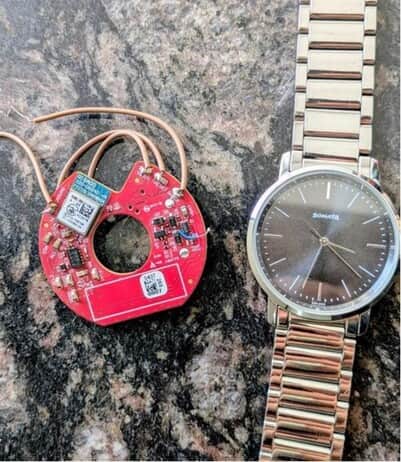
compact PCB design and hardware integration
BLE communication stack implementation
mobile application integration
cloud synchronization for analytics and data processing
One of the biggest goals during development was ensuring that the hardware remained lightweight and responsive without compromising tracking performance or wireless
Biggest Challenges
The hardest part wasn’t writing firmware.
It was fitting everything into an extremely small from factor while keeping the system reliable.
Some issues we faced during development:
- PCB Size Constraints
Designing a compact multilayer PCB while maintaining signal integrity was difficult.
- BLE Stability
Maintaining stable communication during fast movement and impact required multiple firmware optimizations.
- Sensor Calibration
Small variations in sensor positioning affected motion accuracy more than expected.
- Battery Limitations
Power optimization became critical because of the limited physical space available for the battery.
- Shock Resistance
The internal electronics had to survive repeated impact conditions.
Tech Stack
Hardware & Embedded:
NRF-based wireless chipset
BLE communication
IMU/motion sensors
custom PCB design
embedded C/C++ firmware
Software & Cloud:
mobile application integration
cloud analytics
real-time data processing
Current Status
Right now the project is still in the prototype and testing phase.
We’re mainly validating:
tracking consistency
battery performance
real-world usability
sensor accuracy during repeated testing
Since this was a custom client-focused embedded project, there aren’t public user/download numbers yet, but internally the prototype testing has been promising so far.
Future Plans
Some future improvements we’re exploring:
better motion prediction algorithms
improved battery efficiency
more compact hardware revisions
enhanced mobile analytics
expanded sports tracking use cases
We’re also interested in exploring whether products like this have a real consumer market beyond professional sports training.
I mainly work on embedded systems, IoT product and custom hardware development as a hire embedded software engineer.
https://digitalmonk.biz/hire-embedded-developer/
Would love feedback from other makers or founder building hardware-focused products.

Impressive work, Himanshu! Integrating a BLE stack and IMUs into something as small as a golf ball is a massive engineering feat—especially with the impact/shock resistance factor.
As a Technical Content Strategist, I noticed your tech stack is solid, but scaling this beyond pro training to the consumer market will depend heavily on the narrative. Most consumers won't care about the NRF-based chipset; they care about the 'Clarity of Insight.'
Have you thought about how to simplify the 'technical complexity' into user benefits for your landing page or documentation? I’d love to chat about how a sharper product story could improve your market validation!
The interesting part here isn’t really the golf ball.
It’s the shift from external tracking infrastructure → embedded telemetry inside the object itself.
Once the intelligence moves into the hardware layer, the company starts looking less like a “sports gadget” and more like a real-time motion intelligence platform.
That’s a much bigger category long term.
Also think products like this usually outgrow descriptive engineering-style branding faster than expected once the analytics layer becomes the real moat. Something like Xevoa.com or Davoq.com feels much more scalable if this expands beyond golf into broader sports telemetry or embedded tracking systems.