Building a successful niche product as a wedge into a bigger
market

Neel Bhattacharya saw a problem and new AI would be the solution. Then, she waited years for voice AI to get to where it needed to be for her idea to succeed — and in 2023, she finally built TheSolarAI.
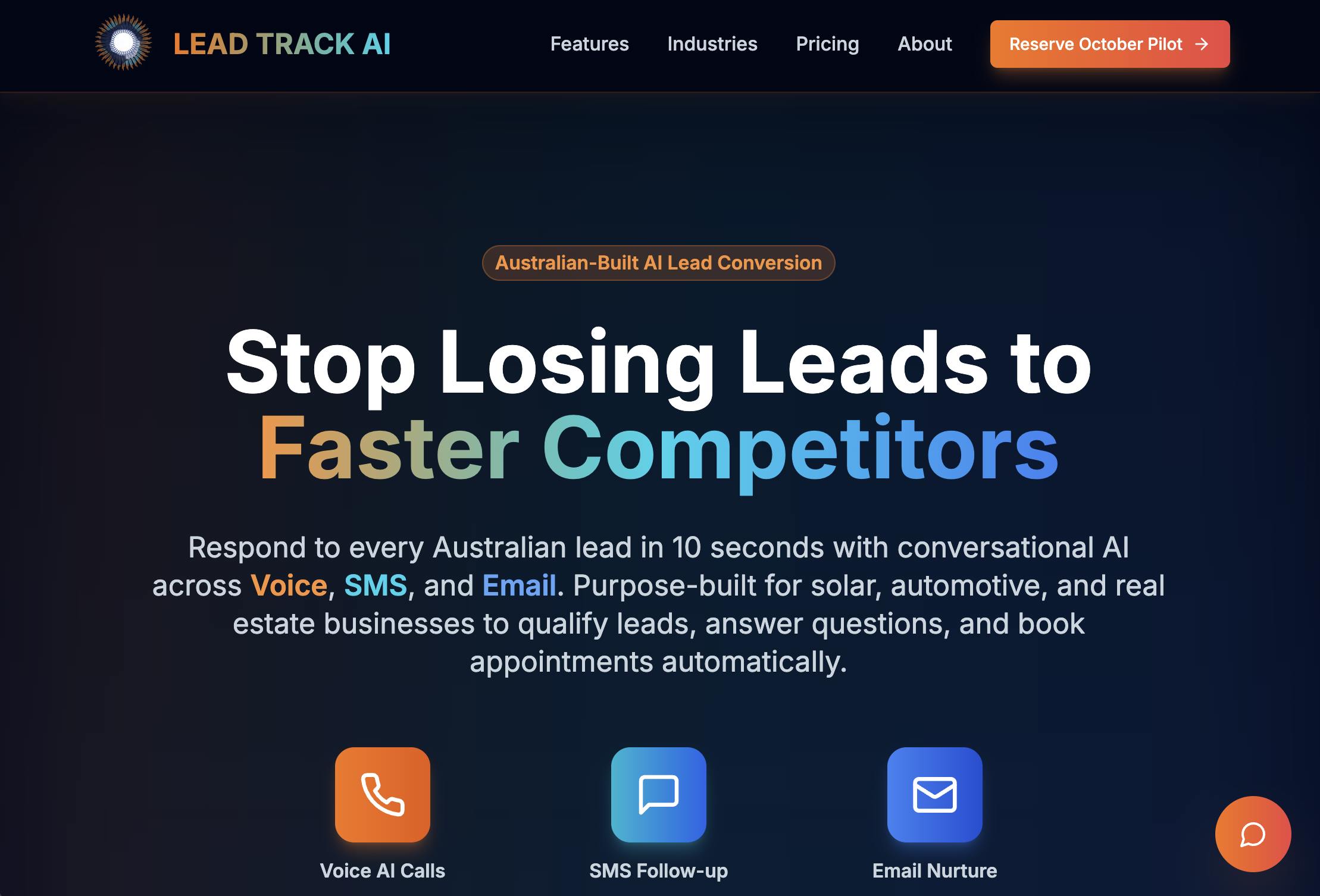
Now, it's making a high 4-figure MRR serving as a wedge into its horizontal counterpart, LeadTrackAI.
Here's Neel on how she's doing it. 👇
Starting with a wedge
I'm not building an "AI company." I'm solving the problem I've obsessed over for 20 years: Why do businesses lose customers they've already paid to acquire?
My background is enterprise marketing automation — IBM Unica (now IBM Marketing Cloud), Salesforce, Adobe Campaign. I built multi-channel orchestration systems before "marketing automation" was even a buzzword.
During that time, I saw a pattern: Companies that responded fastest across voice + SMS + email won. Not the biggest budgets. The fastest, most coordinated responses.
Then, I moved into Australia's energy sector. Solar companies were spending $50K+ monthly on Google Ads, generating hundreds of leads, and taking 4+ hours to call them back.
Buyers choose whoever responds first.
By 2023, AI voice technology finally matured enough to solve this. So I built TheSolarAI.com — a voice + SMS + email orchestration system that responds to solar leads in under 60 seconds and converts them into appointments.
Why voice? Because $20-50k decisions need human conversations. But businesses can't staff 24/7. AI bridges that gap.
We're currently serving enterprise clients across Australia's solar sector with TheSolarAI.com, and we're expanding the model to LeadTrackAI with automotive, real estate, home services — just about any industry where speed + multi-channel follow-up = revenue.
Solar was the wedge. LeadTrackAI is the horizontal platform.
Performance pricing
We're at about $8k MRR. We use an interesting business model — it's 100% performance-based.
Clients pay $0 upfront. We only earn commission when leads convert to appointments. Why? After 20 years implementing enterprise platforms, I learned that CFOs buy outcomes, not features.
"What if it doesn't work?" was always the objection I heard, so I removed it. Pay nothing until it works.
Yes, it's capital-intensive. Yes, it creates lumpy revenue. But it aligns incentives perfectly. We're partners, not vendors.
Here are the metrics the important metrics:
18-month average client retention
30-90% conversion rate improvements for clients
Zero churn in the past 5 months
Performance pricing creates evangelical customers. That's worth more than predictable MRR.
Pricing issues
That said, performance pricing nearly killed the business.
I pay AI/SMS/infrastructure costs upfront, then wait 30-90 days for commission. So, in the early months, we were gaining clients and getting them strong conversions, but bleeding cash while we waited for payment cycles.
If I restarted, I'd probably rethink pricing in the beginning and go hybrid instead. Innovation in pricing is great, but you need to be able to afford your business model.
Building workflows
The AI was easy. The workflow was hard.
After 20 years building enterprise marketing systems, I knew:
Which touchpoints mattered (voice → SMS → email)
When to follow up (60 seconds, 2 hours, next day, 3 days, 1 week)
What to say at each stage (qualify → educate → create urgency → close)
I started by Frankensteining an MVP using GPT-4, Twilio, a VPS, and Google Sheets as my database (yes, really). Ugly, but functional.
Three weeks in, I tested on 50 "dead" leads a Brisbane installer had abandoned. Result: 46% contact rate, multiple booked appointments, closed deals. He asked to use it immediately. That was validation.
It took me two months to build the real platform. Then it took me six weeks to get my first paying customers.
I wasn't inventing technology. I just was applying 20 years of enterprise expertise to AI capabilities that finally caught up to the strategy I'd known would work.
Challenges with voice AI
Voice AI quality was inconsistent in the beginning. It would talk over customers, mishear Australian accents ("solar" → "sola"), fumble objections, etc.
It took four months of fine-tuning conversation flows, accent training, and objection libraries.
Customers helped — they knew what "good" sounded like from analyzing millions of conversations over the years.
Reliability over hype
Reliability scales better than hype. So, when it comes to my stack, here's my motto: Use proven tools; innovate in the application.
That's why LeadTrackAI (and our earlier platform, TheSolarAI) runs on a deliberately “boring” but powerful stack.
We use:
OpenAI GPT-4 Turbo for logic
ElevenLabs for natural voice
Deepgram for real-time transcription
Twilio for calls and SMS
The backend runs on Python/FastAPI, PostgreSQL, and Redis, hosted on AWS for speed and scale.
Next.js/React powers the dashboard, and we integrate directly with Salesforce, HubSpot, and Pipedrive for instant adoption.
The result: Scalable voice automation handling 1,200+ daily interactions.
Because in the end, technology is 20% of success — understanding the workflow is 80%. That’s our real competitive edge.
Growth via relationships
To grow, I leveraged years of relationships and credibility.
Most founders talk "growth hacks." My strategy: Call people I've known for 15 years and say, "I built something that solves the problem we've been complaining about forever."
Most founders can't do this because they're building for industries they discovered last quarter. Your network IS your moat when you've worked in your industry for years.
Here's the breakdown:
1. Direct network
50 personalized LinkedIn messages to former colleagues, consultants, conference connections
30% of demos → paying clients
2. LinkedIn content
Behind-the-scenes building, client wins, industry insights
Positioned as expert/educator, not vendor
3. Industry events
All-Energy Australia, Smart Energy Council events
Shared frameworks, never mentioned product
And here's what DIDN'T work:
❌ Google Ads (expensive, wrong audience)
❌ Facebook Ads (B2B solar doesn't browse FB for SaaS)
❌ Cold email (low response, felt spammy)
If there was a do-over
If I could do it again, here's what I'd do differently:
Hybrid pricing sooner
Build leadership team by month 3 and get the right team to complement what you lack
Build in public from day 1
Choose a familiar problem
The best products come from obsessing over a problem for YEARS, not weeks. So build what you've complained about for years
I've ranted about "businesses losing leads to slow responses" for 20 years and have been fixing it with various automation suites. TheSolarAI wasn't a "pivot." It was my years of obsession.
What problem have you experienced for 5+ years that's still unsolved?
And go Enterprise. Most indie hackers chase SMBs. It makes sense — I hate enterprise sales. Six to eight week sales cycles, security reviews, contract negotiations. I spent weeks in meetings instead of coding. But enterprise value is 10-50x higher.
Domain expertise compounds
And one more thing: If you're 35+ and think you're "too old" to be a founder — you're not.
I'm 46 and it's my unfair advantage: 20 years of domain expertise in a world of AI-first founders with zero real-world experience.
Most AI founders today:
Graduated from Stanford/MIT in the last 5 years
Know ML/AI deeply
Have ZERO understanding of actual business problems
They "learn" an industry in 6 months by reading blog posts, interviewing 5 people, building a chatbot, then wondering why nobody buys.
I did the opposite.
Because domain expertise compounds; technical skills are a commodity.
If you're 35+, your 15-20 years of domain expertise is an unfair advantage younger founders don't have. Use it.
What's next?
My goals are centered on building a sustainable, high-impact technology platform that redefines efficiency in sales. In the short term, our focus is on securing more enterprise clients, scaling our leadership team, and expanding our multi-channel AI automation across both our specialized solar brand (TheSolarAI) and the new verticals under LeadTrackAI.
The medium term is about transitioning this into a robust, modular platform — introducing self-serve tiers, API access, and 10x-ing our infrastructure to handle massive volumes of leads as we grow.
Our long-term vision is where the two brands converge into a powerful mission: To establish the platform as the global standard for high-volume, automated sales conversion.
The specific goal remains to help 1 million households go solar by 2030. I'm building a profitable business that solves profound, real-world problems. I’m not optimizing for a valuation metric; I am building a company that champions impact, sustainability, and sanity as its core business model.
I post 2-3x/week about AI, enterprise software, solar, and indie hacking on LinkedIn. And check out LeadTrackAI!

Leave a Comment
This resonates a lot.
A focused niche product is often a much better growth wedge than a broad, all-in-one solution.
We work with early-stage founders who start with a very specific on-demand use case (ride-hailing in one city, tow trucks, or food delivery for a niche cuisine). Once they get real user data and revenue, they expand into bigger markets or adjacent verticals.
What’s interesting is that many of them use a ready-made, customizable product as their initial wedge instead of building from scratch, it saves months of development and lets them test product–market fit faster.
Totally agree that niche-first execution beats big-vision-only strategies.
Good
Love the detailed breakdown
Building a successful niche product as a wedge into a bigger market is a smart strategy — it proves value, attracts early users, and paves the way for broader growth.
Insightful guide on leveraging niche products to enter larger markets, offering practical strategies for growth, positioning, and competitive advantage.
This is such a smart approach. start narrow, dominate one painful workflow, and then expand outward. Most SaaS tries to go "broad → niche", but "niche → broad" is way more defensible.
I’ve been seeing this pattern a lot recently:
Creators and small teams don’t want giant all-in-one platforms anymore. They just want one thing done extremely well, especially if it saves them time.
Your point about solving a high-frequency problem also resonates. When you pick a niche where people repeat the same workflow daily or weekly, adoption becomes frictionless. It naturally becomes a wedge into a bigger market because once you’re embedded in that routine, you get permission to expand.
Really enjoyed the breakdown, thanks for sharing the thought process. 🙌
impressive
It’s inspiring to see how deep domain expertise and patience can compound into something this strong. The transition from TheSolarAI to LeadTrackAI feels like a natural evolution. Really enjoyed reading this, lots of lessons here for anyone building with AI right now
I will definitely check this out. I am in the United States, so I am curious to see how this works for my Saas Company for the the Music Business.
Loved this. What really stood out to me is how much of the advantage comes from workflow depth and domain expertise, not just the AI layer.
I am working on AI for finance and I see the same thing every day. The tech is the easy part. Knowing the real bottlenecks, the timing of touchpoints, and what actually moves revenue is the hard part.
The solar wedge into LeadTrackAI is such a clean example of “earn the right to go horizontal” instead of trying to be a platform from day one. And the point about being 35+ with years of domain experience as an unfair advantage is underrated.
Curious: when you knew it was time to step beyond solar, was it mostly customer pull from other industries, or your own conviction that the playbook would generalize?
What really stood out to me here is how the workflow depth + domain expertise did most of the heavy lifting, not the AI layer itself. That mirrors what I see in my own work: technology is rarely the bottleneck; understanding the real process and the real pain points is.
I also appreciate the honesty around performance pricing. It’s one of those models that looks brilliant from the outside but can quietly strain cash flow until you’ve built enough stability. Seeing you transition toward hybrid pricing makes a lot of sense.
And the wedge strategy is textbook: dominate one urgent niche, refine where it matters, then expand horizontally with proof instead of hype. More founders should take this path instead of trying to go “horizontal” on day one.
Curious: when did you know it was the right moment to expand from solar into broader verticals? Was it customer pull, data, or something else?
Great insight—starting with a niche product as a wedge can help gain traction, validate the market, and open doors to a larger audience. Smart strategy for growth.
What really stood out to me is how your growth came from relationships, credibility, and positioning, not hype.
That’s exactly what I see every day when helping SaaS founders grow through Reddit:
Most founders underestimate how powerful trust-driven communities are. Reddit in particular rewards the same principles you're applying:
solving a real industry problem
showing your expertise through conversations, not ads
positioning your solution inside the exact pain points users are already discussing
building authority before doing any kind of “pitch”
When those three align, the conversion is instant , because Reddit doesn’t care about hype, it cares about proof and expertise.
Your story is a perfect example of what happens when you start with one clear wedge and let credibility carry you horizontally.
If anyone reading this is building something similar , especially in SaaS, AI tooling, or B2B solutions , and wants to use Reddit to build authority, test early messaging, or generate your first real user demand organically, I’m always happy to share what’s been working for my clients this year.
Growth gets a lot easier when your audience comes to you because they trust your expertise.
How Smart Tech Can Boost Your Productivity as an Indie Entrepreneur
As an indie entrepreneur, you’re constantly juggling multiple tasks and responsibilities. From managing your online store to handling customer inquiries, keeping track of orders, and maintaining a healthy work-life balance, the challenges can be overwhelming. Thankfully, technology has advanced in ways that can help streamline your operations and make your daily routine more efficient. In this article, we’ll explore how smart tech and innovative gadgets can boost your productivity, with recommendations from Aubong Storeto help you stay ahead of the curve in 2025.
1. Smart Home Devices: Automate Your Workspace
One of the best ways to enhance productivity is by creating a workspace that works for you. Smart home devices, such as intelligent lighting systems, voice-controlled assistants, and smart thermostats, can significantly improve your office environment. These devices allow you to control your workspace with ease, making it more comfortable and conducive to focus.
For example, a smart lighting system can automatically adjust the brightness based on the time of day, helping you maintain energy levels and focus. With a smart thermostat, you can create the perfect temperature for concentration without having to get up from your desk. Explore Aubong Store for a range of smart home devices that can help optimize your work environment.
2. Productivity-Boosting Gadgets for Entrepreneurs
In addition to smart home devices, there are a variety of gadgets specifically designed to boost productivity. Whether you’re managing an e-commerce store or working on new projects, tools like smartwatches, noise-canceling headphones, and wireless chargers can make your day more efficient.
For instance, a smartwatch can help you keep track of important tasks and deadlines without constantly checking your phone. Noise-canceling headphones, on the other hand, can help you block out distractions and stay focused on your work. If you’re always on the go, consider investing in wireless chargers to keep your devices powered up throughout the day.
At Aubong Store, you’ll find a selection of the best tech gadgets that are perfect for indie entrepreneurs looking to stay productive and organized.
3. Smart Tools for E-Commerce Entrepreneurs
If you’re running an online store, integrating smart tech tools can help streamline your business processes. For example, smart inventory management systems can automate restocking, ensuring you never run out of key products. Additionally, customer support chatbots powered by AI can provide real-time assistance to visitors on your site, freeing up your time for more important tasks.
Using tools like automated email marketing systems or smart scheduling apps can also help you manage your customer interactions more effectively. With these tools, you can create personalized campaigns, schedule appointments with ease, and monitor sales metrics—all from a single dashboard.Aubong Store offers a range of smart tools and tech solutions to help you grow and manage your online business efficiently.
4. The Power of Smart Fitness Devices for Better Work-Life Balance
Maintaining a healthy work-life balance is crucial for long-term success as an entrepreneur. That’s where smart fitness devices come in. Wearable fitness trackers can help you stay on top of your health and wellness goals, track your physical activity, monitor your sleep patterns, and even remind you to take breaks during long workdays.
By incorporating fitness routines into your daily schedule, you can boost your energy levels and mental clarity, ultimately improving your productivity. At Aubong Store, we offer a variety of smart fitness trackers that can help you stay on top of your health while managing the demands of entrepreneurship.
5. Smart Financial Tools to Simplify Your Business Finances
Managing your finances as an indie entrepreneur can be overwhelming, but smart financial tools can simplify the process. From tracking expenses and managing invoices to monitoring cash flow and setting up tax reminders, these tools help you stay on top of your finances without the need for manual tracking.
Smart accounting software like cloud-based apps can automatically categorize expenses, generate reports, and even alert you when bills are due. This allows you to focus on running your business while staying organized and financially sound. Visit Aubong Store to explore the latest tech tools designed to help you manage your business finances efficiently.
Conclusion: Embrace Smart Tech to Boost Your Indie Business
As an indie entrepreneur, you’re already wearing many hats, but with the right smart tech tools, you can optimize your productivity, streamline your business processes, and maintain a healthy work-life balance. Whether you’re enhancing your workspace with smart home devices, improving your efficiency with productivity gadgets, or simplifying your business finances with smart tools, technology can be the key to success.
Visit Aubong Store to find a variety of smart gadgets and tools that can help you take your indie business to the next level in 2025 and beyond.
That's an excellent question. The cash flow challenge of 100% performance pricing nearly broke us early on. For LeadTrackAI's expansion verticals, we are moving toward a hybrid pricing model. It maintains the incentive alignment while ensuring the business can afford to scale sustainably.
I've tried to channel all my work in consumer research into a simple method that changes how people think about sleep—and improves lives for just $2. I’d love to hear your thoughts!
That sounds like a powerful application of domain expertise to a consumer problem! Focusing on simplicity and a low barrier to entry ($2) is a v smart play
great writing and thoughtful work
Very interesting. I agree, find a sloution to problem that has been there for years.
I believe the strengths of this product lie in its excellent understanding of customer segments and its ability to pivot.Generally, most people tend to rely on probabilistic approaches through online advertising via Meta or Google.
However, online advertising, whether for B2C or B2B, is only effective with a solid understanding of the target segment.While this case is cited as a failure, the subsequent decision to fully commit to sales, including offline methods, is exceptional.
In a world where many seek efficiency and rationality, this reminds us of the importance of analog strategies and the need to focus on niche areas.
long read but really a masterpiece...
This is really amazing
Niche products require solving a specific problem exceptionally well, gaining loyal customers, and using that success as leverage to expand into wider, more competitive markets.
Focusing on a small niche first makes the whole journey cleaner, and your story shows how steady work in the right corner can open bigger doors later.
Crazy how reading this timeline feels like looking at a history of our own habits changing — not just phones. Each model didn’t just add a feature, it shifted how we communicate, take photos, and even think about technology. The iPhone story is really the story of how everyday tools quietly redefine culture year after year.
This is an absolute masterclass in Digital marketing strategy and business building with purpose and precision. Starting with a niche like solar and expanding into broader verticals through proven marketing automation workflows is a brilliant move. Your deep domain expertise and relentless focus on solving a real, persistent customer acquisition challenge truly set this apart. The performance-based pricing model is bold and incredibly customer-centric, perfectly aligning incentives and driving conversion rate optimization. Thanks for sharing such a transparent look into your growth marketing journey — super inspiring!
Focusing on a niche is a smart move—solving one clear problem always builds stronger traction before expanding to a broader market. Love how you use the niche as a wedge and build momentum based on real user needs!
This is indeed a question worth pondering; I've learned a lot.
Great insights!
I completely agree , success is less about the technology itself and more about how you apply it to real problems.
We’ve seen the same with remote teams: when the process is solid, everything scales naturally. 💪
"This is such a compelling story — it really highlights the power of domain expertise and solving a problem you’ve lived with for years. I love how you combined deep industry knowledge with AI to create something that’s both practical and high-impact. The performance-based pricing approach is bold but clearly aligns incentives beautifully. Thanks for sharing such a detailed breakdown — it’s inspiring for anyone thinking about building real enterprise value rather than chasing the hype
Incredible story, Neel! Your approach perfectly shows why domain expertise and patience matter more than chasing trends. I really like how you focused on workflow reliability over hype that’s such a rare mindset in today’s AI space. The performance-based pricing model is bold but deeply aligned with client success, and it’s inspiring to see it work in real markets like solar. Huge respect for building something real, profitable, and purposeful.
Really liked this; classic wedge strategy done right. Starting niche lets you win trust, refine the product in a focused environment, and then expand into the broader market with credibility and data. The way you positioned around a small, underserved segment instead of trying to go wide from day one is textbook smart.
Curious; what signal told you it was time to expand rather than keep dominating the niche: plateauing growth, feature pull from adjacent users, or repeat inbound from outside your ICP?
P.S. I’m with Buzz; we build conversion-focused Webflow sites and pragmatic SEO for SaaS and product launches. Happy to share a quick 10-point GTM checklist if useful.
Nice product! Have you thought about using a short SaaS video on your homepage to show how it works?
Zero churn in the past 5 months is impressive! Having evangelical customers is definitely key, they will help to get more loyal customers
This is such a masterclass in clarity and purpose, you’re not just building “with AI,” you’re solving a real, long-standing business pain with precision. The part about reliability over hype and domain expertise compounding really hit home. We’re building Loopra, an AI workspace that turns chaotic team inputs (voice notes, docs, screenshots, transcripts) into structured knowledge and we’re already seeing how tricky categorisation and handling large files can get at scale. Hearing how you built steady, reliable systems from years of experience is a great reminder that endurance and workflow depth beat hype every time.
This is a really awesome example of how domain expertise can translate into building valuable solutions. It really comes from the fact that you always need to be solving problems that people actually have. Great reminder and congratulations to you!
amazing
Inspiring Story
Inspiring story. I'm 36 and just starting to build out a solution for the industry I've been in for the past 15 years.
Safe to say, you're right. Stick to your domain and make it better.
To create a successful niche product that can be used as a wedge into a larger market, it is necessary to start small and focus. Businesses can create strong value, gain trust, and refine their products very quickly by focusing on a specific audience with a clear problem. Once the niche has been established and has proven to be successful, it can be used to expand into broader markets with confidence, ensuring sustained growth, loyal customers, and a strong competitive advantage.
This is such an important lesson in focus. The fear for many of us is that starting with a niche means we're limiting our potential. But this story shows the opposite: a sharp focus is what unlocks potential. By becoming the absolute best solution for a small group, you get the traction, feedback, and revenue needed to expand confidently. It's a much safer and more sustainable path than building for a vague 'everyone' from day one. Congrats on proving the model!
Wow nice
Have you ever conducted any tests outside of Australia?
Did you build this solo or with a team?
interesting
I've been writing for Indie Hackers for the better part of a decade. In that time, I've interviewed hundreds of startup founders about their wins, losses, and lessons. I'm also the cofounder of (AI interview assistant) and customer feedback via Loom). And I write two newsletters: (micro-SaaS acquisition opportunities) and (archaeo/anthro news).
I've been at Voice AI for a year and it's not easy getting clients, most demos are people who just want to get in the business, not actually buyers. Buyers do not like AI taking calls, some see value in after hours though.
I hear you on the grind - a year in and I'm still fighting for every real buyer. But here's what keeps me going: "The obstacle in the path becomes the path." Every objection you're hearing now is teaching you how to position better.
Keep pushing. Sounds like you're learning exactly what you need to know :)
Does JAMES tell callers he is an AI? Love 40+ hustle story! Well done!
Just curious — why would you choose to build in public from day one if you had the chance to start over?
Excellent question! Three reasons:
a, When you're building at night while juggling a day job, it's easy to quit when nobody's watching. Public building creates healthy pressure.
b, The conversations that come from sharing your journey early are really imp. You learn what resonates, who your audience is, and what problems matter most.
c, if you BIP, by the you launch, you would already have an audience who'd watched you solve problems in real-time.
I waited too long to share because I was afraid. 'What if' I fail' publicly' , 'what if' my friends know what Im upto? employers think if me? That imposter syndrome cost me 2+ years of community building. If I could redo it, I'd share from day zero – messy MVP, ugly prototypes, all of it.
The vulnerability creates connection. And connection creates customers.
Just my take :)
Great insights! Focusing on a tight niche before expanding is a proven strategy—solving a real pain point first not only gets traction but also builds trust and an early customer base. Love how the post emphasizes close interaction with users and iterating based on their feedback as the foundation for long-term growth. Thanks for sharing these practical steps.
Thank you, Abdur! The 'niche first, expand later' strategy has been everything for us. Appreciate you reading and taking the time to comment!
There is an ancient Chinese saying: favorable timing, advantageous location, and harmonious people.
Love this!
And you're absolutely right – all three had to align. Patience was the hard part, but it paid off.
Thank you for sharing this wisdom!
We grow together.
Out of curiosity, why do you say you would build in public from day 1 if there was a do-over?
Excellent question! Three reasons:
a, When you're building at night while juggling a day job, it's easy to quit when nobody's watching. Public building creates healthy pressure.
b, The conversations that come from sharing your journey early are really imp. You learn what resonates, who your audience is, and what problems matter most.
c, if you BIP, by the you launch, you would already have an audience who'd watched you solve problems in real-time.
I waited too long to share because I was afraid. 'What if' I fail' publicly' , 'what if' my friends know what Im upto? employers think if me? That imposter syndrome cost me 2+ years of community building. If I could redo it, I'd share from day zero – messy MVP, ugly prototypes, all of it.
The vulnerability creates connection. And connection creates customers.
Just my take :)
Finally a success story that didn't happen overnight with $10,000 MRR in three days. We need more of this. The Levi Strauss approach really stands out - while everyone's rushing to mine AI gold, she's selling the picks and shovels to solar companies who actually need to get work done. Doing this is hard and takes time. I think we sometimes forget that with all those stories of instant success. I love the honesty on the pricing and the building in public from day. Finally a story where someone used hard won experience to make a real company with real success and real problems!! Bravo!!!
Thank you so much for this! Your comment really resonates. The "overnight success" narrative has done real damage to founders who are building sustainably.
The hardest part was honestly the waiting – waiting for voice AI to mature enough, waiting through the cash flow challenges of performance pricing, waiting while everyone around me seemed to be moving faster. But domain expertise compounds slowly.
Appreciate you taking the time to read and comment!
Exactly! This kind of story is refreshing because it reminds us that sustainable success is usually built on persistence, not overnight hype. The ‘picks and shovels’ model is one of the smartest plays right now focusing on real problems and tangible value instead of chasing trends. It’s great to see someone taking the slow, steady, intentional path and actually building something that lasts. Truly inspiring!
Caroline, thank you! 'Slow, steady, intentional' – that's exactly it. When you're building at night while managing a day job and family, you don't have the luxury of moving recklessly.
The irony is that what felt like disadvantages (age, responsibilities, limited time) turned out to be the very things that kept me focused on solving real problems instead of chasing hype.
Really appreciate your thoughtful comment!
Absolutely love that perspective. It’s amazing how what once felt like constraints often become the foundation for depth, clarity, and discipline. You’re right building with intention creates something sustainable, not just flashy. Your journey really captures the power of focused growth over frantic motion.
I am currently working in a company -CSG Technosol Pvt Ltd which is located in noida sector 62 but i stay in delhi, travelling in noida from delhi is a very hard decision but yes , we need to accept that
Absolutely that perspective really resonates with me. Constraints often sharpen our focus and discipline. It’s inspiring to see how you’ve turned what most people see as limitations into strengths. Thanks for sharing that insight!
Brilliant.....it’s often the smartest way to earn trust and expand naturally.
Really appreciate you dropping by , reading my story and your encouraging words !
Interesting pricing concept. I honestly love the idea. Do you plan on keeping that same model or getting some more social proof then moving to a full subscription model from the start?
Great question! We're actually moving to a hybrid model now. Perf. pricing was incredible for building evangelical customers and proving product-market fit, but it's capital-intensive and creates lumpy cash flow.
Going forward, we're testing: base subscription (covers infra costs) + performance bonuses (aligns incentives). This gives us predictable revenue while keeping the 'we only win when you win' philosophy.
The social proof from our early performance-only clients is nice (and was very imp) – when a customer says 'they didn't charge me until it worked,' that's powerful positioning for enterprise sales.
What's your take on hybrid models vs. pure subscription for something like this?
Love how you’ve combined decades of domain expertise with modern AI to solve a real, high-impact problem. Your focus on speed, multi-channel follow-up, and performance-based pricing is a masterclass in aligning incentives with outcomes. The point about enterprise experience being an unfair advantage is spot on — most founders underestimate the value of deep industry knowledge. Really inspiring to see AI applied with strategy, not just hype.
Thank you!
Honestly, performance-based pricing was terrifying at first (and nearly broke us), but it forced us to build something that actually works. When your revenue depends on your customers' success, you don't ship vaporware.
Really appreciate you dropping by , reading my story and your encouraging words !
Interesting story
Thank you ! Really appreciate you dropping by , reading my story and your encouraging words !
Curious on what was your main marketing/distribution channel because I can see (I might be mistaken) that both sites are vibe-coded and the domains are new-ish (March and September) so how did you grow to an extent that this is considered successful, as seen in the title on this article? Thanks.
Hi there , my main mode of 'distribution ' was my network NOT Website. The old fashioned way of picking the phone. email or message .
Read the article it is laid out above
It wasn't safe for you to assume I did read it prior to asking the question, thus the question? Another fake ass shit. As with 99% posts on IH. lol 'read the article' LOL
She literally gave the answer in the post and confirmed the same in her reply. Best of luck to you.
No she didn't, you simp. Also, your toy does not work https://journeytogether.io/ nor did it work a 6 days ago. Such a builder. /flex. I stand by what I said about IH: "Another fake ass shit. As with 99% posts on IH". Best of luck to you, too. Although, you might achieve better things by not relying on luck.
IS IT POSSIBLE TO RECOVER LOST CRYPTO? YES, ONLY HACKANGELS
Hey, my name is Frank, and I'm a crypto trader! I just wanted to share my incredible experience with The Hack Angels. They are truly exceptional when it comes to crypto recovery. They managed to recover my lost $1.7 million worth of Bitcoin from a scam, which I honestly thought was impossible. If you ever find yourself in a similar situation, I highly recommend reaching out to them.
You can contact them through their hotline at +1 (520) 200-2320 (available on phone/WhatsApp)
If you're in London, you can even visit them in person at their office located at 45-46 Red Lion Street, London WC1R 4PF, UK. They're super helpful and really know their stuff! Don't hesitate to reach out if you need help!