Building an App Store for vertical AI agent bundles. Day 4, here is the bet.
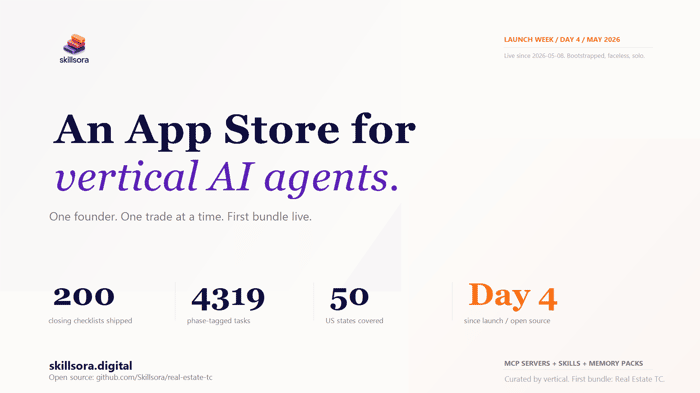
I am building Skillsora, an app store of prebuilt vertical AI bundles for builders targeting non-technical B2B niches.
Day 4 post launch. Sharing the bet because I want to see who pushes back.
The first bundle
14 days of research, 8 days of building. The target vertical is US Real Estate Transaction Coordinators. These are the people who manage all paperwork between contract signing and closing on a home sale. Around 100k in the US. Each closing has 30 to 60 deadlines and 50 to 100 documents. Rules also vary by state and change frequently with legislation.
What is inside the bundle:
3 MCP servers in TypeScript: closing checklist, deadline chaser, escrow tracker
5 skill files chaining the full workflow from intake to post closing
200 closing checklists across all 50 US states and 4 transaction types (residential, commercial, new build, short sale)
4,319 phase tagged tasks with real legal citations (CGS, RCW, NRS, M.G.L., N.J.S.A.)
License system signed with HMAC SHA256 plus SHA256 audit trail on every registered document
The system can be cloned locally, run in a couple of minutes, and used to operate a real estate closing workflow without doing the regulatory research from scratch.
The thesis
Generic AI agents are commoditizing fast. By the end of 2026 most horizontal AI tools will look interchangeable.
The defensible layer is vertical depth. Systems built for one specific trade, where workflows are encoded, edge cases are handled, and domain rules are baked in from the start.
The real bottleneck in building vertical AI is not the model. It is the upfront work of understanding the domain and encoding it, often 10 to 20 days before any real product work even begins. That is the layer Skillsora removes.
Pick a vertical, plug in a bundle, and go from idea to usable system in days instead of months.
There is a gap between generic AI infrastructure and traditional vertical SaaS. That gap is what I am building into.
Three tensions I am thinking about
First tension is builders versus end users
The same bundle can serve developers building tools for brokerages or the brokerages themselves. My current belief is that builders are the stronger leverage channel because each one can distribute to multiple clients. End users are easier for early validation. I am still exploring how both sides can reinforce each other.
Second tension is the MCP positioning problem
“MCP server” resonates with builders but means nothing to non technical users. Right now I keep MCP entirely in documentation and technical repos. The customer facing message stays simple, an AI assistant for real estate closings.
Third tension is depth versus breadth
There is pressure to ship multiple verticals in parallel. For now I am staying focused on one vertical to fully understand distribution before expanding. I am open to evidence from others if a multi vertical approach worked better early on.

The bet makes sense - vertical bundling is how you get adoption without needing enterprises to assemble everything themselves.
One pattern I've noticed: solopreneurs buying agent bundles often don't have an ops layer underneath. They're running the agents but tracking results in sticky notes, Slack DMs, or nothing at all. The agent does the work; the human still loses the output.
I've been building a Notion OS for exactly this layer - 6 linked databases (projects, clients, decisions, revenue, client portal, weekly review) so the solo operator has somewhere to land what the agents surface. Structured context makes the whole stack smarter.
What's your distribution angle - going after solopreneurs directly, or teams first?
This is a strong bet. The interesting part is not really the “app store” angle, it is the encoded vertical depth.
The real value here is that you are packaging regulatory context, workflow logic, edge cases, and implementation structure into something builders can actually deploy. That feels much closer to vertical AI infrastructure than a marketplace of skills.
One thing I’d be careful with is the name.
Skillsora sounds like it could be a learning platform, talent marketplace, or course product. But what you’re describing is much more serious: reusable vertical systems with domain rules baked in.
If this becomes the layer between generic AI infra and vertical SaaS, the name probably needs to carry more infrastructure weight.
Something like Exirra.com would fit that direction better long term. It feels more like an intelligence/system layer than a skills marketplace, which is closer to where the product seems to be going.