BUILDING INDUSTRIE5 — WEEK 01: Why I'm Building a Second Brain for Companies
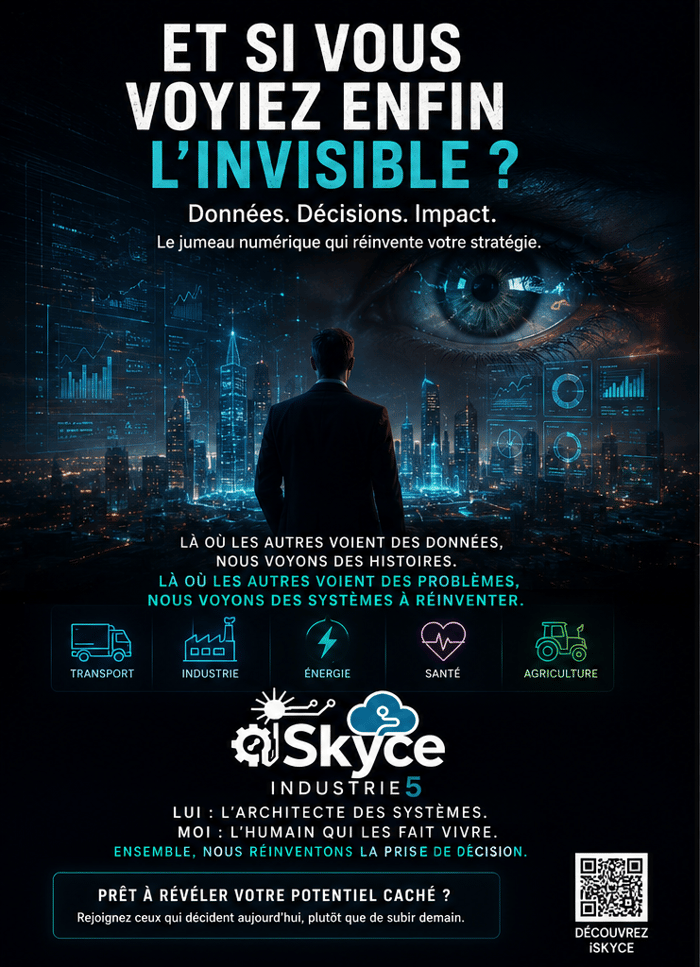
What if your company could see what it doesn't see yet?
The Terrace Confession
Fifteen months ago, I left my office and moved into my terrace.
I'm not a developer by trade. I'm a former financial broker who refinanced loans for 20+ banks. I've done sector analysis, audits, and ran an e-commerce business. But for the past 15 months, I've been on a crazy mission: building INDUSTRIE5 — a digital twin platform that helps companies see their invisible risks and opportunities.
Why am I telling you this? Because I believe the best tools aren't built by people who only know code. They're built by people who know the pain of making decisions in the dark.
The Problem I Saw (And Still See)
During my years doing audits and sector analysis (for companies like Eurofins , Savencia , Fives Machiningor ,Voltalia etc... ), I noticed something frustrating:
Companies make strategic decisions with only 40% of the data they actually have.
The rest? It's hidden in:
Unconnected spreadsheets
Siloed departments
"Dark Data" nobody looks at (hidden BFR, unaudited subcontracting, CO2 scope 3 gaps)
Market signals they don't know exist
I watched good companies make bad decisions — not because they lacked data, but because they couldn't see the full picture.
The Vision: From SIREN to Strategy
Here's what I'm building:
Enter a company's SIREN number (French business ID).
Instantly generate a digital twin that knows:
Their financial reality
Their sector-specific risks (Transport, Industry, Energy, Health, Agriculture)
Their hidden vulnerabilities (Dark Data)
Their market position
Run predictive crash tests for the next 5 years.
Get actionable quick wins immediately.
Ask questions to an AI chatbot that understands their specific context.
That's INDUSTRIE5. It's not just a dashboard. It's a second brain for the company.
Where We Are Today (Week 01)
I'm practicing "Building in Public" because I need to stay honest. Here's the real status:
What's Built (80% Functional Locally):
Complete Admin & Client Dashboards: Partners can assign dossiers, clients can follow progress in real-time.
Digital Twin Generation: Works for 5 sectors with specific subtypes (e.g., Transport → Refrigerated, Logistics, etc.).
The Brain Service: 9 core modules running the analysis:
Data Collector
Financial Analyzer
Geopolitical Analyzer
Cross-Border Acquisition
Cost Optimization
Communication Strategy
Client Needs Analyzer
Regulatory Analyzer
Projection Generator (Currently integrating 5-year scenarios)
Business Model: Three tiers (Diagnostic Express, Roadmap, Total IA) + Data+ (monthly recurring data refresh).
Tech Stack: Next.js, Node.js, MongoDB, Custom AI Orchestrator.
** What's Next (The 6-Month Push):**
Finalizing the Projection Generator (Module 09) with realistic pessimistic/realistic/optimistic scenarios.
Completing the predictive audit engine (5-year crash tests).
Launching the first beta clients.
Deploying to production (GitHub + Vercel ready).
The Business Model (Honestly)
I'm not chasing VC money. I'm building for profitability.
Diagnostic Express: 3 hours of research → 10 slides → Quick win.
Roadmap: 11 hours → 30 slides + Visual Roadmap.
Total IA: 30 hours → Deep dive + 1h accompaniment.
Data+: The recurring engine. Monthly data refresh, market updates, new norms. This is where the long-term value lives.
Success Fee: Optional alignment on results.
My goal? Recurring revenue that reflects real value, not just software seats.
Why I'm Building This in Public
Because I'm a "caméléon" — not a coder, but an entrepreneur who believes:
"What intelligence predicts, humans adapt."
I'm learning to code as I build. I'm making mistakes. I'm discovering that validating the problem is harder than building the technology.
And I want you to follow the journey — the wins, the failures, and everything in between.
My Question to You
If you could give a company one additional sense that it doesn't have today, what would it be?
The ability to see 5 years into the future?
The ability to hear weak market signals?
The ability to feel hidden risks (Dark Data)?
Something else entirely?
I'm genuinely curious. Drop your thoughts below.

The "hidden risk" sense is the one I'd bet actually changes decisions in the moment. A 5-year projection is valuable but abstract — you nod at it and move on. Knowing today that there's an unaudited subcontracting gap or a Dark Data blind spot is something you can act on this week. Curious how you're weighting recency vs. depth across the 9 Brain Service modules — a dashboard surfacing last month's Dark Data feels very different from one still catching up on last year's audit.
"validating the problem is harder than building the technology" is the sentence I'd want to sit with longest here, because everything above it describes technology, 9 modules, 5 sectors, three pricing tiers, before a single beta client has confirmed which of those actually matters to a real company. that's not a criticism of the vision, it's a genuine question: if you had to cut the scope down to the one module that alone would get someone to pay for a diagnostic express, which one would survive, and have you tested that specific piece with anyone yet
on your actual question, the sense I'd want a company to have isn't seeing further ahead, it's knowing the difference between a confident answer and a guessed one. I've been thinking about this a lot this week from a different angle, systems that report success without actually having checked anything are more dangerous than systems that are just wrong, because wrong gets caught and false-confident doesn't. for a "second brain" specifically, the killer feature might not be "here's your 5-year projection," it's "here's the one place we genuinely don't have enough data to tell you anything reliable," since that's the blind spot most dashboards paper over instead of admitting
The interesting part is turning fragmented company information into something people can actually use for decisions. I’m especially curious how you’ll make the “digital twin” concrete enough that a company immediately sees what it changes in practice.