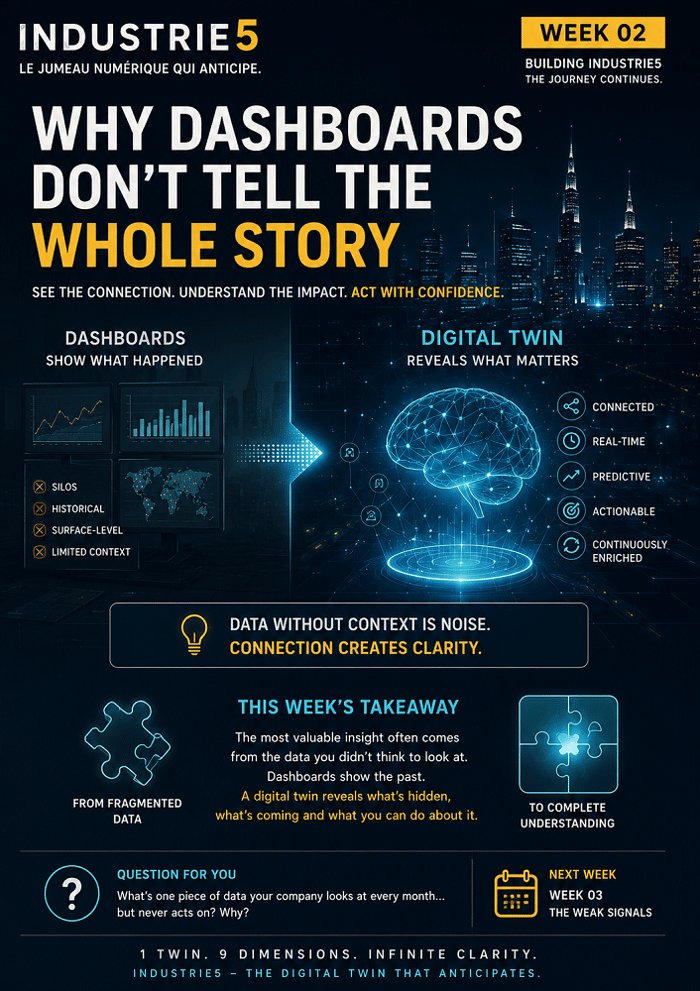
BUILDING INDUSTRIE5 — WEEK 02 Why Data Never Tells the Whole Story
Your company talks. Are you really listening to its weak signals?
Last week, I asked a simple question:
What if a company could see what it doesn't see yet?
The answers were fascinating.
Several people pointed toward hidden operational risks.
Others questioned how a system should distinguish between recent information and outdated data.
And one question particularly stayed with me:
What if the most dangerous information isn't the information we have — but the information we think we understand?
That's where this week's thinking begins.
- A dashboard can tell you what happened.
Revenue went up.
Costs went down.
Margins changed.
Orders increased.
Cash flow tightened.
A market moved.
All useful information.
But there is a problem.
These numbers rarely exist alone.
A change in one part of a company can be connected to something happening somewhere completely different.
A financial signal can have an operational cause.
An operational problem can have a regulatory cause.
A regulatory change can affect the market.
A market movement can expose a weakness in the supply chain.
And suddenly, what looked like five separate pieces of information becomes one story.
That's the part I'm interested in.
- From data to context
When I started thinking about INDUSTRIE5, I didn't want to build another dashboard that simply tells a company:
"Here is what happened."
I wanted to explore something different:
"Here is what might be connected."
Because sometimes the valuable information isn't hidden inside one piece of data.
It's hidden between several pieces of data.
And that's where fragmentation becomes dangerous.
-
The idea behind the digital twin
The purpose of the INDUSTRIE5 digital twin is therefore not simply to accumulate more information.
It's to progressively build context around the company.
The more relevant information becomes connected, the more useful the picture becomes.
And that picture should not remain static.
A company changes.
Its market changes.
Its regulations change.
Its costs change.
Its competitors change.
Its risks change.
So the digital twin has to evolve with it. -
That's why I'm thinking about a continuous cycle:
Data → Context → Analysis → Insight → Decision → New Data
Then again.
And again.
Not a static report.
A system that can evolve with the company.
-
But here's the question that bothers me
How much can you really understand from data without understanding its context?
Imagine two companies with exactly the same revenue.
Same number of employees.
Same EBITDA.
Same growth rate.
On paper, they might look almost identical. -
But one could have:
a fragile supplier;
an unusual cash-flow dependency;
an upcoming regulatory exposure;
an underused asset;
or a market opportunity hiding in plain sight.
The numbers might look similar.
The companies aren't.
-
What I'm learning while building INDUSTRIE5
The difficult part isn't necessarily collecting more data.
The difficult part is deciding:
What matters?
What is connected?
What is missing?
What has changed?
What should be questioned?
And perhaps most importantly:
What shouldn't the system pretend to know?
That's becoming an increasingly important principle in this project.
A useful intelligence system shouldn't only tell you what it thinks is true.
It should also be able to show you where uncertainty remains. -
Week 02 takeaway
More data doesn't automatically create more intelligence.
Sometimes the real value comes from connecting the right information, at the right time, with the right context.
That's one of the reasons I'm building INDUSTRIE5.
Not to replace the decision-maker.
But to give the decision-maker a wider field of vision.
❓ Question for the community
I'm curious about your experience:
What's one piece of information your company tracks regularly that becomes almost meaningless when taken out of context?
Or perhaps the opposite:
What's one signal you wish your company had noticed earlier?
I'd love to hear your experiences.
They may influence what I build next.
- NEXT WEEK — WEEK 03
Weak Signals.
The things that are still small enough to ignore...
until they're not.
INDUSTRIE5 — The digital twin that anticipates.
