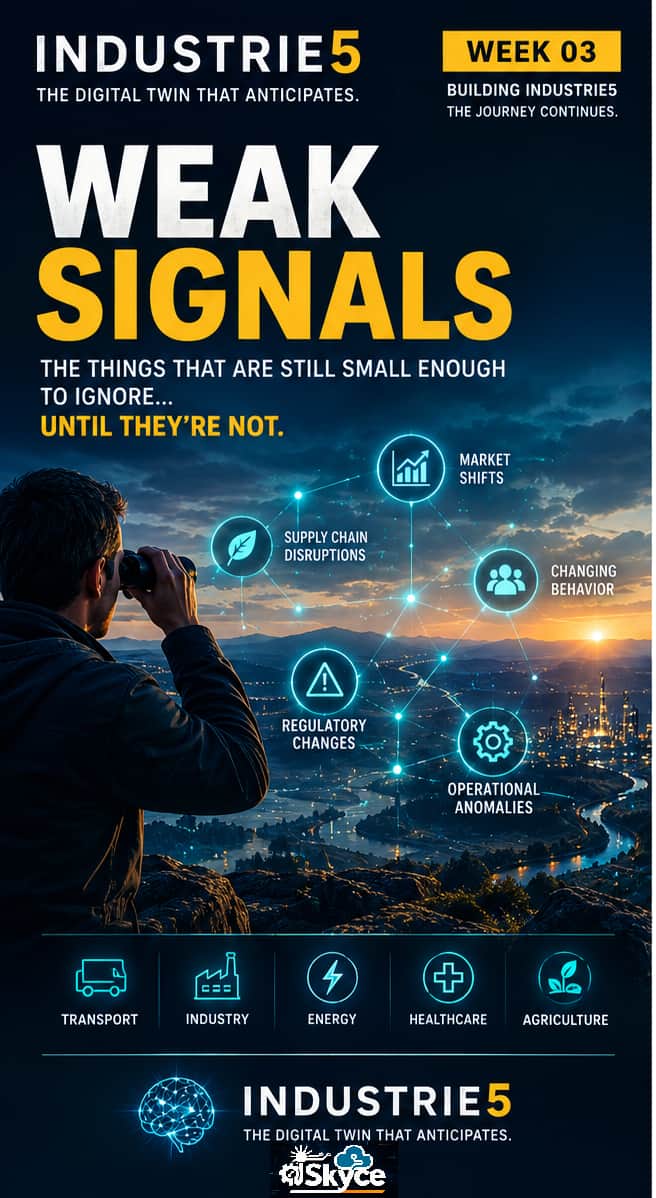
BUILDING INDUSTRIE5 — WEEK 03: Weak Signals The things that are still small enough to ignore... until they're not.
Last week, I wrote about why data never tells the whole story.
This week, I want to go one step further, and what happens before something becomes a problem?
Usually, it doesn't arrive with a warning siren , and It starts quietly.
- A supplier takes a little longer than usual.
- A customer changes a purchasing pattern.
- A margin slowly moves in the wrong direction.
- A regulation begins to evolve.
- A competitor enters a market.
- A recurring operational anomaly appears.
- A few employees start doing something differently.
Individually, each signal can look insignificant, together, they might tell a very different story.
The problem with weak signals
- The difficulty isn't necessarily finding information.
- Companies already have an enormous amount of it.
- The difficulty is recognizing that something small has changed — and understanding whether that change matters.
- A dashboard is generally very good at showing what has already become measurable.
But what about the things that are:
too small to trigger an alert; spread across different sources; developing slowly; outside the usual reporting cycle; or simply not connected to each other yet?
That's where I'm becoming increasingly interested in weak signals.
A simple example
Imagine a company notices:
Supplier delays +3%
Not alarming.
Then:
Transport costs +4%
Still manageable.
Then:
A regulatory consultation appears
Interesting, but perhaps unrelated.
Then:
One important customer changes its ordering pattern
Again, nothing dramatic.
Four isolated observations , but what if they're connected?
Perhaps there is something developing underneath the surface.
Perhaps not, and that's precisely the point, A weak signal is not a prediction, it's an invitation to investigate.
This changes how I think about INDUSTRIE5
When I started building the project, I was focused on collecting and structuring information.
The more I build, the more I realize that the interesting part isn't simply having more data.It's knowing what deserves attention, and sometimes that means asking:
- What changed?
- Why did it change?
- Is it persistent?
- Is it connected to something else?, and what information are we still missing before we can say anything with confidence?
That last question may be one of the most important ones.
Because I don't want INDUSTRIE5 to create false confidence, if the available information isn't sufficient to support a conclusion, the system should be able to recognize that too.
From weak signal to useful intelligence
This is one of the ideas I'm exploring with the digital twin.
Not:
"Here is a prediction," but rather.
"Here is something worth looking at."
Then:
"Here is why it might matter."
And eventually:
"Here are the possible actions you could investigate."
The human remains the decision-maker, AI helps widen the field of vision.
Still building
This is also why I'm documenting INDUSTRIE5 before it's finished.
I'm still testing assumptions. Some ideas will survive. Others won't and some questions only appear once you start building the actual system.
Weak signals are one of those questions.
How do you distinguish a meaningful early signal from simple noise? , and how much weight should it receive?
How recent does information need to be? and how do you avoid turning uncertainty into false certainty?
I don't have all the answers yet. That's part of the build.
❓ Question for the Indie Hackers community
I'd love to hear from people who work with companies, products, markets or data:
What's one "small" signal you have seen ignored until it eventually became impossible to ignore?
It could be operational, Financial, Customer-related, Technical, Regulatory, Market-related, Or something completely different.
I'm collecting experiences, not just opinions.
Some of the answers may directly influence what I build next.
