Building Is Hard. Getting Discovered Is Harder.
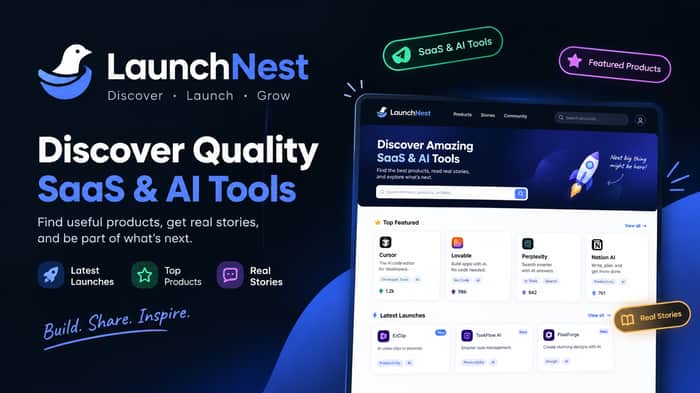
Building Is Hard. Getting Discovered Is Harder.
The product is finished.
The landing page is ready.
The launch is live.
And then comes the difficult part: finding people who actually care.
LaunchNest LN gives founders another place to showcase SaaS, AI tools, and indie products while helping users discover what’s being built.
Keep building. Keep launching. Keep getting discovered.

Discovery gets easier when you treat it as a feedback loop instead of a launch event. I would start with one narrow audience, log the exact words they use when describing the problem, and reuse those words in the page and in each distribution channel. That makes it easier for both people and search systems to understand who the product is for. Then measure qualified conversations, not just clicks.
went through this exact loop just last week. Built IndianBusinessTools (free GST/invoicing tools for India), got it launched, and realized fast that launching and being findable are two completely different problems.
Discovery platforms like this are underrated for exactly that gap. How's the traffic been for early people who've submitted to LaunchNest?
can definitely relate to this!
I've recently launched my first independent website, TrueCarCostUK, a free calculator that helps UK drivers understand the real cost of owning a car.
I've spent months learning and building it in my spare time alongside my full-time job. Now that it's live, I'm discovering that getting people to actually find and use it is a completely different challenge!
I'm currently experimenting with TikTok, SEO and communities like Indie Hackers.
For those who've successfully launched their own projects, what helped you attract your first genuine users?
For a calculator like TrueCarCostUK, I’d treat the first 20 users as a research channel, not just a traffic milestone. Pick five real buying-intent questions—such as “Can I afford [model] on £X salary?”—and make a useful result page for each. Share them only where that exact question is already being discussed.
Track calculator completions, not just visits. Once one model or question consistently produces completions, turn it into a small landing-page and SEO cluster. TikTok can help validate the language people use, but focused search and communities will likely bring the higher-intent first users.
Thanks, really appreciate you taking the time to give such detailed advice
Tracking completed calculations rather than just website visits is a great point. I've recently got Google Analytics working, so that's something I'll look into adding next.
I'm still learning as I go, building TrueCarCost around my full-time job, so getting feedback like this is genuinely helpful.
I'm going to focus on getting my first real users and understanding what they actually want before getting carried away building more features. Thanks again
Glad it helped. You’re approaching it the right way: let the first real users and their questions shape the next pages, then turn the strongest queries into a clear traffic-to-calculator funnel.
I run Kotrixel, where we help early-stage teams with websites, SEO, and conversion flows. If you’d ever like a second pair of eyes on TrueCarCostUK’s page structure or tracking setup, you can reach us at kotrixel.com, on Instagram @kotrixel, or WhatsApp +447497883090.
The uncomfortable truth is that building can feel more productive because you can control it.
Distribution is harder because you can post, write, launch, email people, and still get almost no response. There’s much more uncertainty involved.
I think that’s why many technical founders keep adding features instead of spending time on marketing. Coding gives immediate feedback. Distribution often doesn’t.
This is relatable - getting your service in front of the right users as fast as possible is key, and this isn't obvious at first.
Solid point. Validating user demand before getting too deep into the architecture saves so much time.
I think that's a good point. If you ever need honest feedback on your project, you know where to find me haha.
The replies here are all "same problem", which is itself the data point: everyone's at the "launch is live, nobody came" stage together.
Disclosure: I'm building Mythex, an AI app builder, so I'm in the same hole. Three things that have actually moved for us, in order of effort-to-payoff:
Answering the question instead of announcing the product. Not "we launched", but replying to "what should I use to build X" threads on X, Quora and here. The people who click through are already shopping, so they convert far better than launch traffic.
Free directory queues, started early. AlternativeTo, SaaSHub and similar are free but take weeks to approve, so they only pay off if you submit long before you need them. Worth knowing: most of the fast "launch platforms" now charge - There's An AI For That starts at $49, Futurepedia at $247. Those are ads, not discovery.
Writing about the bug, not the product. A post describing something specific that broke and what we changed gets more replies than anything launch-shaped we've written.
One gentle pushback on LaunchNest itself: a directory's hard side isn't founders submitting, it's readers. Founders will queue up for free forever. Do you have a plan for who's browsing it, and why they'd come back?
I totally agree with you.. I have lunched an web based technical seo tool totally on beta test phase right now.. Been reaching out to peoples to volunteering the technical seo and web performance testing.. Still no result.. seems like outreaching is not getting anywhere near as i expected.
I am also going through this stage, and it is indeed very difficult.
"Finished product. Ready landing page. Live launch." — and then crickets. That's the brutal reality for so many indie builders. The discovery gap is real. Glad you're building something to close it. LaunchNest sounds like exactly what makers need after launch day 🚀
This is one of the lessons that becomes obvious only after you actually ship something. While building, it feels like finishing the product is the big challenge. Then you launch and realize that getting the right people to notice it can be an entirely separate job.
The difficult part is that distribution also requires experimentation. You might have to test SEO, communities, partnerships, content, direct outreach, directories, or completely different channels before finding one that works consistently. I think more founders would benefit from treating distribution like product development: ship small experiments, measure the response, keep what works, and drop what doesn’t.