Building Lumra: Organizing AI Prompts the Smart Way
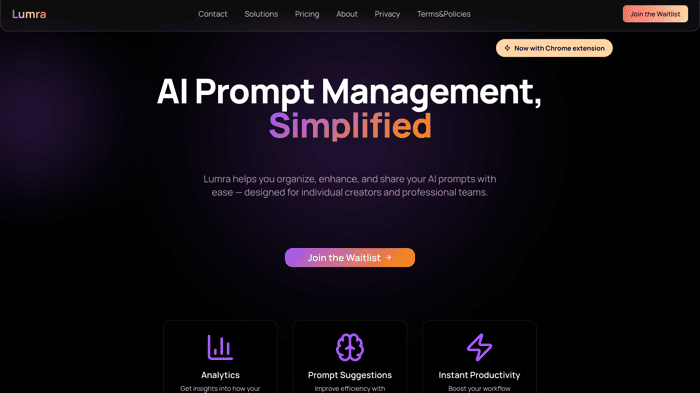
Hey Indie Hackers 👋
I’ve been working on AI projects for a while, and one thing kept frustrating me: managing prompts. They were scattered across docs, browser tabs, notes—you name it. Lost versions, forgotten tweaks, endless confusion.
That frustration sparked Lumra. My goal: a tool where prompts are organized, versioned, and shareable, whether you’re working solo or in a team.
We’re still in the early stages, but here’s what I’ve learned so far building Lumra:
1. Start simple – focus on the core problem first: keeping prompts manageable.
2. Think ahead – structure your data and workflows so they can scale without redoing everything.
3. Use it yourself – nothing shows bugs and UX gaps like actually using your own product.
We’re building in public, and the journey is just as exciting as the product itself. I can’t wait to share development updates, lessons learned, and eventually, the launch with this community.
If managing your AI prompts sounds like a headache you’d like solved—or if you’re just curious—you can join the waitlist here: https://lumra.orionthcomp.tech
Would love to hear from other founders: how do you tackle building tools that solve your own workflow pain points?

Organizing prompts in a way that actually reduces friction is a real productivity multiplier.
At this stage, what’s the one user behavior you’re tracking to know your system is actually making prompt workflows easier — repeat saves, retrieval speed, or fewer abandoned prompt drafts?
Repeat reuse.
When users consistently return to the same prompts and refine them instead of rewriting from scratch, it’s a strong signal that friction is actually reduced.
That’s a strong signal.
One nuance I’ve found useful is how prompts are reused — pure reuse vs reuse-after-small-edits.
When users make minor refinements instead of large rewrites, it usually means the prompt is becoming an asset, not just storage.
Sounds like you’re tracking the right behavior.