Building modern file integrations with FTP, APIs and webhooks
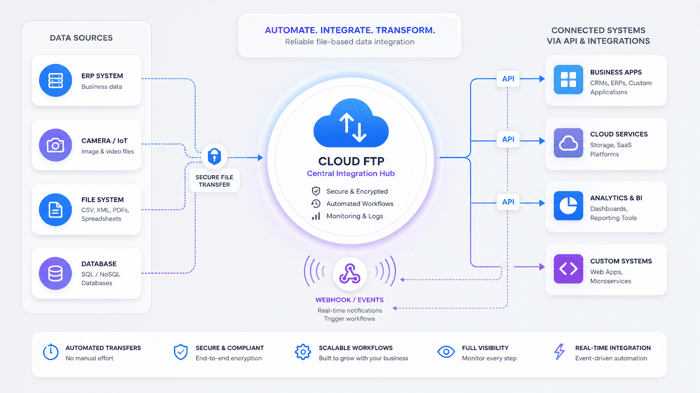
File-based integrations are everywhere.
ERP systems exporting data. Cameras uploading footage. Legacy systems pushing CSV files. Partners exchanging documents.
And despite all the talk about APIs and real-time systems, a surprising amount of real-world infrastructure still runs on one simple thing:
File transfers.
The problem isn’t FTP. It’s everything around it.
The missing layer
Traditional FTP setups are good at one thing:
Moving files from A to B.
But modern systems need more:
- Events when something happens
- Programmatic access to data
- Integration with other systems
- Visibility and control
Without that, teams end up building:
- Cron jobs polling directories
- Scripts parsing file systems
- Fragile integrations
We kept seeing the same pattern again and again:
Things work — until they don’t.
From file transfer to event-driven workflows
What if file transfers weren’t passive?
What if:
- A file upload triggered an event
- That event called another system
- And the data could be accessed via API
That’s the shift from “FTP server” → “integration layer”.
The model: FTP + webhooks + API
We’ve been working on combining three simple building blocks:
- FTP for ingestion
- Webhooks for events
- API for structured access
Individually, these are nothing new.
Together, they unlock something much more powerful.
Real-world example 1: ERP → customer system
Let’s say you need to share data from your ERP system with an external partner — for example an auditor, a customer, or a BI tool like Tableau. You don’t want to give direct access to your ERP, but you still need a secure and automated way to deliver data they can consume.
A common integration flow:
- ERP exports a file
- File is uploaded via FTP
- A webhook is triggered
- Customer system receives the event
- Data is fetched via API
ERP → FTP → Webhook → Customer system → API
No polling. No custom parsing. No glue scripts everywhere.
Real-world example 2: Video surveillance alerts
A very real use case could be a surveillance setup where cameras continuously upload footage, but you only care when something actually happens. You don’t want someone watching feeds all day — you need instant alerts when motion is detected.
Another scenario:
- Camera uploads a video file
- File lands via FTP
- Webhook triggers instantly
- Notification system sends SMS/email
Camera → FTP → Webhook → Notification
Result:
- Real-time alerts
- No constant monitoring
- Simple integration
Real-world example 3: Smarter backups
Many teams rely on scheduled backups, but have experienced silent failures at some point — files are uploaded, but no one really knows if they’re valid or complete.
Backups are usually passive.
But they don’t have to be.
- Backup file is uploaded
- Webhook triggers validation
- API checks file size / existence
- Alert if something is wrong
System → FTP → Webhook → Validation → API
This turns “hope it worked” into something observable.
Real-world example 4: FTP + S3 pipelines
In more advanced setups, you might receive files from external systems, while your processing and analytics live in the cloud — for example on AWS.
You need a simple ingestion point, but also scalable storage and processing.
- Files uploaded via FTP
- Synced to S3
- Webhook triggers processing
- Data flows into pipelines
FTP → S3 → Webhook → Processing
This combines:
- Simplicity (FTP)
- Scalability (S3)
- Automation (events + API)
Why this approach works
Because it separates concerns:
- FTP = ingestion
- Webhooks = events
- API = access
Instead of forcing everything into one system, each part does what it’s best at.
What we’re building
We’ve been working on a cloud-based FTP platform with built-in webhooks, and we’re currently adding a REST API layer. Scheduled for production release end of May 2026.
The goal is simple:
Make file-based workflows programmable.
Instead of treating FTP as a dead end, it becomes part of a modern integration stack.
Final thought
FTP isn’t going away.
But how we use it is changing.
And for many teams, the real opportunity isn’t replacing FTP —
it’s turning it into something that actually fits modern infrastructure.
If you're curious, we've been documenting some of these patterns here:
https://ftpgrid.com/cloud-ftp/
https://ftpgrid.com/tutorials/move-ftp-to-cloud/
https://ftpgrid.com/sync-ftp-to-aws-s3/

This is exactly the kind of product that outgrows its current frame.
FTPGrid is clear, but it anchors the product too low in the stack.
You’re not really building “cloud FTP.”
You’re building file-triggered integration infrastructure.
That’s a much stronger category.
The moment this becomes the programmable layer between legacy systems and modern workflows, “FTP” stops being the product and becomes just one ingestion method.
That’s the shift.
FTP is the entry point.
The real product is orchestration for file-native systems.
FTPGrid works while the wedge is narrow.
Exirra.com fits the broader ceiling better.
Stronger infra signal, less protocol-bound, easier to grow into once this is selling programmable integration instead of managed FTP.