Building my first SaaS without a coding background
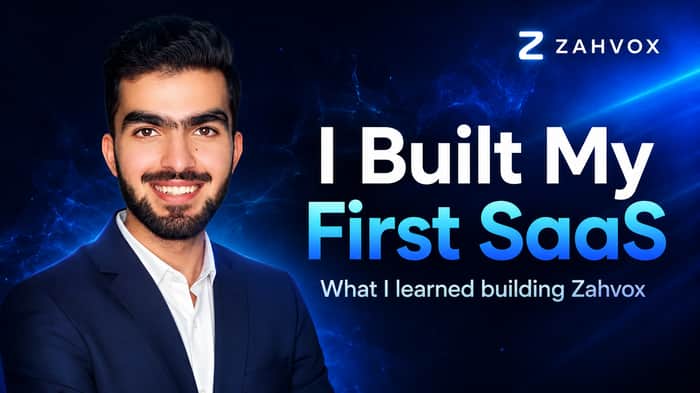
How I went from websites, SEO, automation, and client systems to building Zahvox, a voice-to-writing platform for people who think faster than they type.
I did not come from a traditional software engineering background.
My name is Hussain Jatoi, also known as Hussain Abdul Rauf Jatoi. I am a Business Growth Systems Architect from Pakistan, and most of my work has been around websites, SEO, GEO, lead capture, CRM, follow-up systems, automation, and AI workflows.
Before building Zahvox, I was not the person writing complex software from scratch.
I was the person trying to understand why business systems break.
Why a website gets traffic but does not create trust.
Why leads come in but disappear.
Why teams use tools but still work manually.
Why someone has the right idea but cannot turn it into useful output fast enough.
That way of thinking eventually led me to my first SaaS product.
Zahvox is a voice-to-writing platform for people who think faster than they type.
The first version is simple: a free browser tool where users can speak, get a live transcript, edit the text, copy it, download it, and use writing utilities for notes, emails, meeting notes, word count, reading time, and typing speed.
The product is live here:
My personal site is here:
This is the story of why I started it, what I learned while building it, and why I think AI has changed what non-traditional founders can build.
Where my journey started
I was born in Pakistan and spent around 14 years growing up in Jeddah, Saudi Arabia before returning to Pakistan.
I did not follow the normal path into software.
There was no computer science degree behind this. No traditional engineering job. No years of writing production code at a startup.
My interest in digital work started much earlier and much smaller.
Around 2015, I started experimenting with Photoshop on a borrowed laptop my uncle had sent. At the time, I was not thinking about SaaS. I was just trying to understand how digital things were made.
Design led to websites.
Websites led to SEO.
SEO led to lead generation.
Lead generation led to CRM and follow-up systems.
CRM led to automation.
Automation led to AI workflows.
Over time, I became less interested in isolated tasks and more interested in systems.
A website is a system.
A sales funnel is a system.
A follow-up process is a system.
A content engine is a system.
A business that captures attention, converts leads, follows up properly, and reduces manual work is not built from one tool. It is built from connected parts.
That is the background I brought into Zahvox.
I was not starting from code.
I was starting from friction.
The problem I kept seeing
The idea behind Zahvox started from a very simple problem.
People often have thoughts faster than they can type them.
This happens in meetings.
It happens while planning.
It happens when writing client replies.
It happens when trying to explain an idea.
It happens when preparing notes, emails, drafts, proposals, and messages.
The thought is already there, but typing slows it down.
You start with one sentence. Then you edit it. Then you delete it. Then you rewrite the opening. Before the full idea is even out, you are already polishing the first line.
That is useful later.
But during the first capture, it can slow the idea down.
I noticed this in my own work too. I was already using AI tools, voice input, and productivity workflows. Speaking was often faster than typing. But the problem did not end at speaking.
The spoken thought still needed to become clean text.
It needed to be edited.
It needed to be copied.
It needed to be used inside an email, note, reply, proposal, message, or document.
That is where many normal tools stop too early.
They turn speech into text, but they do not think much about what happens after the transcript appears.
That gap became the idea behind Zahvox.
Why I call it voice-to-writing
At first, it would have been easier to describe Zahvox as a speech-to-text tool.
That is a known category.
People understand it.
Search engines understand it.
Competitors already exist there.
But it did not feel accurate enough.
Speech-to-text is only one layer.
Speech-to-text asks: what words were spoken?
Voice-to-writing asks: what should this spoken thought become?
That difference matters.
A founder may speak a product idea and need a note.
A freelancer may speak a client update and need a polished reply.
A salesperson may speak after a call and need a follow-up.
A student may speak an explanation and need study notes.
A creator may speak a rough idea and need a draft.
In each case, the transcript is not the final product.
The useful written output is the final product.
That is why Zahvox is being built as a voice-to-writing platform, not only a transcript tool.
The mission is simple:
Help people reduce typing friction by turning spoken thoughts into usable writing.
Why I started with a free browser tool
I could have started with a waitlist.
That would have been safer.
A landing page. A few sections. A nice mockup. A “coming soon” form. Maybe some big claims about what the product will become.
But I did not want to test only interest.
I wanted to test behavior.
Would someone open the tool?
Would they allow microphone access?
Would they speak?
Would they edit the transcript?
Would they copy the output?
Would they use it somewhere else?
Would they tell me what felt wrong?
A landing page can get compliments.
A working tool shows friction.
That is why the first Zahvox release is a free web experience.
It is not the full platform yet. It is the first useful layer.
The current version includes:
- free web voice-to-text
- voice recording
- live transcript
- editable transcript
- copy text
- download text
- basic writing utilities
The browser extension, text injection, AI cleanup, formatting, saved history, personas, writing modes, desktop app, mobile app, plugins, and team workflows are part of the larger roadmap.
But I wanted the first step to be simple:
Open the tool.
Speak.
Get text.
Edit it.
Use it.
Building without a coding background
AI made this possible for me.
That is the honest answer.
Without AI development tools and no-code tools, Zahvox probably would have stayed as an idea for much longer. I would have kept writing notes, researching competitors, thinking about positioning, and waiting until I had the right technical partner.
Instead, I could start building.
The early version involved AI development tools, including Antigravity. Later, I used Lovable to build and refine the website, homepage, design direction, structure, and SEO foundation.
That helped me move faster than I could have moved alone.
But I do not think “AI built it for me” is the right way to describe it.
AI helped with execution.
It helped create pages.
It helped structure ideas.
It helped turn product decisions into something visible.
It helped me fix, test, and improve.
But AI did not decide what Zahvox should be.
It did not know which claims were honest.
It did not know which features were live and which were only planned.
It did not know how the product should earn trust.
It did not know which category would make the most sense.
It did not know what I wanted the product to stand for.
That part still needed a founder.
And that became the biggest lesson.
AI can reduce the building barrier, but it does not remove responsibility.
What was harder than expected
The hard part was not only building the tool.
The hard part was clarity.
When you build with AI, you can create a lot very quickly. That sounds good, but it creates a new problem.
You can create too many pages.
You can write too many claims.
You can make the product sound bigger than it is.
You can describe planned features as if they already exist.
You can sound like every other AI tool.
That is dangerous because users do not only judge your product by what it does. They judge whether your words match the product.
If you overclaim, you lose trust.
If you hide what is still planned, you lose trust.
If your tool feels early but your website sounds like an enterprise platform, you lose trust.
So I had to keep pulling Zahvox back to a principle I now care about a lot:
Clear status over hype.
If a feature is live, say it is live.
If it is in development, say it is in development.
If it is planned, say it is planned.
That sounds simple, but when you are excited about the future of your own product, it is easy to blur those lines.
The trust problem in voice products
Voice is more personal than typing.
When someone uses a voice tool, they are not just clicking a button. They are allowing microphone access. They are speaking thoughts into a product.
That creates a trust moment.
The product has to make the user feel in control.
They should know when recording starts.
They should know when it stops.
They should know when text is copied.
They should know when text is downloaded.
They should know when text is cleared.
This shaped how I think about Zahvox.
A voice product should not only look good. It should feel clear.
User control matters.
Honest status matters.
Simple flows matter.
Trust matters before advanced features.
That is one reason I am not trying to pretend the product is already complete. Zahvox is being built in stages, and I want users to know exactly what stage it is in.
Why Zahvox fits my wider work
Zahvox is not separate from my background. It is connected to the same work I was already doing.
My work has been around helping businesses reduce friction in their growth systems.
A website should reduce confusion.
A CRM should reduce lost leads.
Automation should reduce repeated manual work.
Follow-up systems should reduce missed opportunities.
Zahvox applies the same thinking to writing.
Typing friction is a bottleneck.
Blank pages are a bottleneck.
Messy voice notes are a bottleneck.
Raw transcripts that cannot be used easily are a bottleneck.
The aim is not only to build a voice tool.
The aim is to make spoken thinking easier to turn into useful work.
That is why the long-term direction includes writing modes, personas, AI cleanup, saved history, browser extension workflows, and team use cases.
But the first layer has to work first.
Who I am building it for
Zahvox is for people who write often and think faster than they type.
That includes founders, freelancers, agency owners, consultants, creators, students, salespeople, virtual assistants, local business owners, and people who simply hate typing long text.
The use cases are practical:
Founders can capture product ideas, updates, and decisions.
Freelancers can draft client replies, proposals, and follow-ups.
Agency owners can turn spoken campaign thoughts and client updates into usable writing.
Consultants can capture recommendations, frameworks, call notes, and action items.
Creators can turn rough ideas into hooks, outlines, scripts, and drafts.
Salespeople can create follow-ups, CRM notes, and call summaries.
Students can turn spoken explanations into study notes.
This is why I do not want Zahvox to be seen only as a transcription tool.
The product should become useful in daily writing workflows.
What I learned from building the first version
The first lesson is that AI helps you start, but it does not remove judgment.
You still need to understand the user.
You still need to check the claims.
You still need to decide what should be live.
You still need to decide what not to build yet.
You still need to make the product clear.
The second lesson is that a free tool still needs trust.
Free does not mean frictionless.
People still ask:
Who built this?
Is this safe?
Will it work?
Is this a serious product?
Will I waste my time?
That is why I am building the founder profile, company pages, roadmap, values, security notes, and public presence around Zahvox.
Not to look bigger than it is.
To make the product easier to understand and trust.
The third lesson is that positioning is not decoration.
The difference between “speech-to-text tool” and “voice-to-writing platform” changes how I think about the product.
One is about conversion.
The other is about the workflow after conversion.
That distinction guides the roadmap.
The fourth lesson is that simple is not weak.
The first version does not need every future feature.
It needs to make the first workflow useful.
Speak.
Capture.
Edit.
Copy.
Use.
If that habit is useful, the platform can grow from there.
What I would do differently
If I were starting again, I would write the product sentence earlier.
Not a slogan.
A product sentence.
Who is it for?
What problem does it reduce?
What does the user have before using it?
What do they have after using it?
For Zahvox, the sentence is:
Zahvox helps people turn spoken thoughts into usable writing.
I would also separate live, in-development, and planned features from day one.
When you build fast, the future feels very close. But users do not live inside your roadmap. They only see what exists today.
Finally, I would spend more time with user language before writing product copy.
Founders use category words.
Users use frustration words.
A founder says “voice-to-writing.”
A user says “I know what I want to say, but I hate typing it.”
Both matter, but the second one is usually closer to the pain.
Where Zahvox is today
Zahvox is still early.
The free web tool is live.
The browser extension is in development.
Advanced writing features are planned.
I am not claiming a big revenue number yet.
This is not a story about hitting $10k MRR in 30 days.
It is a story about building my first SaaS from a non-traditional path, using AI and no-code tools to cross a barrier that used to feel too high.
For me, that is already a meaningful step.
A few years ago, I would probably have needed a technical co-founder before even testing this seriously.
Now I can build, publish, learn, and improve.
That does not make building easy.
It makes building possible.
That is a big difference.
What comes next
The next step is to keep improving the first workflow and build toward the browser extension.
The extension direction matters because people do not only write inside one tool. They write in email fields, chat boxes, documents, CRMs, web apps, forms, and other browser surfaces.
The long-term goal is to bring voice-to-writing closer to those places.
Over time, I want Zahvox to support:
- better transcript handling
- browser extension workflows
- text injection into input fields
- AI cleanup
- basic formatting
- saved history
- personas
- writing modes
- desktop and mobile experiences
- team workflows
- paid plans for advanced features
But the product principle stays the same:
Do not add complexity before the simple workflow is useful.
The aim behind Zahvox
The aim is to make voice-first writing a normal part of how people work.
Not only for people who want to avoid typing.
For people who think, explain, plan, sell, study, create, and communicate faster by speaking first.
A world where useful writing can start with speech, not a blank page.
That is the bigger direction.
But right now, the work is very practical.
Build the tool.
Make it clearer.
Listen to users.
Improve the workflow.
Keep the product honest.
Grow with patience.
That is where Zahvox is today.
You can try the free tool here:
You can read more about Zahvox here:
https://zahvox.com/
And my personal website is here:
I am curious for other founders here:
If you have built your first SaaS with AI, no-code, or without a traditional coding background, what was harder than expected?
Building the product, explaining it clearly, earning trust, or getting the first real users?
