Built a Free No-Login Tools Site — Made ~$300 with AdSense — Looking for Growth & Strategy Advice
Hey Indie Hackers 👋
I’m Kai, a full-stack developer who builds things because I need them myself. A while ago, I started building geekskai.com — a collection of free, no-login, browser-based tools for developers and creators. The goal was simple: solve small, everyday problems instantly without signup walls or paywalls.
🧰 What the site is:
No accounts
No subscriptions
Quick, practical tools (converters, generators, calculators, etc.)
Built for fast “instant utility” in the browser
💡 Why I built it:
I was tired of tools that force you to register, subscribe, or pay before you can use something as simple as a converter or timestamp generator. So I put mine online for anyone to use — instantly and for free.
📊 What’s interesting so far:
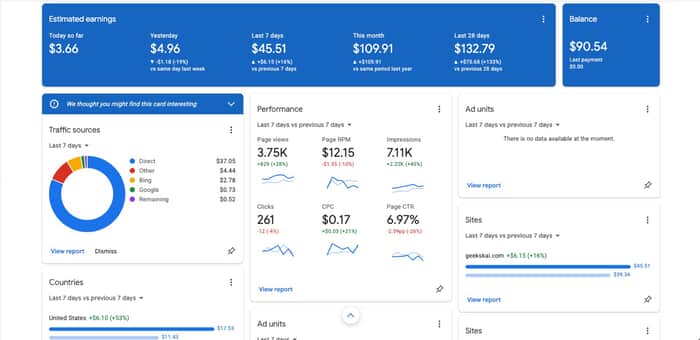
I added Google AdSense mostly as an experiment — not expecting much — and I was surprised to see real revenue. From Jan 1–present the site has:
~$300 in AdSense revenue this month
~3.2K pageviews
~$14 RPM (which feels promising for this type of product)
It’s not huge, but for a project with no paid marketing or heavy growth work, it feels like a meaningful signal.
🙋♂️ Where I need help
I’m primarily a dev — not a product marketer or growth specialist — and I’m trying to learn how to grow something like this properly. I’d love the community’s insight on things like:
What kinds of tools you personally bookmark and use often?
Should I stay broad with many different tools, or focus deeply on a specific niche?
How can I think about product positioning and growth?
At what point would you consider paying for additional features (if at all)?
Any tips on community building, SEO, or distribution for a tool-centric website?
If you’re curious to check it out: 👉 https://geekskai.com/tools/
Thank you so much for reading — really looking forward to your feedback and questions!

This is an awesome start! I have several similar tools I use like this all the time as an engineer. I love the collection aspect where I currently have to go to several different places to find decent versions of what I'm looking for. More recently the ones I've been using are JWT validation, base64 decoding and encoding, and converting formats between json, csv, yaml, etc.
As far as paying for tools like this it would fall on API access that would allow me to automate my workflows when needed as opposed to going to the site to do one off jobs. For example, I pay for an image conversion API because I got tired of going to the free tool online and I use it often.
Thanks a lot — this is super helpful feedback.
I really resonate with what you said about the “collection” aspect. As an engineer, I also hate having to jump between a dozen different sites just to find a decent JWT tool / base64 decoder / JSON↔CSV converter, etc. That’s exactly the pain I’m trying to solve with this site.
And your point about monetization makes total sense: the web tools should stay free for quick one-off tasks, but API access for automation is where paying becomes worth it (especially once a tool becomes part of a workflow). The image conversion API example is a great real-world proof of that.
If you don’t mind me asking — what would make an API version compelling for you?
(e.g. pricing model, rate limits, auth style, batch endpoints, SDK/CLI support)
Really appreciate you taking the time to share this.
My biggest motivation these days is ease of use followed by pricing.
I'm pretty versatile when it comes to many things as I'll just throw together a wrapper to simplify anything as needed.
Most of my side projects are relatively small but some of them hit crazy bursts of traffic that push me into paid cloud tiers when I'm not even making money on them. It's hard to justify keeping a project going when it's costing me a ton of money. So, I end up building tools like the gateway I just launched which then allows me to shuffle my traffic around to various clouds and ride the free tier wave for much longer before incurring any costs.
I really love the idea of micro tools—they’re seriously undervalued. You can build a few of these tools and easily make $1–2k per month. Some tools I built over a weekend took just 6–7 hours, and they’re still making me money without me touching those projects.
That’s really encouraging to hear — and honestly, it matches what I’m starting to feel too.
I’m still early in this and very much learning as I go, so it’s great to hear from someone who’s actually seen micro tools compound over time. The fact that some weekend builds can keep earning passively is kind of the dream scenario I’m hoping to get closer to.
Out of curiosity, what made the biggest difference for you in getting those tools to actually make money?
Was it SEO, distribution, picking the right problems, or something else?
Would love to learn from your experience.
Really cool project, I love the zero-friction approach and it’s nice to see it already getting some traction
Thanks a lot — really appreciate that.
The zero-friction part is actually the core idea for me. I wanted everything to be usable instantly without accounts or setup, because that’s what I personally look for when I need a quick tool.
Still early days, but the initial traction definitely gives me motivation to keep iterating.
If you have any thoughts on what usually makes tools like this stick for users, I’d love to hear them.
This really resonates. Small, no-login tools solve real problems fast, and that trust compounds quietly. ~$90 may sound small, but it’s strong validation for zero-friction products done right.
This is really well said — especially the part about trust compounding quietly.
That’s exactly what I’m hoping to build over time: something people can rely on without friction or hidden costs. The revenue itself isn’t the main goal yet, but it’s reassuring to see that this approach can validate itself in a sustainable way.
From your experience, are there any signals you usually watch for to know when a zero-friction product is worth doubling down on?
That’s helpful, thanks.
One signal I’ve started paying attention to is repeat usage without reminders — when people just come back because it’s the fastest option.
Another early sign for me is tools getting bookmarked or shared internally without me pushing them.
Curious if you’ve seen similar “quiet signals” beyond revenue.
Those are great signals — bookmarking and internal sharing are especially underrated indicators in my experience.
They’re quiet, but they usually mean the tool has crossed that line from “interesting” to “useful enough to rely on.”
Appreciate you sharing these — definitely helps me think about what to pay attention to beyond surface metrics.
Thanks again for the thoughtful discussion.
The "instant utility" insight really resonates. I've bookmarked a bunch of these minimal tool sites, and what makes them sticky is exactly what you described — zero friction.
Curious about a few things:
Traffic sources: Are most visitors coming from Google search? If so, are there specific tools that dominate traffic? I've noticed with utility sites, 1-2 tools often drive 80%+ of pageviews.
$14 RPM is actually solid for developer tools. Are you seeing higher RPM on certain tools vs others? Tools with more "decision-making" intent (like converters before a deployment) might perform better for ads.
On the "niche vs broad" question: I'd personally lean toward depth in one area first (like dev utilities), then expand. Makes SEO easier and builds a clearer mental model for users.
For the "would pay" question — I'd consider paying for CLI versions, batch processing, or API access for automation. The web interface stays free, but power users get paid options. That's basically how devhints.io and similar sites evolved.
Nice progress on a quiet project. The 64% week-over-week growth suggests you're onto something.
Really appreciate you taking the time to write such a thoughtful breakdown — this is incredibly helpful.
On traffic: yes, most of it is coming from Google search right now. And your 80/20 observation is spot on — a small number of tools are already driving the majority of pageviews. I’m still analyzing which ones deserve more focus, but that pattern is definitely emerging.
On RPM: I’m seeing noticeable differences between tools, and your point about “decision-making intent” makes a lot of sense. Tools used right before an action (deployments, conversions, formatting, etc.) do seem to perform better, even with similar traffic.
The niche-first approach also resonates with me. Staying focused on developer utilities feels like the right next step before expanding horizontally.
And the paid ideas you mentioned (CLI, batch processing, APIs) are especially interesting — that feels like a natural way to keep the web experience free while offering value to power users. I haven’t built anything paid yet, but this is exactly the direction I’ve been thinking about.
Thanks again — comments like this are a big reason I wanted to share the project here.