Built AIToolStack in 2 days — launching Tuesday. 4 signups, zero audience, one big personal number.
Quick share from an in-progress launch. Putting this here because IH is the only community where being early and small is a feature, not a bug.
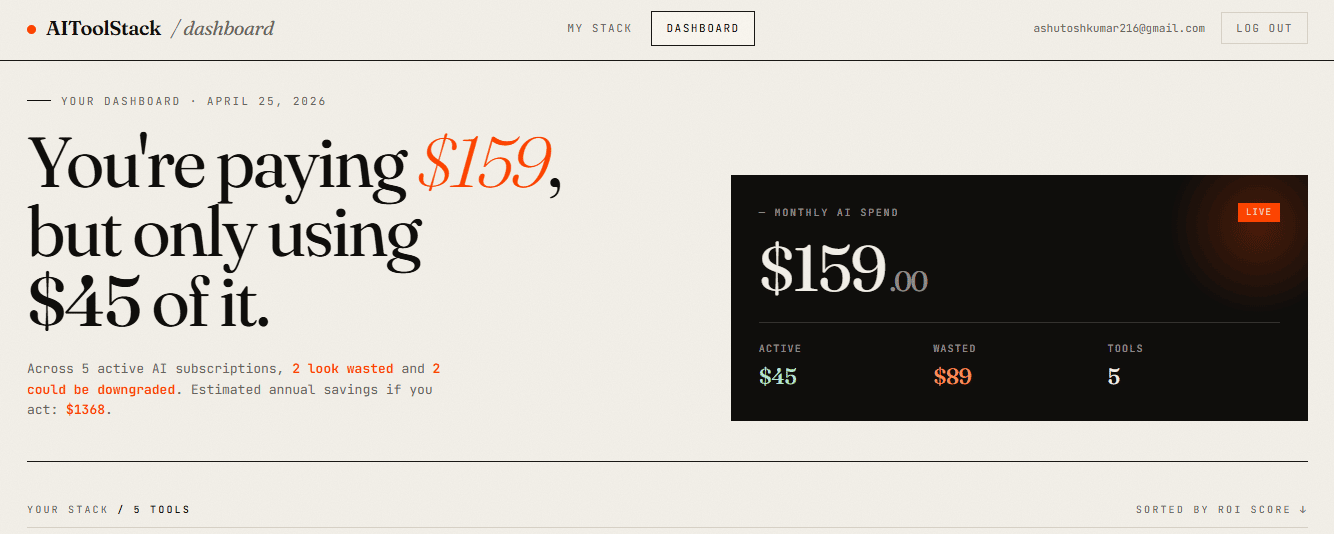
Context: I'm a full-stack dev. Built AIToolStack over two 10-hour days this week. It tracks your AI subscriptions and tells you which ones to Keep, Downgrade, or Cut based on actual usage — because I was paying $159/month across 5 AI tools and using only $45 worth.
Where I am right now:
- Product is code-complete — auth, dashboard, payments (Dodo), 5-tool free limit, Pro at $9/mo
- 4 waitlist signups (from 20 personal asks)
- Zero social media presence
- Launching on r/InternetIsBeautiful this Tuesday 6 PM IST (8:30 AM ET)
Stack:
- Vanilla HTML/JS (no framework — deliberate choice for ship speed)
- Supabase (auth + Postgres)
- Vercel (hosting)
- Dodo Payments (India-based indie-maker friendly payment infra)
- Fraunces + JetBrains Mono for the aesthetic
- $0/mo infra cost on free tiers
What's working:
- The daily check-in (yes/no per tool) is the feature, not the UI. The 10-second reflection is what actually changes behavior. Was going to be embarrassed about "no automation" — ended up being the soul of the product.
- Free tier with a 5-tool limit as the wedge. Feels natural because most real people have 4-6 tools, not 10.
- Dodo Payments integration took 30 min with a static checkout link. Manual grant of Pro access for launch week, webhook automation in week 2.
What I don't know yet:
- Whether the Reddit narrative resonates at scale — tested on 20 warm contacts, 4 converted. Cold stranger conversion could be anything.
- How to handle the "why not automate the check-in with an extension?" comments I know are coming.
- Whether the aesthetic (editorial/warm paper vs. generic SaaS purple-gradient) helps or hurts.
My honest numbers after a week of tracking:
- Paying $159/month across 5 tools
- Using $45 of it
- 1 Keep (Claude), 2 Downgrade (ChatGPT, Midjourney), 2 Cut (Jasper, Gemini)
- Annual savings if I act: $1,368
Pricing:
- Free: up to 5 tools
- Pro: $9/mo — first 50 locked in forever
- No annual plan yet (will add post-launch if traction is real)
https://aitoolstack-three.vercel.app
Will update with launch results next week — good, bad, or ugly. Feedback and brutal questions welcome.


Quick update on the launch:
Tonight at 6 PM IST I posted to r/indiehackers, r/SaaS, r/SideProject, and r/IMadeThis — all 4 got auto-removed by automod within 1 minute.
The reason: 9 karma, zero comment history. Reddit's spam detection treats new accounts posting external links as marketing bots, regardless of content quality.
Lesson for any solo dev planning a Reddit launch: build 100+ karma over 4-6 weeks of genuine commenting BEFORE you need to post. Don't wait until launch week.
So tonight is a different launch than I planned. The product is live regardless: https://getaitoolstack.com — free up to 5 tools, $9/mo Pro for unlimited, first 50 founders lock in $9 forever.
I'll rebuild Reddit presence over the next 2 weeks for a proper relaunch. For tonight, this thread + LinkedIn are the launch.
If you've ever launched something and had a channel disappear out from under you in real time — would love to hear how you handled it.
This is a nice execution, especially launching quickly instead of overbuilding. A lot of AI directories try to do too much early, but keeping it simple and getting initial users is a smart move.
Curious how you’re thinking about differentiation though, since there are quite a few AI tool directories already. Are you focusing more on SEO, curation quality, or a specific niche to stand out?
Thanks — appreciate it.
Quick clarification on positioning, because it's actually different from the directory question: AIToolStack isn't a directory of AI tools. It's a personal tracker for the AI subs you already pay for.
You add your own stack (ChatGPT, Claude, Midjourney, whatever you use), log yes/no each day on whether you actually used each one, and after a few days the dashboard tells you what to Keep / Downgrade / Cut based on your real usage — with the dollar savings.
So the differentiation isn't "vs other directories" — it's vs spreadsheets and "I'll cancel that next month" intentions. Closest analogy is a habit tracker for subscriptions you've stopped using but keep paying for.
The use case I had: paying $159/mo across 5 AI tools, only using $45 worth. The 10-second daily check-in is what surfaces that gap. Directories don't solve this — they just help you find more tools to add (which is part of why people end up overpaying in the first place).
Also launching Tuesday (small portfolio of three SaaS apps, also no audience to speak of). The $159 paying / $45 using split is the kind of number that survives because it's not round and it's personal. Keep that in the lede. The deliberate-friction framing for the daily check-in is genuinely good and I'd push it further: most "AI usage analytics" tools fail because they tell you what you used, which you already knew. The yes-no reflection makes you decide, which is the actual scarce resource. One thing I'm curious about: what's the 60-day retention story? If the tool works, people cut what they need to cut and then arguably don't need it. Or does the monthly check-in keep them in the loop because subscriptions keep mutating? Your first 50 Pro users will answer that and I'd be curious what you find.
This is the question I keep coming back to, and the honest answer is "I don't know yet." Three hypotheses, ordered by what I want to test:
1. Stack mutation. AI tools launch every week. Right now I've added 5; in 3 months I'll have probably tried and cancelled 3-4 more. If the cycle keeps going (which I think it will — 128 new AI platforms launched in 2025), the check-in mechanic stays useful as long as new tools keep entering the stack.
2. Habit-as-product. The 10-second yes/no isn't really about tracking — it's about forcing a reflection moment. Some users might keep paying not because they need new verdicts but because the daily friction is what protects them from re-accumulating subs. That's a "product as commitment device" play, like Headspace for spending.
3. Adjacent expansion. Once someone trusts the dashboard for AI tools, they probably want it for non-AI subs too — Notion, Figma, etc. AIToolStack might earn the right to expand into general subscription tracking after the AI niche proves out. But I'd want to nail AI-only first.
Honestly, what I expect to learn from the first 50 Pro users: months 1-2 are easy (initial cleanup is the hook), months 3-6 reveal whether mutation + reflection are real, or whether I'm building a tool people use once and churn. If churn is brutal at month 4, the answer might be a yearly check-in product instead of monthly subscription. That's actually fine — I'd rather know.
What's your launch on Tuesday? If you're shipping with no audience too, would be good to compare notes on the launch-week numbers.
The $159 paying / $45 using split is a genuinely strong hook — that's the kind of specific, personal data that makes people immediately wonder what their own number is. I'd lead with that in the Reddit post before naming the product.
The "why not automate?" objection is worth pre-empting. The daily yes/no check-in is deliberate friction that forces the reflection — automation defeats the point. Frame it as a feature: "this is a tool that asks you to think for 10 seconds, not one that thinks for you."
One thing harder than getting cold conversion data is getting structured, actionable feedback before you launch to a big audience. 20 warm contacts told you whether they signed up — but did they tell you what confused them, what UX friction almost lost them, or what they wish was built differently? That pre-launch feedback gap is a real problem for solo devs launching fast.
I'm building something called Stackrate to address exactly that — dev-to-dev peer review with a credit system so the feedback is structured and comes from other developers who actually ship. If you search for it you can find the waitlist. Happy to give your tool a look too — the $9/mo first-50 pricing feels right for this space.
Genuinely good feedback — both points land. I'm reworking the Reddit opener to lead with the $159/$45 number before product context (the backstory was burying the lede). And "a tool that asks you to think for 10 seconds, not one that thinks for you" is the cleanest framing I've seen — borrowing that for the response template I'm building for the inevitable "why not automate" comments.
Re: Stackrate — I'm going to stay focused on the Reddit launch this week, but I'll genuinely take a look after Tuesday when I have headspace. Pre-launch feedback gaps are a real problem and I'd be curious to see your approach.
Hey 👋 love the honesty in your post — building fast and validating instead of over-engineering is the right move
The problem you’re solving (wasted AI subscriptions) is super relatable and has strong potential
Since you’re launching with zero audience, getting initial traction quickly will be key
We help early-stage products get their first users through targeted promotion using creators on platforms like TikTok, Instagram, and YouTube
Happy to share a few ideas if you’re open 🚀
Appreciate the offer. I'm staying focused on the Reddit launch this Tuesday before considering paid promotion — want to see how the organic channels perform first so I have a baseline. If the launch goes well and there's budget for testing, I'll keep you in mind.
I like the concept. Plus the editorial theme looks better. It gives a more unique look than most dark-themes, bluish purple accented apps.
Thanks — that means a lot, honestly. The aesthetic was the part I almost talked myself out of. Every "indie SaaS template" pushes you toward the same dark-purple direction, and I kept worrying it'd look too unconventional for an AI tool. Decided to commit to it because Fraunces + warm paper just felt right for a product that's about reflection (the daily check-in) rather than dashboards-as-dopamine.
Curious — do you pay for AI tools yourself? Trying to gut-check whether the $159/$45 split is unusual or pretty common.