Case Study: AI Trainer Platform and Job Board [Months 1-6]
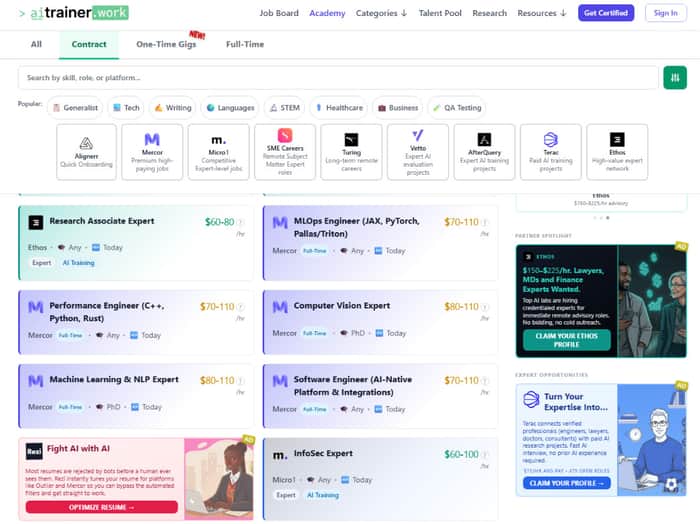
I launched aitrainer.work back in January, initially as a job board and aggregator that pulls together AI training, RLHF, and data annotation opportunities from different platforms. Today it also comprises platform intelligence and user reviews, an AI training academy with optional paid certification, a gro
wing Talent Pool with hundreds of registered candidates, and more.
The Job Board
Internally I've built about a dozen scrapers for the main platforms offering these jobs. They run regularly to pull fresh opportunities into my database. Then I consolidate everything into one searchable dataset that populates the site.
The unique aspect about this market compared to other types of work is that people hunting for AI training gigs don't stick to one platform. These are all project based, contract work. Multiple opportunities means multiple applications. So even if they find work with one platform, they still need to actively hunt for more projects. My job board aggregates all these opportunities in one place rather than having them jump from one platform to the other. That said, I am far from the only person doing this, there are dozens of similar sites out there. But I am making sure people come back by providing the most added value and best possible user experience.
Money Talk
Almost every platform I cover has a referral program. Someone applies through my link, they get hired or onboarded, and I get a commission or revenue share on their earnings. Here's where it gets messy. These platforms onboard hundreds of people but often don't have enough projects immediately available. So candidates sit in the pipeline waiting, sometimes for months, sometimes they never actually get any work despite being onboarded.
I have hundreds of people successfully hired through my referral links. Maybe a handful have actually started working and generating revenue share for me. That's why most of my early earnings came from onboarding bonuses rather than actual rev share. It's supposed to flip once people get assigned projects, but that takes time.
Month       Sessions   Revenue   Notes
January     9.5k       $709      Launched main site
February    7.2k       $305      Got hit by Google update
March       7.9k       $24       Referral lag hitting hard
April       9.6k       $270      Launched talent pool, free academy
May         12k        $150      Still in the pipeline gap
June        15k        $1,360    Paid certification live
Google Penalty and the Bing Lifeline
I shipped in early January. Google indexed me immediately and ranked me well. Then in February, after that big Google update, traffic basically disappeared. A bunch of pages got de-indexed.
Honestly? I'm not worried. It's a brand new site, and pSEO sites always take hits. Instead of dying though, traffic stayed steady because Bing and ChatGPT started sending me users. There's some irony in an AI training job board getting most of its organic traffic from AI chatbots, but I'm not complaining.
I've launched some long form content and I'm testing different approaches, but recovery isn't my biggest concern right now.
My Job Board is Better Than Yours
100% of my effort when designing this site was being different and better than everyone else. My background in UX really helped here, as most sites these days are vibe coded but delegate every aspect of the design process to AI and rarely conduct any research or iterate on what they do.
The turning point happened recently when one of my major partner companies reached out directly. They needed help sourcing high quality candidates for specific RLHF roles and I went into my talent pool of 500 plus candidates and sent targeted manual invites for those roles to relevant candidates. Based on the data I have I estimate a placement rate of 8 percent, which is huge for this industry.
Tech Stack
I started building aitrainer.work with OpenGraph's Ampcode back when they had a free tier. I then switched to Claude Pro in March and basically used it as a second member of my team since then. I handle product, design, and strategy. Claude questions my ideas and we co-design a final plan. It then does the heavy lifting on the code. It's worked well, though I did blow twenty bucks in API costs in half an hour the other day because I hit my weekly limit mid sprint.
The UX first approach has kept competitors from getting traction even when they've straight up copied parts of my site. Someone lireally copied my whole site including the academy modules and paid certification (they didn't even bother to change any of the names). But they're building AI sloppy, and they do not have a engaged user base, and I'm building and iterating around actual user feedback.
What's Next
The obvious play is fixing the Google situation. If I can recover and get the technical SEO sorted, traffic should double or triple from there. I am currently focusing on embedding proprietary data onto each and every of my pSEO pages and make sure they have something to offer besides "here's a job we found".
Beyond that I'm thinking bigger: proprietary tools like a CV builder instead of relying on affiliate ads, a B2B hiring portal where companies pay for direct access to the talent pool (real MRR), and eventually publishing proprietary market research based on my data to generate authority and backlinks.
Right now it's still a one person operation running on passion and a solid hourly rate equivalent, but the unit economics are finally pointing in the right direction.

The interesting transition seems to be moving from an AI job aggregator into a talent intelligence platform.
What would convince you that companies paying for access to your talent pool is the stronger long-term business model, rather than continuing to optimize the referral marketplace?
The most interesting shift here is from aggregation to intelligence. A larger database is useful, but your defensibility seems to come from understanding each candidate’s skills, history, preferences, and readiness well enough to surface the right opportunity at the right moment.
Your targeted invitations—and the estimated 8% placement rate—look like early evidence of that. Have you considered making this personalized opportunity intelligence the core product experience, rather than treating the job board as the center?