Case study: How Bonsai nails free trial UX for higher conversion
Hey, hackers! Would love to share with you the first issues of a new newsletter.
Here we uncover product design insights from successful SaaS companies to grow our products.
There is a ton of debate around whether to require CC to start a free trial or not.
In this issue, we are looking at how Bonsai designed a flow that leverages the best from both options.
Let’s go.
Vova
Who are we looking at
Bonsai is an all-in-one SaaS tool for freelances that helps take care of contracts, invoices, time tracking, tasks, etc.
G2 Rating: 4.8 out of 5 (48 reviews)
Users: 500k+ (*based on their website)
Bonsai’s solution takes best from both
In nutshell, Bonsai requires a CC to start a free trial. But WHEN they do that is what makes a difference.
Let’s have a closer look at how they do that.
1/ Frictionless sign up
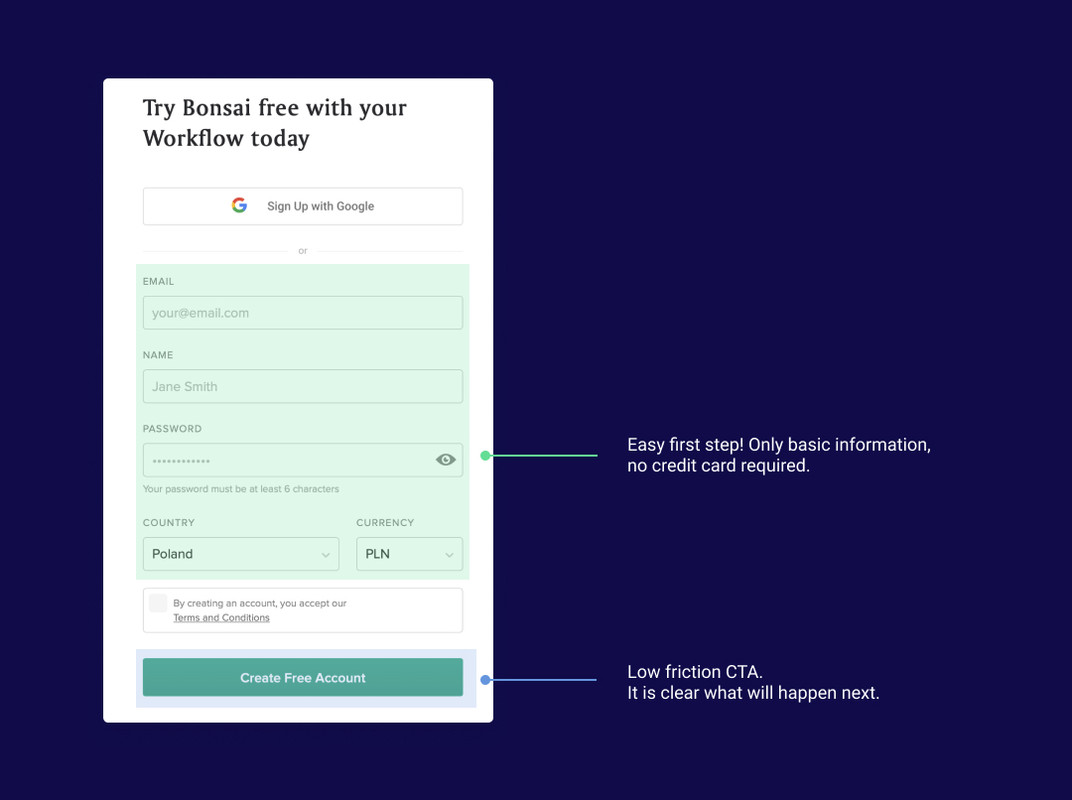
💡 2-step sign up
Though Bonsai requires the CC to start a free trial, they don’t do that on sign up.
If a user isn't ready to start a trial, Bonsai can reach them via email later.
2/ Optional free trial
At the end of their onboarding, they ask if you’d like to start a trial.
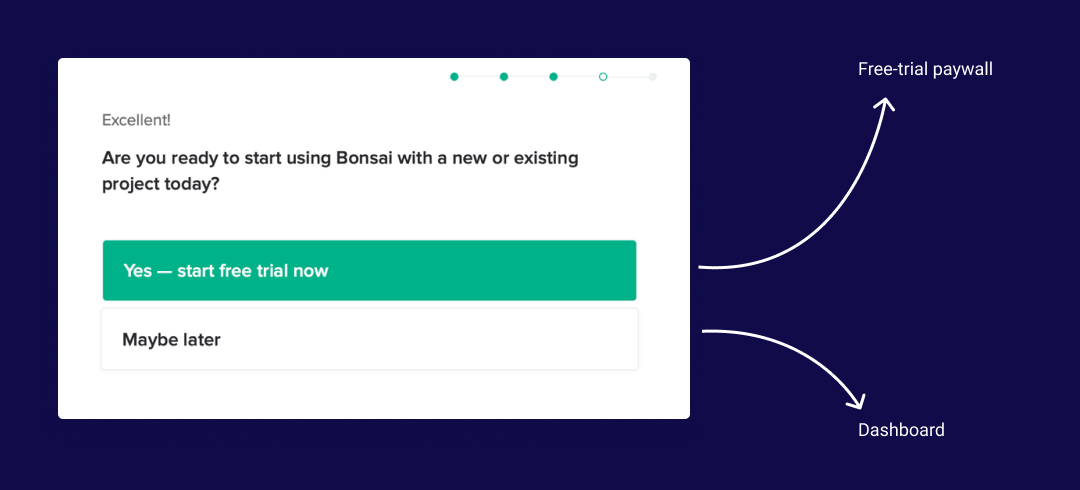
💡 Don't lose those who don't yet trust your product enough.
The most qualified prospects would start a trial anyway.
The hesitant ones have a chance to build more confidence in your product.
3/ Freedom to explore the product
Once you skip the trial step, you’re free to look around the product.
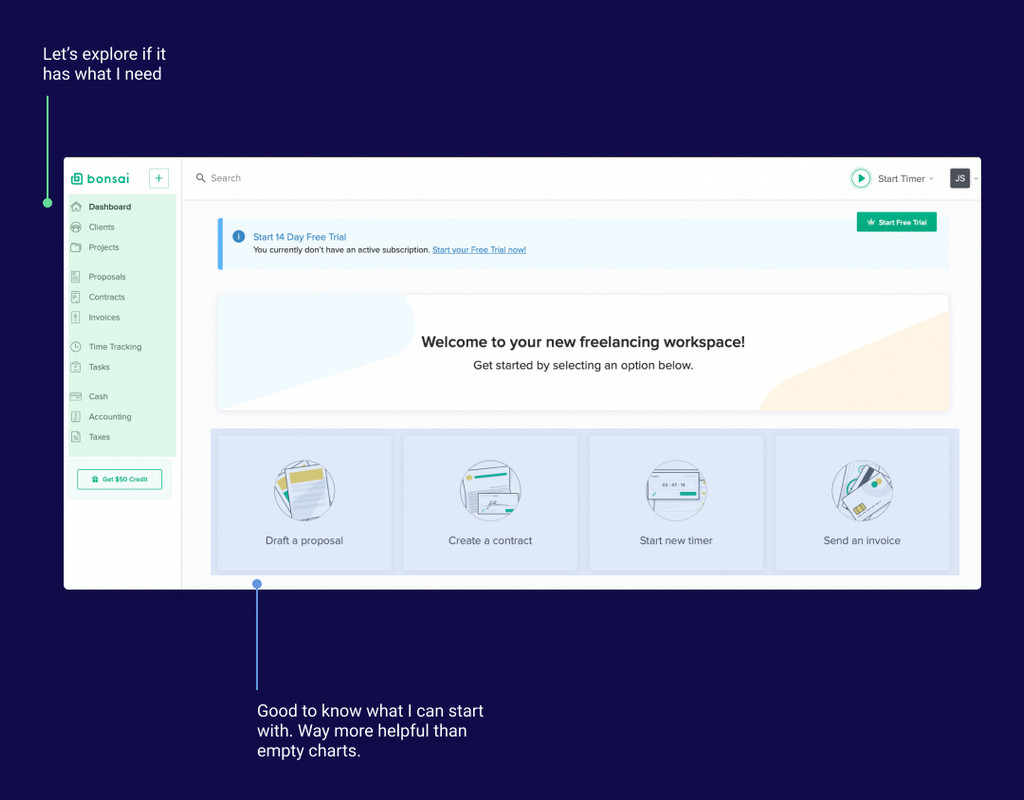
💡 Don’t leave the user in a void
When we don't know what to do next, we leave.
Always show what’s the next step is.
4/ Educational feature pages
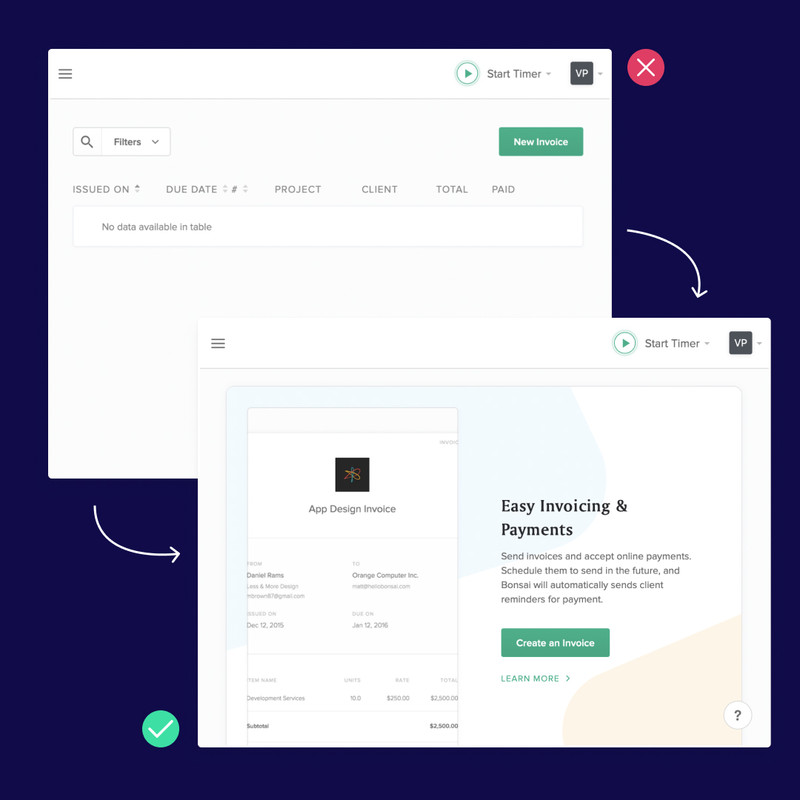
When you explore the product, you see a micro placeholder instead of empty screens.
Bonsai guides users on what to expect, how it works, and what to do next.
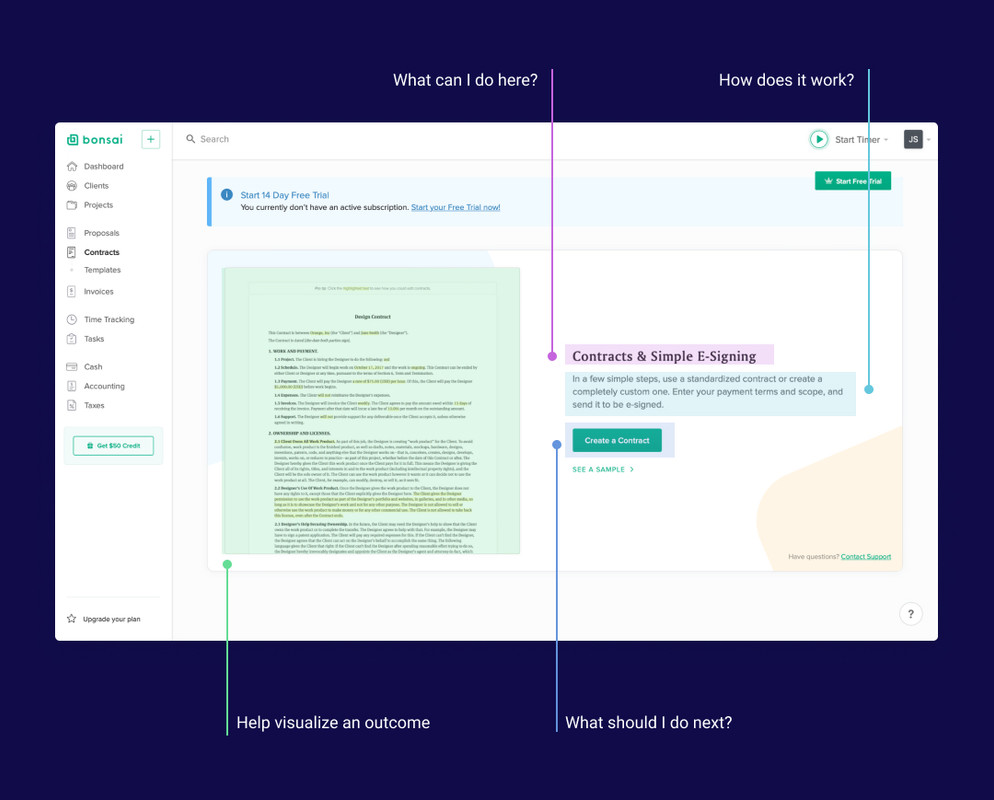
💡 Show your product in action.
Use empty states to show the value of your product and educate your user on how it works.
The better user understands the product, the more confidence they have.
Here’s an example of how to implement that:
5/ Gated product usage
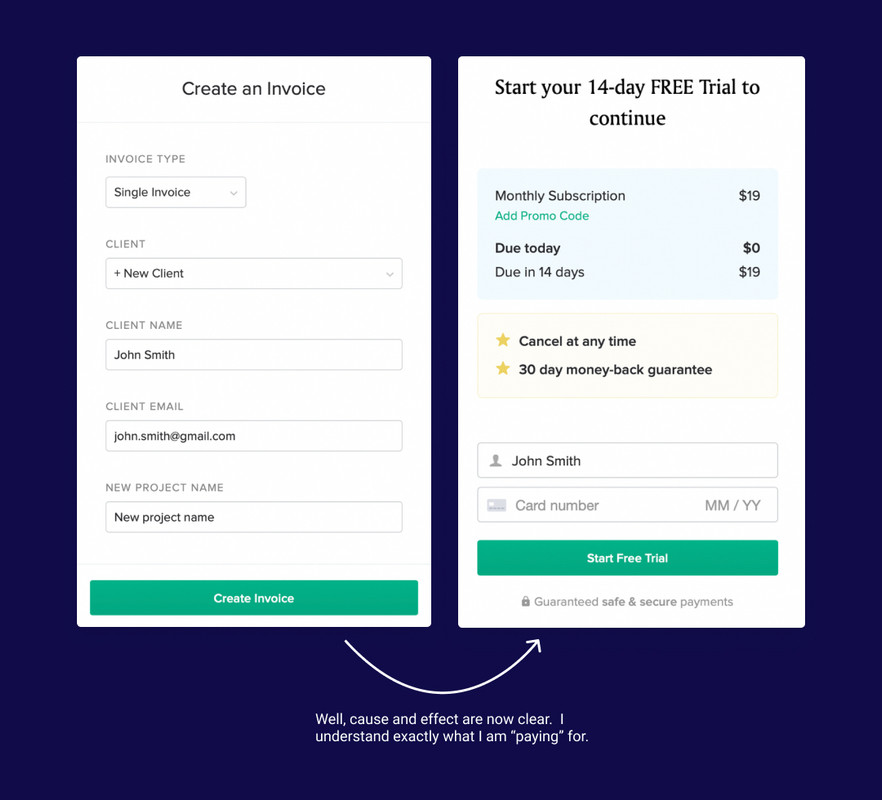
When you want to create a contract, task, or project - you’re prompted to start a free trial.
They don’t gate viewing the product. The gate using the product.
💡 Feature gating
You prompt the user to start the trial right before they get what they want instead of asking for CC before they see the product.
Users build more trust & confidence up until that point. As a result, more users will be willing to share CC to start a free trial.
6/ Paywall that addresses objections
💡 Handle objections
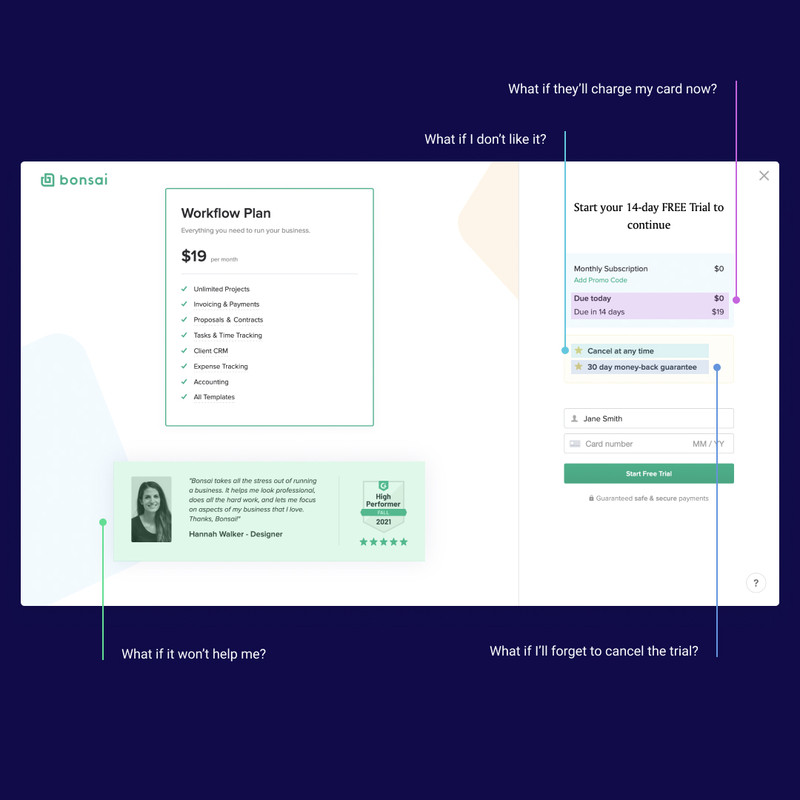
When we get a CC out of our wallets, it is when all the fears come up. Help users to address the fears that hold them back from taking action.
- It won’t help me → Social proof
- What if I don’t like it? → Cancel any time
- I’ll forget to cancel the trial → 30-day money-back guarantee
- They’ll charge my card now → Due today: $0
How to apply to my product?
Here’s what we can learn from Bonsai about free trials that require CC on file:
- Use 2-step checkout, so you can reach those who aren’t yet ready to add cc on file.
- Give users an option to look around if they are hesitant to start a free trial. Gate using, not viewing.
- Use empty states as a chance to showcase the value of your product.
- Proactively address user objections on the paywall
Product question
How it the results will change if you’ll swap your trial terms? Does the trial you have now best for you?
Resources
Here are the links if you want to dig deeper into the free trial topic:
- SaaS Free Trial: Credit Card or No Credit Card? Here’s the Verdict
- SaaS Free Trial: Require a Credit Card to begin?
- “No Credit Card Required” -- Increase Sign-Ups With Cardless Free Trials
- SaaS Free Trial: Requiring a Credit Card is Shortsighted
And this is it for the first issue!
Thank you for reading 🙂
Kudos to @sweatC for early feedback and for helping to make 1st issue better.
Is it something you’d like to see more? Subscribe here to get the next issue to your inbox https://www.getrevue.co/profile/theventur
P.S. Would love to hear your feedback about the first issue ✌️

Great post here! And a solid topic too. This will be super helpful for a lot of IHers.
To go even deeper into onboarding, where do you think product tours fit into helping to convert free trials into paid users?
We're building Driftly so this is always a big topic of conversation for us. In most cases, the higher rate you get credit card details, the higher rate you'll convert. But what about ending product tours with add your credit card details here, upgrade to a paid plan here, etc?
P.S. Love the formatting of this post. Thanks for using markdown. You rock ❤️
Thank you for your comment, @joehoward!
The faster users can see the value of the product the higher chances that they'll put in their credit card details. And product tours are doing a great job here.
Asking for CC after a product tour I think is great timing as you build goodwill with the user. And they had a chance to build more trust that the product can solve their problem.
And when you have it another way around (paywall -> product tour) I think you lose all the benefits of the product tour. Since the ones who were the most convinced would get there anyway. But the users who didn't trust enough didn't have a chance to learn more.
The only reason I am on the fence regarding product tours is that it was so much pain in the ass to code them :)
Totally agree. You want to give product tours to those who need you to build trust with them the most!
Good thinking. I think using product tours to get somebody to add their credit card or upgrade to a paid account needs to happen at very specific times.
The first tour might be too early since the user most likely hasn't discovered the value of the product yet.
But after a few tours might make sense.
Or as the last item in a checklist.
Driftly also has segmentation so you could target these messages to users who have been more active, completed other tours and seen the most impactful areas of the product.
I lucked out and get to work with @jacobbeckerman so it's "easy" for us apparently haha. Hopefully your challenge in coding tours means it's hard for others who will see our product and rather pay to integrate product tours than build it themselves 😆
As someone who was coding it, I'd rather pay than do it again :)
Music to my ears 🎷
Thanks for sharing such kind of detail information. I will definitely apply it on https://fantaserye.su/ and will share the results here. I hope that the results will be positive.
Glad it resonated @jaison512
Unbelievable & a best motivation for the newbie.
THANKS, for sharing the information. I will definitely apply this to my site https://doramasqueen.live/ and will back to the result. Hope these will be positive.
Amazing post!
I'll be taking this into consideration as I begin the UI/UX design to side-project I'm getting started on.
I'm new to Indie Hackers and it's these types of posts that make me grateful I found Courtland's podcast. You've gotten yourself a well-deserved email subscriber.