Challenges in building a smart golf ball
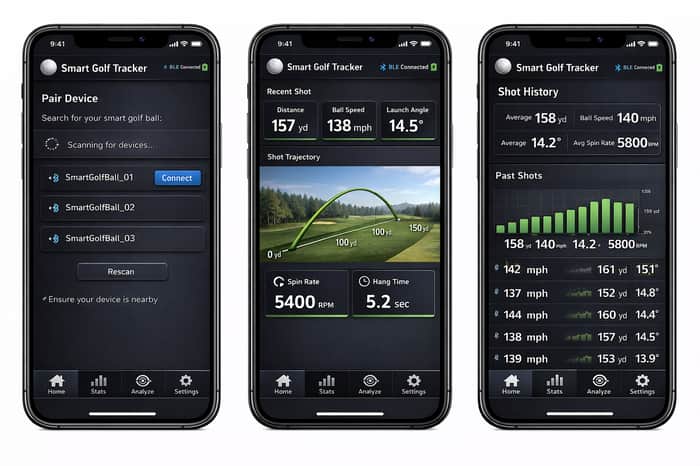
Earlier, I shared the case study behind a smart golf ball project we worked on.
Now, I wanted to have a deep dive into the trouble we went through making this product work, as before prototypes we needed to address a few concern.
But firstly, the idea sounded simple.
Just a chip enabled golf ball capable of tracking motion, spin, impact force, and directional movement using BLE and onboard sensors.
But once we entered real hardware development, the project turned into a series of engineering challenges.
- Extremely Limited Internal Space
A golf ball gives almost no room for electronics.
We had to fit:
• BLE communication
• IMU motion sensors
• Battery
• Power management circuitry
• Compact PCB
Inside a very small enclosure without affecting the overall balance or feel of the ball.
Even tiny PCB layout changes affected:
• weight distribution
• sensor accuracy
• wireless performance
- Achieving 9–12 Months Battery Life
This became one of the biggest challenges in the entire project.
The requirement was clear:
The device needed to run for nearly 9–12 months on a tiny battery.
To make that possible, we spent a lot of time optimizing power efficiency.
Some major optimizations included:
• implementing deep sleep modes
• reducing unnecessary BLE activity
• optimizing wake-up timing
• tuning sensor polling intervals
• minimizing idle power consumption
Balancing long battery life with real-time motion tracking was much harder than expected.
- Handling High-Speed Impact Vibrations
During testing, impact vibrations created unstable IMU readings.
The sensor data looked fine during normal movement, but high-speed golf hits introduced:
• motion noise
• inaccurate readings
• inconsistent tracking data
We had to recalibrate sensor filtering and optimize firmware logic multiple times before getting reliable results.
- BLE Performance Inside a Compact Enclosure
Wireless communication inside such a small enclosure was another challenge.
A small antenna placement adjustment could:
• improve range
• reduce signal strength
• affect connection stability
RF tuning became a critical part of the hardware design process.
- Real-World Testing Changed Everything
Bench testing was not enough.
The real issues only appeared during actual movement and impact testing.
That phase exposed problems related to:
• vibration handling
• battery drain
• BLE stability
• sensor calibration
A lot of redesign and firmware tuning happened after real-world testing.
Final Thoughts
This project reminded us that compact embedded products are never “small” projects.
When devices become smaller:
• engineering becomes harder
• power optimization becomes critical
• RF behavior becomes unpredictable
• testing becomes more important than theory
Small hardware products usually hide the biggest engineering problems inside them.
We recently worked on a real-world smart golf ball prototype involving BLE, motion sensing, and compact PCB design.
[https://digitalmonk.biz/smart-golf-ball/]
Projects like this show how an IoT software development company needs to balance firmware, hardware, BLE communication, power optimization, and real-world testing together in compact embedded products.
[https://digitalmonk.biz/iot-development-company-in-india/]
