ChatGPT opens only 5 to 10 pages per answer. Here is what decides which ones.
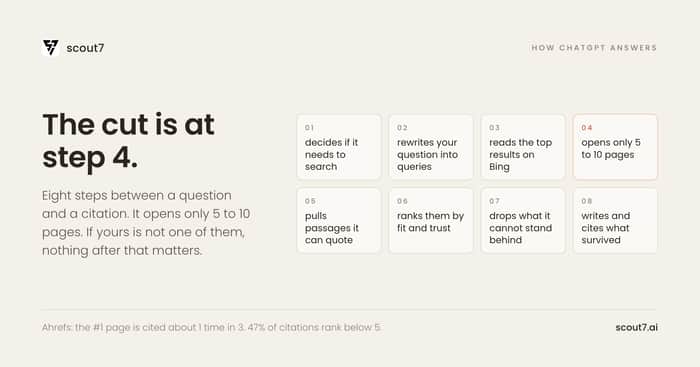
When you ask ChatGPT something that needs the web, it does not read the whole internet. It does eight things, in this order.
- It decides if the question needs a search at all.
- It rewrites your question into a few search queries.
- It reads the top results from Bing. Not Google. Bing.
- It opens only 5 to 10 of those pages.
- From those pages, it pulls out short passages it can quote.
- It ranks those passages by how well they fit and how much it trusts the source.
- It drops anything it cannot stand behind.
- It writes the answer and cites what survived.
The real cut is step 4. If your page is not one of the 5 to 10 it opens, nothing after that matters.
Two numbers from Ahrefs: the page ranked #1 on Google gets cited about 1 time in 3. And 47% of citations come from pages ranked below position 5. So rank helps, but it is not the input.
Two things to do. Check your rank on Bing, because step 3 happens there. And make sure each page has one clear passage that answers one clear question, because step 5 is looking for exactly that.
Which page of yours would you want it to open?
Built at Scout7: https://scout7.ai?utm_source=indiehackers&utm_medium=post_sep_8

Struggling to write the right AI prompt?
Try RefInzi— turn a rough idea into a better prompt in seconds.
Free: refinzi.com
The step 3 advice needs a split, and your own audit of my site is what shows it.
You ran utilityseo.com yesterday. Zero of the 20 articles that feed answers for my category mention us, one competitor sits in 18, and my brand name returns my own pages in the top 7. So I rank fine. I am just never in the shortlist.
The reason is that for a category question, my page was never a candidate. The 5 to 10 pages opened are pages about the category, which means listicles and reviews on domains I do not own. Check your Bing rank is exactly right when your page could plausibly be the answer. For an unbranded buying query it optimises a page that was never in the running.
Testable version of that: look at which pages actually got opened for the list query. If none of them are vendor sites, then no amount of on-page work on a vendor site changes the outcome. The move is being inside someone else's page.
The distinction between “getting opened” and “getting cited” is probably the most useful takeaway here. It also makes me wonder whether optimizing for clear, extractable answers could become as important as traditional SEO as AI search keeps growing.
One useful way to test this is to separate selection from citation. Log the page that was opened, the passage quoted, and the buyer question that triggered it. If a page is opened but never cited, the problem is extractability or fit. If it is never opened, it is competing for the shortlist. That distinction makes the next edit much less guessy.
This is a useful breakdown because it highlights something many people overlook: when ChatGPT gives only a limited number of pages, the result isn't necessarily random. Understanding how pages are selected can make research much more efficient.
I especially like the focus on relevance and ranking rather than simply assuming that the first pages shown are the only useful sources. Knowing how the selection process works can help users write better prompts and get more targeted results.
The 5–10 page claim is interesting, but the commercial test seems downstream. Have sites using Scout7 actually seen more ChatGPT citations or AI-referred traffic after making these changes?
I would measure that as two separate outcomes: visibility and traffic. A page can enter the shortlist and still lose the click, while a citation can happen before analytics catches up. For a clean baseline, record the exact buyer question, engine, date, page opened or cited, and any referral. Then compare the same questions after one change at a time.
That visibility vs traffic distinction is useful. If you’re open to it, what’s the best email to reach you on?