Choosing Tasks Based on Urgency, Importance, and Complexity
(As I was working on my post for IH, @nafetswirth posted something very similar earlier today: https://www.indiehackers.com/post/how-to-avoid-the-urgency-trap-4147641ce3. That's a great post, and please take a look at it as well. This only goes to show that it's become an important and an urgent topic! 😜 )
TL;DR: Take an hour every week to reflect and set priorities. Don't let the important tasks slide just because they have no deadlines.
The long read: Have you noticed that you often avoid important tasks, even when they are no more difficult than "urgent", but unimportant tasks?[1] It's not just you -- we all do it, and now it's proven by research![2] :) But why do we do this? According to some, it's because we are trying to reduce our cognitive load.[3]
The benefits of reflecting and planning are widely accepted. For example,
Eisenhower had a 2X2 decision matrix to help categorize tasks into urgent /important categories (later popularized by Steven Covey of "Seven Habits ..." fame). However, tasks vary in complexity,[4] and a working solution should perhaps include all three dimensions.
How to be more consistent about reflecting and planning?
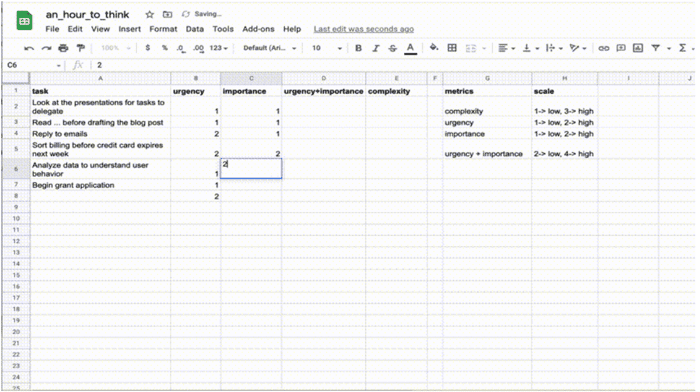
I'm writing this, as I plan to take an hour every week to assign (and sort) my tasks based on their urgency, importance, and complexity, tracked on a simple Spreadsheet. I explained the process in more detail at: https://anhourtothink.com/why-and-how
Habit formation is hard
Logistics is only a small fraction of the challenge. It's hard to form a new habit and stick to it. That's where nudges come in.[5]
Would it help us stick to this plan if we knew there's a community of us trying this? Something along the lines: "join 5 others participating in thinking sessions this week!"
I wanted to give this a try (thinking session + email nudges to participants, including myself), and created https://anhourtothink.com. Feel free to sign up for the nudge emails if you'd like.
Do you schedule "reflection" time on your calendar, or are you more spontaneous about it? Do you manage to think as much as you'd want? If not, why?
References:
[1] HBR article on why we should focus on what's important, and not what's merely urgent: https://hbr.org/2018/07/how-to-focus-on-whats-important-not-just-whats-urgent
[2] We would rather choose urgent tasks even when important (but not urgent) tasks are equally difficult: https://academic.oup.com/jcr/article/45/3/673/4847790
[3] Is reducing cognitive load the reason behind this behavior? https://link.springer.com/article/10.3758/s13414-018-1633-5
[4] Include task complexity in this plan: https://blog.ycombinator.com/startup-school-week-8-recap-adora-cheung-on-prioritizing-your-time-and-kevin-hale-on-evaluating-startup-ideas/
(First ~16 minutes of the talk)
[5] What about nudges? A 10-minute episode from NPR The Indicator: https://www.npr.org/2021/07/27/1021438772/nudge-vs-shove-a-conversation-with-richard-thaler

😁🤙
Lot of additional info in yours 💪
Thank you! I'm curious about your tool, and good luck with it!
🙏