Cloud vs Cybersecurity Certifications | 2026 Path Makes More Sense
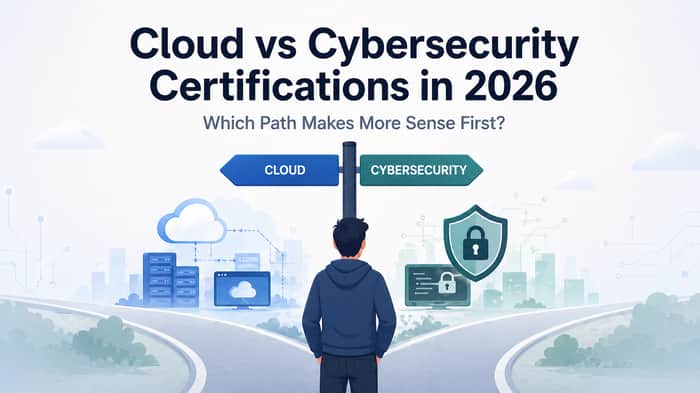
A lot of people planning an IT certification path in 2026 end up stuck on the same question: should they start with cloud or cybersecurity?
It is an understandable debate. Both paths look valuable, both appear in high-growth career discussions, and both are constantly recommended in online certification advice. But the real answer is usually not about which path sounds better on paper. It is about which one makes more sense first for the person starting the journey.
Cloud certifications often make a stronger first step because they connect naturally to a wide part of modern IT work. Today, infrastructure, storage, networking, identity, virtualization, deployment, and access management are all heavily tied to cloud platforms. That means cloud learning often gives a broader picture of how modern systems are built and maintained. For someone trying to enter IT or build a stronger technical base, that kind of exposure can be very useful.
Another reason cloud often works well as a first path is that the learning feels easier to connect to real environments. Even beginners can understand the basic value of virtual machines, storage, access control, backup design, or cloud services running business applications. The concepts feel visible. They have a practical shape. That usually helps learners stay motivated because they can see where the knowledge fits.
Cybersecurity certifications, on the other hand, attract many people because the field looks exciting, important, and future-focused. That is not wrong. Security is critical, demand remains strong, and the field offers serious long-term opportunity. But what many beginners miss is that cybersecurity is often easier to understand after you already know the systems being protected.
That is where many candidates struggle.
It is difficult to understand attack surfaces, privilege misuse, network threats, cloud security controls, or defensive practices if the underlying systems still feel unfamiliar. A person may start a security path with enthusiasm, only to realize that every topic quietly depends on networking basics, operating systems, identity concepts, cloud architecture, and administrative logic. When those foundations are weak, security study can start to feel much heavier than expected.
This is why cloud can often create better early momentum. It gives learners a foundation they can build from in multiple directions. Someone who starts with cloud can later move toward architecture, support, DevOps, automation, platform engineering, or security. In that sense, cloud often opens several doors at once.
That does not mean cybersecurity is the wrong first step for everyone. For someone who already understands networking, system administration, or core IT operations, cybersecurity can absolutely make sense as a first certification direction. In that case, the learner is not entering security blindly. They are building on top of an existing technical base. That changes everything.
I also think personal interest matters more than many people admit. Some people stay consistent only when the subject genuinely interests them. If someone is deeply interested in threat detection, access control, risk, and defense thinking, that motivation can carry them through the harder early stages. Still, interest works best when it is matched with realistic expectations.

From what many learners and prep platforms in the space have observed, including trends visible across certification communities and providers like Cert Empire, the smoother first path for many beginners is often the one that builds understanding before specialization.
That is why the better question is not “Which path is hotter in 2026?” It is “Which path matches my current foundation, my learning style, and my likely next step?”
For many beginners, cloud may be the more practical first move because it builds broad technical understanding and creates momentum. For those who already have core IT knowledge and a clear security goal, cybersecurity can be the better first path.
So the answer is not the same for everyone. The best first certification path is the one that gives you the highest chance of learning well, staying consistent, and building from success instead of frustration.
Curious what others think: if someone is starting from near zero in 2026, would you point them toward cloud first or cybersecurity first?

I actually started with cybersecurity () and struggled a lot at first. Once I went back and learned basics like networking and systems, everything clicked. So this matches my experience.
Not sure I fully agree. With structured paths today, someone can start in if they’re disciplined enough. It’s harder, but not impossible...
Agree with most of this. Cloud first builds the broader technical foundation that makes cybersecurity concepts click — it's hard to reason about attack surfaces, identity, or network controls when the underlying systems still feel abstract.
The other path that works well is when someone is already doing security-adjacent work in their current role — answering vendor questionnaires, helping with access reviews, sitting in on incident response. That hands-on exposure does the same job as a cloud foundation: it grounds the concepts in real systems before formal study. That's how I came into security, after years of architecture and SDLC work, and the certifications were much easier to absorb because I'd already lived the problems they describe.
That’s a great point. Real exposure can replace a traditional cloud-first path because it makes security concepts concrete.
Your experience shows certifications click faster when you’ve already seen real problems.
Spot on, Jack! Building a strong Cloud foundation before jumping into Cybersecurity is definitely the smartest move for beginners. Just like finding the right learning path, discovering what the market actually needs before building is crucial. To help founders figure out exactly which tech niches are in high demand before writing any code, we actually built an AI agent that handles that entire market validation process for you!
Appreciate that! Yeah, the “foundation first” idea applies in both cases whether it’s tech skills or building products, starting with real-world context makes everything else easier to understand.
Your AI agent idea sounds interesting too especially if it helps reduce guesswork early on. Curious, what kind of signals does it use to identify high-demand niches?
To be honest, Bunzee acts like a digital detective, conducting in-depth competitor analysis to pinpoint exactly where your existing business logic falls short. Instead of simply guessing, it leverages these market gaps as direct signals to automatically generate robust Product Requirements Documents (PRDs). It's like a cheat code that lets you skip the complex market research stage and launch the products people actually need right away!
Thanks for your interest in our project. I'll share the site with you. Please give us your honest feedback: https://bunzee.ai/
Sure
Where would you place certifications like CompTIA Security+ in this? Do you see it as a true beginner cert, or more effective after some hands-on system/cloud exposure?
Security+ is often seen as a beginner cybersecurity cert, but it’s much easier after some cloud or IT fundamentals. That’s also something discussed in communities like Cert Empire, where the focus is on building foundations before jumping into security.
honestly for someone starting from zero, cloud first makes more sense. security clicks faster when you already understand what you're trying to protect. jumping into cybersecurity blind is like learning to be a locksmith before you've ever seen a door.
That’s a great analogy 😄 and honestly sums it up perfectly.
Understanding what you’re protecting makes security concepts much easier to grasp. That’s why cloud (or any solid foundation) tends to speed things up for most beginners.
Interesting perspective. While I agree cloud is a strong starting point, I think some highly motivated learners can still begin with cybersecurity if they are willing to backfill the fundamentals alongside. It really comes down to discipline and consistency.
That’s fair and I agree.
I'm starting with cloud
Good Luck...
I think this is one of the more realistic takes on the cloud vs. cybersecurity debate.
If someone is starting close to zero, cloud usually wins — not because it’s “better,” but because it builds context. You’re learning how systems are actually put together before trying to defend them. That reduces a lot of the confusion people hit when jumping straight into security.
Where I slightly push back is that many beginners don’t just struggle with security concepts — they struggle with abstraction in general. Cloud can feel intuitive at a high level, but once you get into IAM policies, networking configs, or multi-service architectures, it can get overwhelming fast too.
So the real advantage of cloud isn’t that it’s easier — it’s that:
👉 it’s easier to anchor to real-world use cases
👉 it gives earlier “aha” moments
👉 it creates more visible progress early on
That momentum matters more than people think.
On cybersecurity, I’ve seen a lot of people burn out because they’re learning “how to secure X” without really understanding how X works. That gap compounds quickly.
One nuance I’d add:
The best path might actually be light foundations → cloud → security, not choosing one from day one.
Something like:
basic networking / OS concepts
entry-level cloud cert
then pivot into security
That way, security becomes a layer on top — not a guessing game.
Overall, I agree with your core point:
This isn’t about what’s trending in 2026, it’s about what gives you momentum early.
Curious how you’d structure the first 3–6 months for a complete beginner 👀
This is a really grounded take.
The point about “momentum” is underrated early wins keep people going, and cloud tends to provide that faster than security. I also like your idea of treating security as a layer on top rather than a starting point. That framing alone probably prevents a lot of beginner frustration.