Code is Cheap, but Scaling AI MVPs is Hard. Let’s Fix Yours.
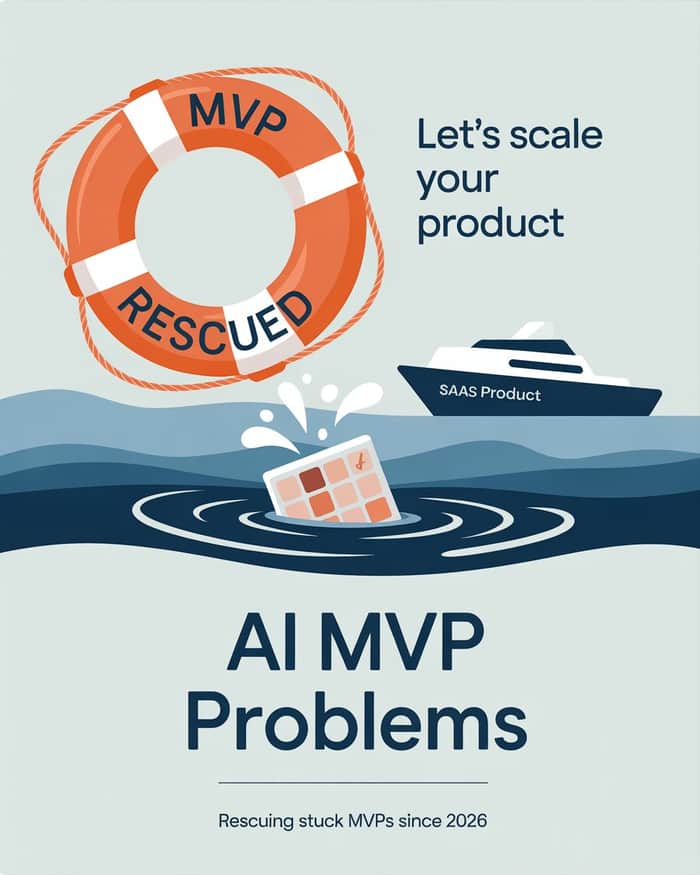
In 2026, writing code isn’t the problem anymore. AI tools like Copilot and ChatGPT crank out MVPs in hours. But here’s the catch:
That AI-generated script? It doesn’t scale.
Bugs pile up when you move beyond 10 users.
What worked for a demo breaks in production.
I’m a Solutions Architect who has seen countless AI MVPs fall short because code is just the start. The real game is turning that spaghetti into a scalable SaaS product-something solid enough for real customers, growth, and actual revenue.
Here’s what I bring: clarity, architecture, and execution. I’ll help you:
Design a tech stack that won’t crumble under the weight of growth.
Fix messy MVPs and make them future-proof.
Transform simple ideas into subscription-worthy platforms.
Drop your pain points, tech stack, or MVP struggles in the comments-or DM me for a free, high-level architectural roadmap. Let’s rescue your product from the AI spiral and scale it right.

This hits close to home. I’m a solo founder balancing a 9/5 warehouse job with building my MVP, Triply. I can feel the 'AI spiral'—the code is there, but the infrastructure (deployments, database hibernation, indexing) is where I’m losing my mind.
I'm currently juggling Supabase and Vercel/Render, and as a non-dev founder, the 'spaghetti' is starting to smell. You mentioned a free high-level roadmap—honestly, how do you decide when to stop adding features and just focus on making the core architecture stable enough so it doesn't break every time I go to my shift at work?
Wow, as a solo founder balancing a warehouse job with building an MVP, It sounds like a stable core foundation is your best friend right now, especially since you’re already feeling the strain of the “AI spiral.”
Here’s how I’d prioritize:
instead, lock the scope of your MVP to its most valuable core functionality. Every non-essential feature adds to spaghetti.
For Supabase and Vercel/Render, focus on simplicity. Are you indexing and hibernating in a way that keeps usage costs predictable? Small tweaks here can make managing infra way less painful.
Stability is more important than shiny. Make your foundation boring, because boring rarely breaks when you're away at work.
Email me with where you’re stuck, and I’d be happy to help sketch out that high-level roadmap to stabilize Triply and avoid the “shift stress."
Thanks for this — "make it boring" is exactly the reframe I needed. I've been treating stability like something to fix later, but you're right that it has to come first. On Supabase, I haven't been intentional about indexing at all — that's my next move. One question: with a free-tier Supabase (it hibernates every 7 days), is it worth upgrading now, or are there practical workarounds to keep things warm without paying yet? Triply is pre-revenue so the budget is tight, but I also can't afford it breaking every time I'm at work.
yeah, seen it. one team built FK relationships for demo query speed - took 3 months to untangle before bulk ops could ship. code debt gets refactored in a sprint. wrong data shape outlives the person who designed it.
100% true — I built a few AI MVPs fast, but things broke as soon as real users came in. Scaling + clean architecture is where the real work actually starts.
I still love how you called out the unit economics angle—it’s such a make-or-break factor, especially with AI credits silently eating away margins.
The instinct to keep adding features when the infrastructure feels shaky is actually backwards — a fragile foundation makes every new feature riskier, not more valuable. I'd flip the question: instead of "when do I stop adding features," ask "what's the one thing that breaks if I get 10x the traffic tomorrow." Fix that first, ship nothing else until it's solid. Most solo founders lose weeks polishing features on top of an architecture that can't actually hold them.
This is the pattern we see constantly at 6senseHQ when founders bring us a project after the "AI spiral" — the code technically runs, but nobody made the calls that only show up under real load: what happens at 1,000 concurrent users, what the error-handling story is, what the actual cost-per-request looks like once it's not just you testing it. The framing above about "demo-ready vs. production-defined" is exactly right. AI collapses the time it takes to get to demo-ready. It does nothing to shorten the gap to production-defined — that part still requires someone to sit down and write acceptance criteria before the architecture gets locked in, not after. The founders who skip that step aren't saving time, they're just moving the cost to a more expensive point later.
The comment thread is going in the right direction, but nobody's named the actual failure point I keep seeing: founders hand off AI-generated code to a dev shop, the shop takes it at face value as a starting point, and three weeks in, everyone realizes the data models are garbage and the whole thing needs to be re-architected. Sprint one becomes sprint one of rebuilding, not building forward.
The "AI made building faster, not thinking harder" framing is right, but the practical fix isn't just better architecture upfront. It's agreeing on what "done" looks like before a line of production code gets written.
The founders who make it past the scaling wall tend to have one thing in common: they had a production definition going in. Not just feature lists, but actual acceptance criteria for what "this works at 1,000 users" means. Data pipelines, error handling, cost per call, and latency benchmarks. Those things don't emerge naturally from an AI-generated codebase, and they don't emerge naturally from a dev engagement without someone forcing that conversation early.
The gap isn't really between MVP and scale. It's between "demo-ready" and "production-defined." Most teams skip the latter entirely and wonder why the refactor cost is 3x.
I know a few solo founders building AI-powered MVPs who are definitely facing these exact scaling challenges. They'd likely be willing to answer your questions for free if you wanted me to pass them along.
this is real
building is fast now, but most AI MVPs break the moment real users show up
i’ve seen similar on the product side - getting traffic or even usage is easier than turning it into something people actually pay for
feels like the gap now isn’t building, it’s making things reliable + worth paying for
Posts like this are why IH is the right community for indie builders — the honest retrospectives are so much more useful than the highlight reel you see elsewhere. One question: looking back, is there anything you would have validated differently before building? The pre-build validation question is one I keep wrestling with.
Totally agree, IH’s focus on honest retrospectives adds so much value that’s hard to find elsewhere. To your question about pre-build validation, it’s definitely a tricky balance!
Looking back, the most important thing I’d validate differently is user behavior over opinions. Instead of just asking potential users, “Would you use this?” I’d dig deeper and watch how they currently solve the problem I’m trying to address. Observing workflows or pain points early can save so much feature bloat later.
how do we get clients
Getting clients often comes down to clarity and focus. For tech founders, the key is aligning with the right audience. few strategies that might help:
Focus on one niche use case and showcase the value, this makes your solution relatable and easier to sell.
Use your MVP as a conversation starter, share it in relevant communities or networks like Indie Hackers to attract feedback and initial interest.
Offer something small but valuable up front (like a demo, free consultation, or limited functionality), this builds trust with potential users or clients.
Marketing your product/business effectively is just as critical as building it.
It's not just about scaling the tech, you have to make sure your unit economics also scale. If you are offering a free option, you obviously are going to be eating the cost of every user in AI credits unless your paid plans can subsidize and properly compensate for them. Then you gotta make sure you have enough paid members per x number of free members. The best part here is AI can help you model all this out ahead of time so you aren't surprised. :)
Completely agree—finding issues in production is incredibly costly. The most common mistake I see in AI-generated codebases is data models built for demos, not real-world usage. These decisions often create bottlenecks once actual users come into the picture.
The scaling gap is real but the bigger problem is most founders don't know their MVP is broken until they're already in production with real users. By then the refactor cost is 3x. What's the most common architectural mistake you see in AI-generated codebases right now?"
the real pain comes when these issues only surface in production, and by then, the cost to refactor is immense. The most common architectural mistake I see in AI-generated codebases is data models designed for quick demos rather than real-world scenarios. These models often lack scalability and create bottlenecks as the product grows. Another big one is poor error handling and state management, which leads to unpredictable failures with real users. Addressing these early can save a ton of trouble later on. Great question!
Feels like the biggest shift is that AI compresses the timeline. Bad architectural decisions, weak data models, and messy abstractions show up way faster now because people can build MVPs in days instead of months.
A few people here also made a great point: it’s often not the scaling itself that kills products, it’s early decisions made for demos instead of real long-term usage.
AI made shipping easier. It didn’t make durable product design easier.
Spot on—AI speeds up building but not the thinking process. The most common stack mistakes I see? Definitely overcoupled components that lack clear boundaries and reusable abstractions, as well as missing validation/error-handling pipelines. These gaps become a nightmare as the product scales.
So true, AI accelerates building, not thinking. Architecture still separates projects that survive from those that collapse. Curious what stack mistakes you see most often?
AI speeds up execution, but architecture and thoughtful planning remain key to survival. The most common stack mistakes I see are overcoupled components that make future updates or scaling a nightmare, hardcoded dependencies, and lack of modularity. Poor error handling pipelines are another big one—issues that seem small early on can cause big headaches as the user base grows. Solid abstraction and scalability upfront make all the difference!
Disagree a bit. Product decisions made during the fast build are the real killer - data models shaped for demos, not for 10k users. Code debt chips away. Wrong data shape doesn't.
You’re absolutely right—data models built for demos can be a massive blocker for scaling. Code debt can be fixed, but the wrong data shape creates long-term issues that are much harder to resolve. Great point!
Coming at it from the other side, I've been running a small AI feature in production for a while. The thing that actually surprised me wasn't the scaling part, it was that the failure modes look really different. Rate limits, cost per call, and what to do when the model returns garbage become way more visible than boring SaaS scaling stuff like DB queries and memory.
I think the gap between demo and production has always existed, AI just made demos cheaper to build so the gap shows up faster. Doesn't really feel like a new problem to me.
Curious if your scaling approach changes based on whether AI is the core feature or just one piece of the larger product.
AI definitely introduces unique failure modes like rate limits and handling bad outputs, which can easily catch you off guard. To your question, if AI is the core feature, the scaling approach heavily focuses on cost optimization and robust validation pipelines. If it’s just one piece, the broader architecture takes priority to ensure flexibility and stability across the stack. Thanks for sharing your perspective!
Strong point. AI has made building cheaper, but it also made fragile products more common. A lot of founders think they have a growth problem when they really have an architecture debt problem waiting to surface.
AI has lowered the barrier to building, but it’s also made fragile products more common. What looks like a growth issue is often just architecture debt catching up, and fixing it later is always more painful. Solid foundations are everything!
Exactly. Early shortcuts often look efficient because the cost is delayed. Then growth arrives and suddenly every quick decision gets repriced at once. That’s why architecture work feels expensive early but cheap later.
100%. The industry is definitely moving towards AI-native development, but people forget it requires massive validation layers.
AI generates the code, but the actual quality comes from strong spec-driven development, heavy testing infrastructure, and evaluation pipelines. If you don't have those guardrails in place across the whole SDLC (requirements, design, testing), you just scale bad code faster. Great point on architecture being the real differentiator now.
Exactly—AI speeds up code generation, but without spec-driven development, robust testing, and validation layers, you’re just scaling bad code faster. Architecture truly is the differentiator that ensures quality and long-term success. Well said!
The finishing problem is real and AI still hasn't solved it. I use a voice dictation tool, and when I'm deep in a building flow, the last thing I want to do is switch windows and type. The bottleneck is rarely code generation, it's the editing and the thinking that comes after. Anything that keeps you in flow longer pays off more than anything else at the MVP stage.
Agreed, AI is great for generating the raw material (code), but the real challenge is closing the loop. The editing, refining, and decision-making process takes a whole different skillset, especially when you want to create something robust and scalable. Staying in flow longer during the MVP stage is such an overlooked factor-totally agree. Thanks for sharing your perspective!
Fair point on scalability — but the AI-generated MVP most solo founders have isn't failing at 10,000 users. It's sitting in a local repo, half-finished, waiting for a free Saturday that never comes. The problem AI solved is generating code. It hasn't solved finishing.
You’re absolutely right, AI solved the “writing code” piece, but finishing takes discipline, clarity, and a clear roadmap. Most MVPs aren’t failing at scale because they never even get close to production. The jump from “local repo” to “real-world SaaS” is where the value lies, and it’s exactly where strategic architecture and product thinking come into play. Appreciate your thoughts-it’s such a common pain point for founders right now!
Really resonates with what I’m experiencing right now.
I’m currently building a Job Tracker SaaS, and getting the MVP up was actually the easy part with tools like GitHub Copilot and ChatGPT. But now that I’m trying to move towards real users, I’m starting to see the cracks—things like data structure decisions, performance concerns, and how to handle future features without rewriting everything.
Curious to hear your thoughts on this:
At what point do you think an MVP should shift focus from “just making it work” to investing in proper architecture? Especially for solo developers trying to validate quickly without over-engineering early on.
Thanks for sharing what you’re building-Job Tracker SaaS sounds like a great ! It’s true, AI makes getting started easier than ever, but scaling for real users exposes decisions you might not even realize were critical early on.
To your question: I think the shift happens once you start seeing traction (even a small one) or anticipate complexity in upcoming iterations (e.g., performance, data relationships, extensibility). It’s a balancing act-focus on validating quickly, but once you spot cracks (like the ones you mentioned), it’s worth investing in a scalable foundation. Happy to share more specific tips if you want to chat further!