Coding blocked me for a bit until I pivoted to GTM & n8n. Here is how I’m automating outreach for Flow Era
A few weeks ago, I hit a temporary wall. Building the real-time tracking logic via pure custom code was slowing me down more than it should have.
Instead of getting stuck, I stepped back and found a much cleaner workaround: Google Tag Manager (GTM).
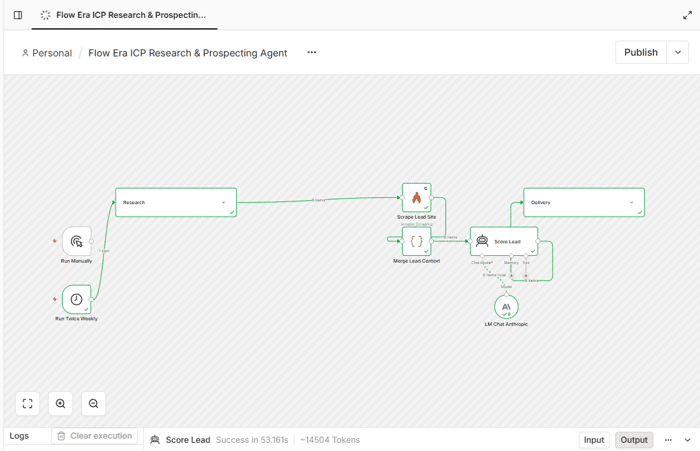
By utilizing GTM for behavior detection, deployment became instantly seamless. But the real magic happened when I connected those triggers to our new *ICP Research & Prospecting Agent in n8n.
Here is how the automated flow works behind the scenes:
Targeting the Right ICP: The workflow scans and qualifies store owners who already have GTM installed making their onboarding to Flow Era frictionless.
Data Scraping & Enrichment: n8n pulls site context (using tools like Firecrawl) to analyze their current setup and conversion gaps.
AI Scoring & Outreach: Anthropic (Claude) evaluates the lead, scores their potential ROI, and triggers a personalized video audit offer.
Honestly, one of my favorite parts of building a SaaS solo is bumping into these technical roadblocks and figuring out a way through them.
Every bug solved and every workflow optimized brings me one step closer to that very first paid subscription.
Would love to hear from other builders what’s a technical workaround you recently implemented that saved you weeks of dev time?

Completely agree with this perspective. Keeping things simple early on really helps avoid over-engineering. Thanks for sharing!
One thing worth stress-testing at the qualification step, separate from the conversion questions already raised here: having GTM installed doesn't necessarily mean it's actively used — a lot of stores get it pre-wired by their theme or agency and then never touch it again. Do you have a way to tell "GTM installed and firing real events" apart from "GTM installed and dormant"? That distinction might matter more for lead quality than the installed/not-installed split alone.
This thread is a good gut check for me I'm building something with a similar "score leads by opportunity" core (local businesses instead of Shopify stores), and the exact failure mode people are pointing at here the workflow gets smarter while the actual offer stays untested is why I stopped and put up a plain landing page before writing a single line of scoring logic. No automation yet, just: does anyone say yes to the pitch at all?
Genuine question for anyone further along: once you DO have a validated offer, how do you decide the automation is worth building vs. just doing the first 20-30 by hand? Is there a signal that tells you "this is repetitive enough now to automate," or do you build the pipeline before you have real volume to justify it?
It’s interesting how a technical problem led to a much simpler solution. I especially like the combination of GTM, n8n, and AI — a great example of how automation can not only save time but also completely change a workflow.
Before adding another agent step, I’d run 10 named stores through it and keep one line per store: why it was flagged, audit sent, reply, objection, paid or not. Otherwise the workflow can get smarter while the offer stays untested. Do you already have that sales record outside n8n?
The GTM behavioral trigger is observational (they have GTM + activity), but the signal metric hides one level down: among all the filtered leads that reach the video audit offer, what % actually take the next step? That gap - between lead score and actual booking - is where automation breaks down. If it's <20%, the workflow is just faster rejection. Measure the downstream: (offers sent, calls booked, revenue closed) as a ratio per segment. That tells you if GTM + AI is actually finding high-intent buyers or just expanding your denominator.
The handoff from scoring to a real conversation is the part I’d watch. Have you found a simple way to tell when an opener has enough context to send?
The workflow looks useful, but the real test is downstream. Are the GTM-qualified leads actually replying or booking calls at a meaningfully higher rate, or is the automation mainly increasing outreach volume so far?
Absolutely right—volume is a vanity metric, conversion is the reality.
The real win with this workflow isn't sending more messages; it's precision and timing. By filtering for high-intent behavioral signals in real time, the leads reaching the downstream sequence are booking calls at a meaningfully higher rate than traditional static lists.
I’ve already sent you an email about this. Please reply there when you get a chance — I’d be interested in hearing how the latest results have changed your thinking.
"Every workflow optimized brings me one step closer to that very first paid subscription" is the sentence I would pin. The n8n path can run without that person existing.
I have the other side of that. 36 people signed up. The last new one was September 10. Today is still 0. I still press send myself. A scored lead is not a paid month.
Write the name of the first store owner who gets the video audit, before the workflow runs again. If you do not have a name, the agent is practicing.
Who is that first store owner?
Grounding automated workflows in real human actions is such an underrated lesson.
You can build the cleanest n8n/AI pipeline in the world, but until you attach a specific store owner's name to the output and deliver real, high-value feedback (like a video audit), it's just practicing in a vacuum.
Bridging that gap between lead scoring and manual outreach is where real conversions happen. Rooting for that first paid subscription!
"Until you attach a specific store owner's name" is still the line. Cheering for the first paid subscription does not put a name on the audit.
I opened the table tonight. 37 people signed up. 13 have used the product at least once. Today is 0. A clean pipeline did not create a person.
Write the store owner's name before the workflow runs again. If you do not have one, the agent is still practicing.
Who is that first store owner — a real shop, or still a slot in the workflow?