Common Dispatching Mistakes That Cost Carriers Money
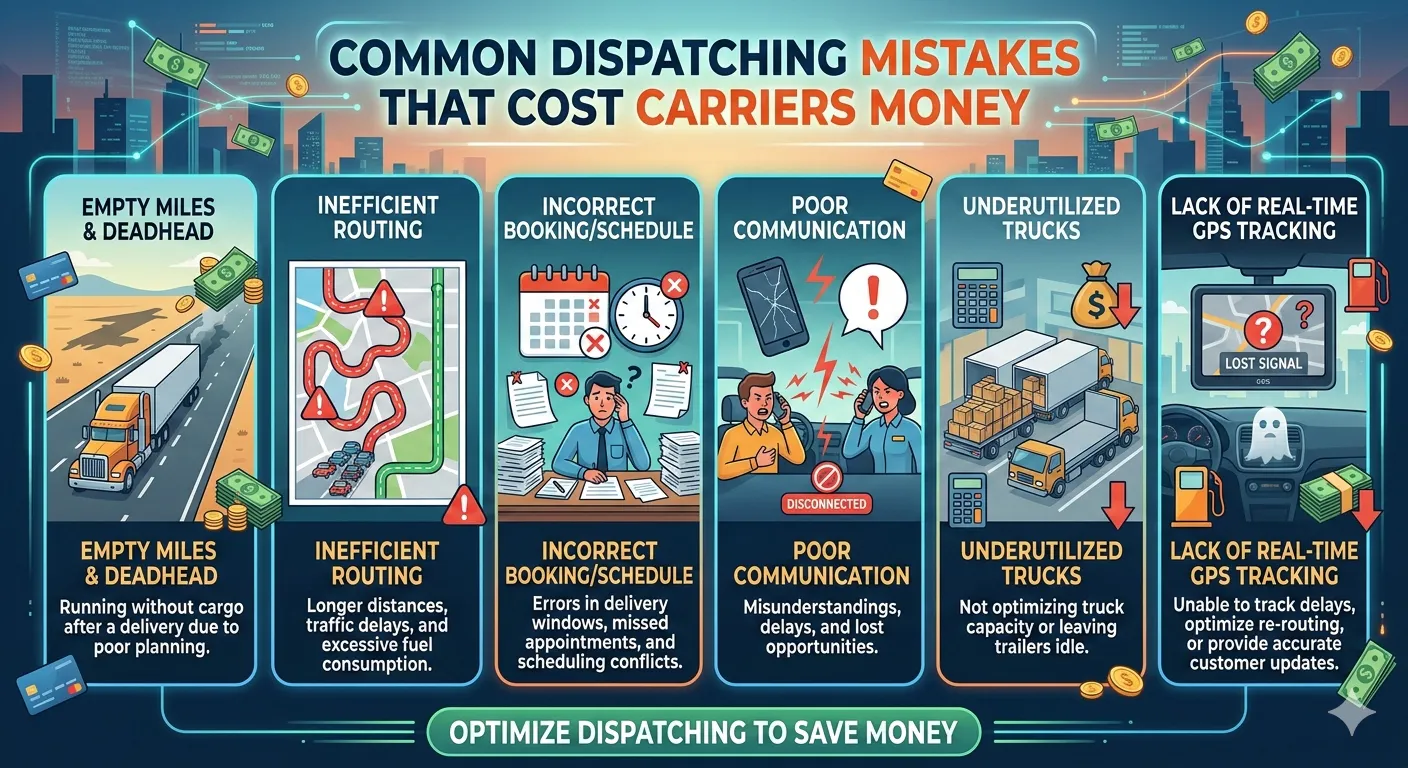
A single dispatching mistake can cost carriers thousands of dollars every month in lost revenue and unnecessary expenses.
In today’s competitive trucking industry, dispatching goes far beyond assigning loads. It directly influences fuel costs, delivery timelines, driver productivity, and overall fleet profitability. Managing rising fuel expenses often requires fuel management systems. Even small inefficiencies can reduce margins and slow down operations.
Many carriers still operate with limited visibility and inefficient workflows, leading to higher costs, delayed deliveries, and missed revenue opportunities.
Inefficient routing and excessive empty miles alone can reduce fleet profitability by 15–25%, making dispatch optimization a critical priority for growth.
Common dispatching mistakes include poor route planning, excessive empty miles, manual processes, lack of real-time tracking, and weak driver communication. These challenges increase operational costs but can be solved with better visibility, automation, and centralized dispatching software.
This guide explores the most common dispatching mistakes and how carriers can fix them using practical, data-driven strategies to improve efficiency and profitability.
KEY TAKEAWAYS
Dispatching mistakes directly impact fuel costs, fleet efficiency, and overall profitability
Poor load planning and route optimization can increase fuel expenses and reduce revenue per mile
Excessive empty miles (deadhead miles) are one of the biggest hidden profit losses for carriers
Manual dispatching and delayed decisions lead to missed load opportunities and lower utilization
Lack of real-time tracking reduces visibility and slows down decision-making
Poor communication with drivers increases delays, errors, and driver dissatisfaction
Ignoring HOS compliance can result in penalties, safety risks, and operational disruptions
Inaccurate load and rate management leads to revenue leakage and billing issues
Disconnected systems create inefficiencies and limit operational control
WHAT IS DISPATCHING IN TRUCKING
In trucking operations, dispatching is the core function that connects loads, drivers, routes, and delivery timelines into a coordinated workflow.
It involves assigning loads to drivers, planning efficient routes, managing schedules, and ensuring shipments are delivered on time while maintaining compliance and cost control. Real-time visibility through truck tracking systems plays a critical role in helping dispatchers monitor fleet movement and make faster, data-driven decisions.
An efficient dispatch system helps carriers:
Maximize fleet utilization
Reduce delays and idle time
Improve driver productivity
Increase profit per mile
When dispatching is managed properly, fleets operate smoothly with clear visibility across operations.
However, poor dispatching creates the opposite effect. It leads to wasted fuel, empty miles, missed delivery windows, and operational confusion that directly impacts profitability.
POOR LOAD PLANNING AND ROUTE OPTIMIZATION
Poor load planning is one of the most expensive dispatching mistakes in trucking. Many carriers still rely on manual planning, static routes, or incomplete data, which leads to inefficient load allocation and longer routes.
As fleets grow, this lack of coordination between drivers, loads, and schedules results in unnecessary mileage and underutilized capacity. Over time, even small inefficiencies can reduce profitability by 10–15%.
Using data-driven route optimization with real-time inputs like traffic, delivery timelines, and driver availability helps carriers reduce empty miles, improve delivery accuracy, and maximize fleet utilization.
EXCESSIVE EMPTY MILES
Empty miles, also known as deadhead miles, occur when trucks operate without carrying freight. This is one of the biggest hidden costs in trucking operations.
Without proper backhaul planning or load visibility, trucks often return empty or travel long distances without generating revenue. Meanwhile, fuel, driver wages, and maintenance costs continue.
In many fleets, empty miles account for 15–30% of total mileage, significantly impacting cost per mile. Reducing them requires better load planning, advance backhaul scheduling, and systems that match available trucks with nearby loads.
POOR COMMUNICATION WITH DRIVERS
Inefficient communication between dispatchers and drivers creates delays and confusion during active loads. Many fleets still depend on calls and manual updates, which become difficult to manage as operations scale.
This often leads to missed instructions, delivery delays, and increased workload for dispatchers. It can also reduce driver satisfaction and increase turnover.
Centralized communication systems or driver mobile apps provide real-time updates, clear load details, and faster coordination without constant calls.
DELAYED OR MANUAL DISPATCHING
Manual dispatching slows down load assignment and limits a carrier’s ability to respond quickly in a fast-moving market.
When dispatchers rely on spreadsheets or calls, they risk missing high-value loads, increasing idle time, and creating unnecessary administrative work. Even small delays can lead to lost revenue opportunities.
Automating dispatch workflows allows faster load matching, real-time visibility into truck availability, and more efficient decision-making.
LACK OF REAL-TIME TRACKING
Without real-time tracking, dispatchers lack visibility into truck location and load progress. This forces teams to rely on updates from drivers, which creates delays and operational blind spots.
As a result, responding to traffic issues, delays, or disruptions becomes slower, and customers receive less accurate delivery updates.
GPS-based tracking systems provide continuous visibility, allowing dispatchers to adjust routes, share accurate ETAs, and make faster decisions.
IGNORING DRIVER SCHEDULES AND HOS COMPLIANCE
Not aligning dispatch decisions with driver schedules and Hours of Service regulations creates serious operational risks.
Manual tracking often leads to violations, unrealistic delivery timelines, and driver fatigue. This can result in penalties, delays, and safety concerns.
Automated HOS tracking systems help ensure compliance while improving scheduling accuracy and overall operational reliability.
INACCURATE LOAD AND RATE MANAGEMENT
Incorrect load details and poor rate management can quietly reduce profitability. When pricing decisions are based on incomplete data or manual calculations, carriers risk underpricing loads and facing billing issues.
Over time, these errors lead to revenue leakage and delayed payments.
Using data-driven pricing tools with visibility into fuel costs, market rates, and cost per mile helps carriers maintain accurate pricing and protect margins.
DISCONNECTED SYSTEMS AND TOOLS
Managing dispatch, tracking, billing, and compliance across multiple systems creates inefficiencies and data silos.
Without a unified view of operations, teams struggle with inconsistent data, delays, and limited visibility into performance.
A centralized transportation management system brings all operations into one platform, improving coordination, accuracy, and decision-making.
LACK OF LOAD VISIBILITY AND MARKET AWARENESS
Limited visibility into available loads and real-time market rates makes it difficult for carriers to make profitable dispatch decisions.
Without access to accurate demand data, carriers often accept low-paying loads, miss better opportunities, or fail to plan efficient routes. This directly impacts revenue per mile and overall profitability.
Using platforms that provide load visibility, rate insights, and market trends allows carriers to make smarter decisions, improve load selection, and increase earnings.
WHY FIXING DISPATCHING MISTAKES MATTERS
Fixing dispatching mistakes is not just about improving operations — it directly impacts profitability, efficiency, and long-term growth.
When dispatch workflows are optimized, carriers gain better control over daily operations, reduce unnecessary costs, and improve overall fleet performance.
Addressing these issues helps carriers:
Reduce fuel and operational expenses
Improve profit margins per load and per mile
Increase driver satisfaction and retention
Deliver more consistent and reliable customer service
Over time, even small improvements in dispatching can lead to significant financial gains across the entire fleet.
When Should Carriers Take Action?
Carriers should consider improving their dispatch processes when they notice:
Increasing empty miles or underutilized trucks
Frequent delays in load assignments
Drivers constantly calling for updates or clarification
Billing errors or delayed payments
Limited visibility into fleet operations and performance
These signs indicate underlying inefficiencies that can impact profitability if not addressed early.
EXPERT INSIGHT
Dispatching inefficiencies rarely come from a single mistake. In most cases, they are the result of disconnected workflows, delayed decision-making, and limited operational visibility across the fleet.
When dispatch, tracking, driver communication, and financial processes operate separately, small gaps begin to form. Over time, these gaps lead to delays, errors, and reduced profitability.
Carriers that consistently perform well focus on unifying their operations. By aligning dispatch decisions with real-time data, driver availability, and financial insights, they create a more controlled and predictable workflow.
The key difference is not just technology — it is how effectively operations are structured and managed on a daily basis.
FINAL THOUGHTS
Dispatching inefficiencies are not just operational issues — they are direct profit leaks that affect every part of a trucking business.
Carriers that continue relying on manual processes and disconnected systems often struggle to maintain margins in an increasingly competitive and time-sensitive market.
On the other hand, fleets that improve dispatch workflows gain faster load execution, better cost control, and higher asset utilization. Over time, these improvements translate into stronger profitability, more reliable operations, and better scalability.
Modern carrier-focused platforms like Fast Forward TMS help unify dispatch, tracking, billing, and compliance into one connected system, enabling carriers to operate with greater visibility and efficiency. Solutions like this are increasingly becoming essential for carriers aiming to scale operations without increasing complexity.

