Competing on price to carve out an $18k MRR
foothold

While Abhishek Chakravarty was building a side project, he noticed an influx of users who weren't quite right for the product. So, he did some investigating, sold the product, and built a Youform specifically for those users. Now, it's bringing in $18k MRR.
Here's Abhishek on how he did it. 👇
Quitting corporate
I started working as a software developer in 2015. My first job was at Accenture. I hated that big corp, so I left after six months to work for a startup. Four years later, I left that startup to work as a freelancer. And I kept building projects on the side.
Some of them worked; some never got any users. Then, I made Botflow, a no-code chatbot builder.
While I was growing it, I realized most of my users were coming from Typeform — a price increase was leading users to search for alternatives. But I had built Botflow as a chatbot builder, not a form or survey builder, and that presented limitations. So, I sold it on Acquire.com for $10k and built Youform from scratch.
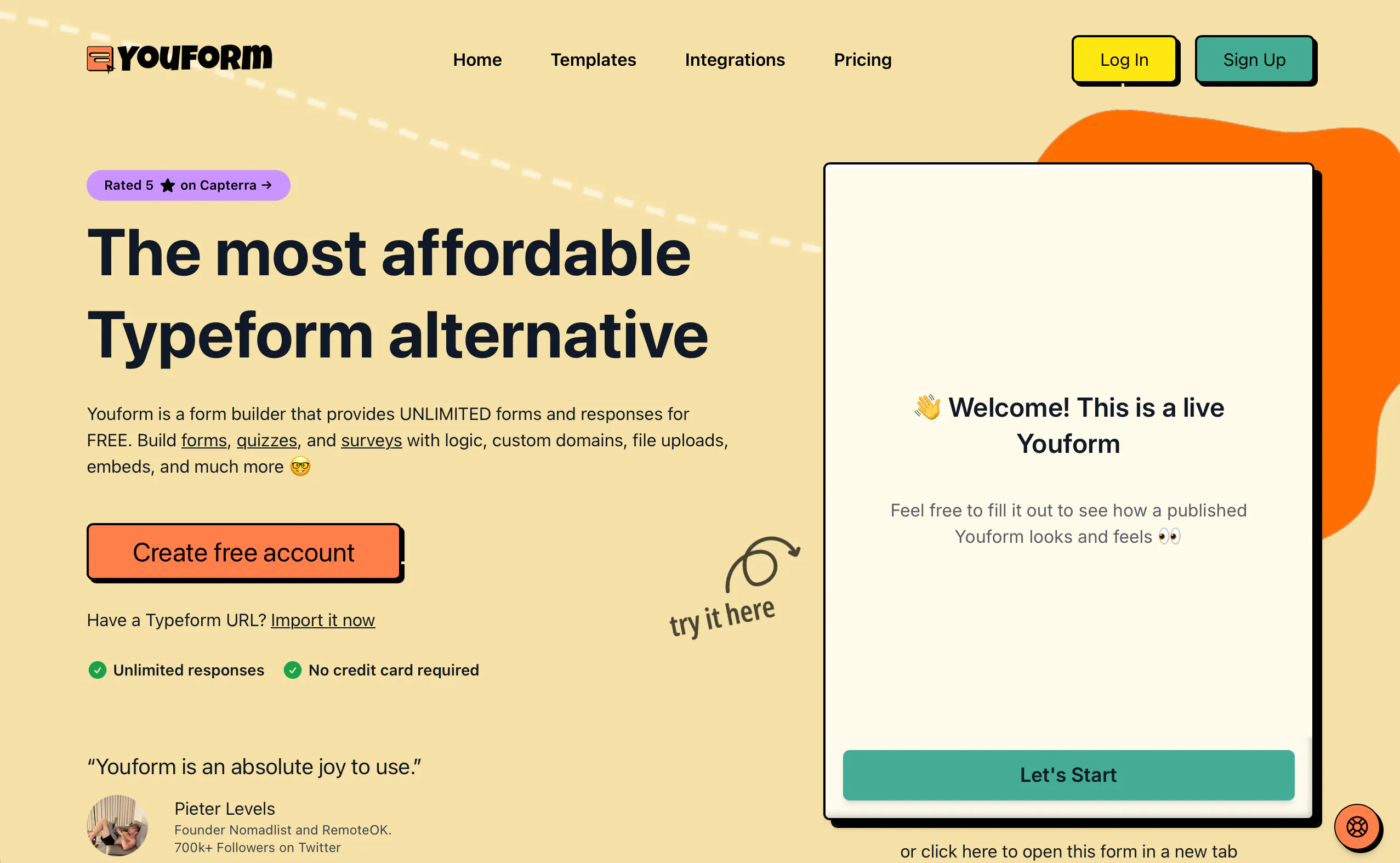
Youform is a form and survey builder that 80,000 users currently love. We're generating $18K MRR.
Building the product
I built the initial version in 3-4 days while freelancing for multiple clients.
Here's my stack:
Laravel
Vue.js
AWS
Laravel Envoyer for zero-downtime deployment
Stripe
I also use many AI models, including Claude, Grok AI, Codex, and Gemini, for tasks like writing code, code reviews, server monitoring, finding low-hanging SEO keywords, and reviewing help documentation to improve it for our users.
Going full-time
When you start a SaaS, the revenue is peanuts, and other appealing products or freelancing clients can easily distract you due to the promise of short-term income. Maintaining focus on the product is a challenge, but once you surpass $5k MRR, a SaaS business offers the best kind of work.
If I had to start over, I would save one or two years of financial runway from my job or freelancing work, then focus completely on the SaaS.
Pivoting from LTDs to subscriptions
Youform is a freemium SaaS. Almost all our features are free, so free users serve as our marketing channel — when they build forms and send them to others, the forms carry our branding and badge, so we gain many users this way.
As far as monetization, we initially started with a lifetime deal for $299. Then, we increased it to $399. We ran that lifetime deal for 40 days and made over $35,000. Since then, we have fully adopted a subscription model.
Our price is $29 per month, the cheapest in the market, offering many features that even existing incumbents do not currently provide. We primarily grow revenue by listening to users and shipping fast.
Growth via social listening
In the beginning, I searched for keywords like "Typeform" on Twitter and Reddit whenever I was taking a break from client work. Then, I'd send a direct message like: "Hey, you are using Typeform. Would you try my product, which is an affordable alternative, and give me some feedback?"
The replies were positive. I gained around 200 users this way.
Then, I met my cofounder, Davis, who runs a successful SASE called Oneup. He proposed a partnership and I agreed.
His Twitter profile provided a boost. He has over 20,000 followers there. When he posted about our partnership, we attracted many lifetime deal users.
From there, we expanded to multiple social media channels like LinkedIn, Reddit, and YouTube. When you're starting out, ranking in search engines is very difficult, so our SEO efforts have been minimal.
Look for competition
Never create something where there is no competition. Find a market gap existing players aren't filling, then position yourself there with simple messaging.
Youform started in a highly crowded market, but we found a market gap, and our messaging was simple from the start. We didn't start with "another form builder" tagline, but "an affordable Typeform alternative," and kept that messaging until we reached $200k ARR.
On that note, target a niche where users are already searching for solutions. For example, if a 'moderative keyword' receives over 3k searches per month, and you can find an alternative keyword for an existing player in the market, it will be much easier to acquire users.

Leave a Comment
Nice journey. Take a look at some of the product-led growth best practices out there for inspiration on pricing and monetization.
This comment was deleted 3 months ago
keep up the grinding bud
3-4 days to ship the initial version while freelancing full-time is wild. Most people wait until they have "enough time." You just didn't.
Great read and amazing journey
I saw the first few tweets when this started a few years ago. Amazing success story!
This isn’t really about price
he saw a segment misfit inside Typeform’s base and repositioned around it
“affordable alternative” wasn’t messaging it was the wedge to claim a different buyer set
Greatt
This was a great read. The part about finding the right users first, then building specifically for them, really stood out.
I'm taking notes on the keyword and SEO part
That's really a detailed story you've shared, loved the golden bits
Social listening makes sense and is low-cost, got to try this. And been Your journey for a year or more now is very inspiring. Keep it going.
Impressive growth. As a data scientist currently building in a different niche (sports markets), I’m curious: how did you handle your initial customer acquisition? Did you rely on organic search or was it mostly community-driven like IH/Reddit?
I want to know that too, the struggling is real
This resonates hard. We're doing something similar in the data room space — DocSend charges $45-150/month per user, and we built Simple Data Rooms at $10/month flat with unlimited viewers. Same playbook: find frustrated users of an overpriced incumbent, offer the core features at a fraction of the cost, and let the product's 'Powered by' footer do the marketing. The social listening point is smart — we've been finding DocSend complaints on G2 and founder forums. Curious: did you find that LTDs cannibalized your subscription revenue long-term, or did they help with initial momentum?
The LTD question is actually a diagnostic: if your subscription model is converting well enough on its own, you don't need the cash injection. If it isn't, the LTD gives you runway but anchors a cohort of users at the wrong price forever.
Youform's LTD worked because they had clear demand signal first: 200 DM-converted users before they ran the deal. The LTD validated momentum; it didn't create it.
Before running an LTD, answer this: of the DocSend refugees you've found on G2, what percentage are actually converting to $10/month? How long does it take? If those numbers are strong, you don't need the LTD. If they’re weak, the LTD won't fix the underlying conversion problem; it'll just paper over it with a cash spike.
What does your current free-trial-to-paid or outreach-to-paid conversion rate look like?
This is a fantastic breakdown, Abhishek! It's super insightful to hear about the journey from Botflow to Youform, especially that pivot driven by closely observing user behavior and realizing Typeform's price increase was pushing people to alternatives – that's some serious market listening. It's also really encouraging to see how quickly you got the initial version of Youform out there, proving that speed and iteration can trump perfection when you're solving a clear user problem. What was the biggest challenge in shifting from LTDs to a pure subscription model after that initial rush of revenue?
The biggest challenge was obviously the constant flow of lifetime deal revenue that we were getting, but we always had the subscription there, even when we were running lifetime deal. Our eventual motive was to ship to subscription because that is the only way a SaaS can survive. LLCs are good when you are starting and need runway money.
Cool, first human written post I found on this website.
Good job to Abhishek though - I can relate to his experience at Accenture, lol :)
The positioning point is what I keep coming back to. 'Affordable Typeform alternative' does more work than 'powerful form builder' because it borrows recognition from a player people already know and then immediately answers the 'why switch' question in the same breath. I'm doing something similar — positioning against Canny which starts at $79/month — and the conversations that come from leading with the competitor comparison are noticeably warmer than the ones where I just describe what the product does. How long did it take before that 'affordable alternative' framing started pulling in organic search traffic?
It is amazing, such a inspiration for me.
Before visiting your favorite café or restaurant, it is always useful to check the View Coffee and Fast Food Prices so you can plan your order according to your taste and budget. The menu includes coffee, burgers, fries, snacks, and drinks for every preference. Knowing the menu beforehand helps you choose the best option for breakfast, lunch, or dinner. Using anchor text like Explore Tim Hortons & Wendy’s Canada Menu can also make your content more SEO-friendly and easier for readers to navigate.
The post explains how Abhishek Chakravarty built Youform, a form/survey SaaS, and scaled it to $18K MRR by strategically competing on price and positioning Instead of building something completely new, he identified users leaving expensive tools like Typeform due to price increases. He then created a cheaper, feature-rich alternative, directly targeting that demand.
Competing on price worked here because it wasn’t just “cheap”—it was strategic positioning. The founder noticed users leaving expensive tools like Typeform and built a simpler, affordable alternative tailored exactly to that demand.
Great input on the DM approach going to start incorporating some of this in our startup ChaChing, its a Stripe Billing competitor that lets you keep Stripe for payment processing all while saving you 50% on billing.
The social listening approach is the most underrated thing in this entire post. Searching "Typeform" on Twitter and Reddit and manually DMing frustrated users is so simple it sounds almost embarrassing — but 200 genuine early users from that alone is real traction that most founders never get from months of content marketing.
I'm doing the exact same thing right now with an AI SEO content tool. We positioned as "10x cheaper than Surfer SEO" from day one and our GSC data is already showing impressions for "Surfer SEO alternatives" within the first week of publishing. The positioning-as-alternative playbook clearly works faster than trying to invent a new category from scratch.
The point about keeping "affordable Typeform alternative" all the way to $200k ARR is the part most founders ignore. There's always pressure to evolve your positioning as the product matures — but if the original message is working, changing it just to feel more sophisticated is a mistake.
One question: at what point did you feel the freemium "Powered by Youform" branding on forms was actually driving meaningful new signups, versus just being background noise? Trying to figure out whether to add similar branding to our AI-generated article exports.
The social listening play is underrated. Finding frustrated users and reaching out directly is exactly how I got my first users for Strimoza too. People who are already complaining about a problem convert way better than cold traffic.
"When you're starting out, ranking in search engines is very difficult, so our SEO efforts have been minimal." ---how hard is it? hard enough to be futile? I'm a first-timer and genuinely asking. There is limited time...must spend it on the highest yield activities, and if SEO doesn't make the list, it should be minimal effort and move on. Yet, sooooo many folks harp on SEO and AEO. Sprinkle some wisdom on me.
Love how you spotted the opportunity from Typeform users and didn’t ignore it. That kind of awareness is what builds real products.
Not just spotted the opportunity...the biggest font on the page reads "The Most Affordable Typeform Alternative". That's gold. Not novel. But gold nonetheless. I love it!
i was also loooking for typeform alternative as it was expensive
"Competing on price is often underrated, but this is a masterclass in using it as a wedge. Great job identifying the Typeform audience and using social listening to scale. That early-stage DM grind definitely paid off. Congrats on hitting $18k MRR!"
Niche
This looks really interesting 👏
Have you considered localizing for Japanese users? It could open up a strong market for you.
"Honestly, competing on price gets a bad rap, but this shows it can work as a wedge if you do it right. Love how he spotted the Typeform refugees, built something simple and cheap, and used social listening to find them. That DM grind early on is underrated. Congrats on $18k MRR!"
I quit corporate, built and sold my first product, then launched Youform—an affordable Typeform alternative now at $18K MRR by focusing on real demand and fast execution.
This was a really solid breakdown.
Quick question early on, what actually moved the needle more for you: pricing strategy or distribution?
I’m working on something similar and trying to figure out where to focus first.
Finding people already expressing a problem is 10x more effective than cold outreach.
HIRE BEST AI HACKER RECOVERY CRYPTOCURRENCY / BANK ACCT RECOVERY EXPERT OPTIMUM HACKER RECOVERY
I'm so delighted to be able to share this story with you all
I put 880k USDT in an online cryptocurrency investment platform and I was scammed out of everything! I lost hope and all my efforts have been given up! I had obligations to my family, and I was worried that I wouldn't keep them. I spoke with a few of my colleagues, but they were all unfavorable in their opinions. When I went online, I found a piece advertising "OPTIMUM HACKERS RECOVERY," a hacking collective with a reputation for recovering cryptocurrency / Bank account recovery, that had received a lot of favorable feedback. I decided to get in touch with them, and within a short period of time OPTIMUM HACKERS RECOVERY was able to retrieve all of my stolen USDT through AI Machine . Being able to recover my misplaced money was incredible. This piece of writing is for everyone who has also lost money investing in cryptocurrencies. please reach out to them on
Em ail: support @ optimum hackers recovery . com
Wha tsApp: + 1-256-256-8636
Web site: https :// optimum hackers recovery. com
HIRE BEST AI HACKER RECOVERY CRYPTOCURRENCY / BANK ACCT RECOVERY EXPERT OPTIMUM HACKER RECOVERY
I'm so delighted to be able to share this story with you all
I put 880k USDT in an online cryptocurrency investment platform and I was scammed out of everything! I lost hope and all my efforts have been given up! I had obligations to my family, and I was worried that I wouldn't keep them. I spoke with a few of my colleagues, but they were all unfavorable in their opinions. When I went online, I found a piece advertising "OPTIMUM HACKERS RECOVERY," a hacking collective with a reputation for recovering cryptocurrency / Bank account recovery, that had received a lot of favorable feedback. I decided to get in touch with them, and within a short period of time OPTIMUM HACKERS RECOVERY was able to retrieve all of my stolen USDT through AI Machine . Being able to recover my misplaced money was incredible. This piece of writing is for everyone who has also lost money investing in cryptocurrencies. please reach out to them on
Em ail: support @ optimum hackers recovery . com
Wha tsApp: + 1-256-256-8636
Web site: https :// optimum hackers recovery. com
HIRE BEST AI HACKER RECOVERY CRYPTOCURRENCY / BANK ACCT RECOVERY EXPERT OPTIMUM HACKER RECOVERY
I'm so delighted to be able to share this story with you all
I put 880k USDT in an online cryptocurrency investment platform and I was scammed out of everything! I lost hope and all my efforts have been given up! I had obligations to my family, and I was worried that I wouldn't keep them. I spoke with a few of my colleagues, but they were all unfavorable in their opinions. When I went online, I found a piece advertising "OPTIMUM HACKERS RECOVERY," a hacking collective with a reputation for recovering cryptocurrency / Bank account recovery, that had received a lot of favorable feedback. I decided to get in touch with them, and within a short period of time OPTIMUM HACKERS RECOVERY was able to retrieve all of my stolen USDT through AI Machine . Being able to recover my misplaced money was incredible. This piece of writing is for everyone who has also lost money investing in cryptocurrencies. please reach out to them on
Em ail: support @ optimum hackers recovery . com
Wha tsApp: + 1-256-256-8636
Web site: https :// optimum hackers recovery. com
'We didn't start with "another form builder" — we started with "an affordable Typeform alternative."'
That's the key insight. Don't compete with everyone. Position yourself against the market leader who just raised prices.
What I love about this story:
— Sold a product for $10k when it wasn't the right fit. That's discipline.
— Built the MVP in 3-4 days. Speed matters.
— Used social listening (Twitter/Reddit) to find users actively complaining about Typeform's pricing.
— Lifetime deal ($35k in 40 days) funded the transition to subscriptions.
Quick questions:
1. How did you handle the transition from LTD buyers to monthly subscribers? Any backlash?
2. What's your churn rate at $29/month compared to the market average?
3. Any advice for founders trying social listening but getting ignored?
$18k MRR from an 'affordable alternative' position is inspiring
Great lesson on finding demand first—positioning as a Typeform alternative was a smart move.
Competing on price is a classic "race to the bottom" that often leads to the "Commodity Trap" In 2026, the real moat isn't the lowest price—it's the "Architectural Trust" and the seamless aesthetics of the user experience. As a Systems Architect, I’ve seen how low-margin growth creates massive "Technical Debt" that eventually eats the MRR. How do you plan to pivot from "Price-First" to "Value-First" before the cost of maintaining your $18k foothold exceeds the revenue?
The pricing strategy here resonates deeply. We're doing something similar in the voice AI space with AnveVoice.
Every competitor in voice AI — Retell, Vapi, ElevenLabs — charges per-minute ($0.10-$0.30/min). That means a small healthcare clinic doing 1,000 minutes of appointment booking could pay $140-$300/month. For an SMB, that's terrifying. You never know what the bill will be.
We went flat rate: $35/mo for 500K tokens. The reasoning was exactly what Abhishek found — there's a massive segment of users who are priced out by the incumbent model, not the technology. Our early data shows flat-rate pricing converts about 3x better than per-minute for SMBs. People want predictability.
The LTD → subscription pivot lesson is gold too. We've been tempted by AppSumo/LTD offers but the math never works for AI products where you have real compute costs per interaction. Flat rate gives you enough margin to deliver value without bleeding cash.
One question for the community: has anyone found a sweet spot between flat-rate and usage-based? We've considered hybrid tiers (flat base + overage) but worry it adds the same unpredictability that drives people away from per-minute in the first place.
Alpha Key continues to be the only authorized cryptocurrency recovery hacker.
I'd like to extend a special greeting to everyone here and around the world. When it comes to cryptocurrency investing, you should be cautious about who you deal with. I thought things were going well at first, but after investing over $96,670 worth of bitcoins, things went south, and I was on the verge of suicide until I learned about Alpha Key Recovery Expert. Knowing them is one of the best things that has happened to me this year. Contact them right away if you have fallen victim to a bitcoin scam.
Email:[email protected]
WhatsApp:+15714122170
Signal:+15403249396
Website: www.alphakeyrecovery.com
A Heartfelt Thank You to CYBERBERSPY for Recovering My Stolen Bitcoin
I am incredibly grateful to CYBERBERSPY for helping me recover my stolen Bitcoin and ensuring that I didn’t fall victim to another scam. Their professionalism and unwavering support throughout the entire recovery process were invaluable to me. In such a stressful and uncertain time, they provided the guidance and expertise I desperately needed.
I can’t thank them enough for their dedication and the peace of mind they gave me. If you’re ever in a similar situation, I highly recommend reaching out to CYBERBERSPY for assistance. They truly make a difference.
You can contact them at. (support (@) cyberberspy (.) c o m
This is such a good example of not inventing demand, just redirecting it.
The “Typeform alternative” angle is the real unlock here — you’re stepping into an existing search, not trying to create one.
The interesting bit I’ve seen after this stage is what happens once that starts working…
You go from:
“how do I get users”
to:
“how do I handle growth without things getting messy”
Especially when:
- more users = more edge cases
- quick shipping starts creating inconsistencies
- infra / deployments weren’t built for scale
Curious — did anything start breaking or getting harder once growth picked up?
Im so glad i read you article, its hit home i know ive got the tool it could be a pricing issue something to mull over.
What stood out to me most is your early traction strategy. ~
You didn’t wait for inbound or SEO to kick in — you went straight to where the intent already existed.
Love this because it flies in the face of the 'never compete on price' advice you see everywhere. Sometimes being the budget-friendly, reliable alternative is the most obvious gap in a bloated market. Did you find that being cheaper attracted a more 'demanding' type of customer, or has the churn been manageable so far?
A strong pivot. Converting user insights into a more focused product was a sharp and strategic decision.
I really like this point. Having competition actually proves there is real demand, but the key seems to be finding the gap in how others are positioning themselves.
I think sometimes the gap is not just in the product or price, but in how clearly the value is communicated to customers.
Have you found that your positioning makes it easier for customers to understand why they should choose you, not just because of price?
Curious how the LTD cohort behaved compared to subscription users long-term. Lifetime deal buyers tend to be more demanding and less sticky than people who pay monthly.
Is typeform a trademark?
The pricing strategy resonates hard. We're building AnveVoice (voice AI for websites) and faced the exact same decision — all our competitors (Retell AI, Vapi, ElevenLabs) charge per-minute usage ($0.10-$0.30/min). Unpredictable bills terrify SMBs.
We went flat rate: $35/mo for 500K tokens. The reasoning was the same as Abhishek's — find the gap the incumbents created by pricing for enterprise, and fill it for the people they left behind. Early signal shows flat-rate converts ~3x better for small business owners who just want predictable costs.
The Typeform price increase migration angle is genius. In voice AI, the equivalent is happening with OpenAI's API pricing changes — every time they adjust, a wave of builders start looking for alternatives. Timing your positioning around incumbent pricing moves is underrated GTM.
One thing I'd add to the "competing on price" framing: it's not really about being cheap. It's about being predictable. The $35/mo isn't low for what it does — it's just not scary. Healthcare clinics and small e-commerce sites don't want to guess their monthly AI bill. That reframe from "cheap" to "predictable" changed our conversion messaging significantly.
That’s really interesting 👏
What made you start this?
This is a great example of using pricing as an entry strategy rather than a positioning strategy.
What stood out to me is that competing on price worked because it helped you get distribution and initial traction — not because it’s a long-term advantage.
The tricky part (and where a lot of founders get stuck) is the transition:
At some point, the question shifts from
“Why are we cheaper?”
to
“Why are we worth more?”
If that shift doesn’t happen, growth usually plateaus because you attract price-sensitive users who don’t expand or stick.
Curious — are you already seeing differences in behavior between early low-price customers vs newer ones?
Feels like that insight could define the next phase of growth.
The "unexpected users" part is the most underrated insight here.
Founders do the same thing when raising, they pitch investors they think they should approach based on name recognition, not fit. Same result: months of wasted effort, wondering why nothing is landing.
Abhishek did the harder thing. He followed the actual signal instead of defending his original assumption.
Curious, at what point did "affordable Typeform alternative" start feeling like a ceiling rather than a wedge? That messaging transition is always messier than it looks from the outside.
80k users and 18k MRR means paid conversion is probably around 1-2%. Thats the risk with price-leader positioning: you attract the most price-sensitive users, who are also the hardest to monetize and retain. Curious what the LTV looks like on customers who came specifically because Typeform raised prices. They chose Youform on cost, which means the next cheaper alternative pulls them away just as easily.
The social listening strategy is something I need to try. I launched a habit tracking app 6 weeks ago and have been struggling with early user acquisition — spent money on Reddit and Apple Search Ads with minimal results. The idea of just searching for keywords on Twitter and directly messaging people who are already looking for solutions seems so obvious now. Quick question — when you were DM'ing people early on, what was your response rate like? And did you find Reddit or Twitter more effective for those cold outreach messages?
The pivot from chatbot builder to form builder based on actual user behavior is a masterclass in listening to your market. And the pricing undercut strategy clearly works when you're targeting users fleeing price increases.
We're taking a similar approach with AnveVoice in the voice AI space. All our competitors (Retell, Vapi, ElevenLabs) charge per-minute — $0.10-$0.30/min, which gets expensive fast. We went flat rate: $35/mo for 500K tokens. The reasoning was the same as yours — our target users (healthcare clinics, small e-commerce sites) hate unpredictable bills. Per-minute pricing creates anxiety about usage, and anxious users churn.
Early data shows flat rate converts about 3x better for SMB compared to usage-based pricing. The tradeoff is you leave money on the table with heavy users, but the retention math more than makes up for it.
One question for Abhishek: how did social listening specifically work for finding Typeform refugees? We've been trying to monitor conversations about voice AI pricing frustrations but haven't cracked a good workflow for it yet.
Amazing journey! I’m a Flutter developer and help founders turn validated ideas into production-ready mobile apps fast. If anyone wants to extend their web tools to mobile, improve UX, or add custom features, feel free to check my portfolio or DM me.
Competing on price is usually framed as a weak strategy — but I think this post shows it can actually work as a wedge, not a moat.
The interesting part isn’t the pricing itself, it’s what happens after you get that initial foothold. At $18k MRR, you’ve essentially bought attention and early adoption — the real game is what you layer on top next (positioning, features, retention, upsells).
What I’ve seen in similar cases is that price works best when it’s paired with:
a clear niche (not trying to be cheaper for everyone)
fast iteration (so you can out-improve competitors, not just undercut them)
and eventually, a shift away from price as the main differentiator
Otherwise, you risk attracting the most price-sensitive users with the lowest retention.
I’m building in the tools/calculator space and seeing a similar dynamic —
low-friction entry works great to capture demand, but long-term growth comes from owning specific use cases, not just being cheaper.
Curious — at what point did pricing stop being the main lever, and what replaced it as the growth driver?
Nice pivot. Turning user insights into a focused product is a smart move.
Nice breakdown of a tough strategy. Competing on price is never easy, but this shows it can work when you understand your costs and target the right users. I like how it highlights the trade-off between volume and margins, and the importance of finding a sustainable path instead of just chasing growth. Solid, practical insights
How do you use stripe in India for payments? Isn't it invite only for Indian businesses?
Two blogs before this, and I find it a little helpful for my motivation. Thanks
Bin stores are a great option for anyone looking to shop smart and save more. They sell a variety of products at discounted rates, making them popular among bargain hunters. Many people look up cheap Amazon bins near me to locate nearby stores offering low prices. Since stock changes frequently, shoppers can often find valuable items at a fraction of the original cost.
Incredible journey. I really resonate with your philosophy of a minimalist stack (Laravel/Vue) and using AI to scale fast.
I’m applying the exact same approach with "retail eu . net" : instead of building just another heavy, slow 'store map,' I’ve focused everything on what I call 'Surgical Retail Intelligence.' The extreme speed of the engine (the Lemine Engine) has become my primary marketing channel, much like how your free features work for Youform.
One question: how did you handle the 'noise' of feedback in the early days? With 80k users, I imagine it’s tough to filter what to implement without breaking the simplicity that made you stand out against Typeform.
The social listening strategy is underrated and I love seeing concrete numbers behind it — 200 users just from searching competitor keywords and DMing people directly. That takes real hustle and most founders skip it because it doesn't scale. But it's exactly how you validate that people actually want what you're building before you invest in scalable channels.
The LTD-to-subscription pivot is also a great case study. We're building an AI-powered ad creative tool and debated the same thing early on — LTDs give you cash upfront and social proof, but they attract a very different buyer than someone who'll pay monthly. The $35k from 40 days of LTDs probably bought you the runway to make the subscription model work without desperation pricing. Smart sequencing.
Curious about one thing: now that you're at $18k MRR with 80k users, is the "affordable alternative" positioning starting to feel limiting? Or is there still a massive underserved segment of people who just want simple, cheap forms without the Typeform tax?
The insight about noticing where users were actually coming from — Typeform refugees looking for something simpler and cheaper — is such a powerful example of letting demand find you instead of forcing a market fit. A lot of founders start by building what they think is cool and then scramble to find users, when the smarter move is exactly what Abhishek did: observe where people are already frustrated and build right there.
We're seeing something similar in the ad creative space. Most small businesses and founders know they should be running ads, but the existing tools are either too expensive (agencies) or too complex (Canva + 6 other tools stitched together). The gap isn't always about building something 10x better — sometimes it's about being 10x more accessible at the right price point.
The pivot from LTDs to subscriptions is also a great call. Curious whether LTD customers behaved differently in terms of feature requests or support load compared to subscription users?
Amazing breakdown. Abhishek proved that "Price as a Wedge" is still the most lethal weapon for indie hackers. Many of us get stuck trying to clone Typeform or Stripe, but the real gap is the "Affordable Gap."
I’m currently building LicenseKit (https://tinystrack.com) with the same philosophy: Why should indie devs pay massive cuts to legacy platforms just for a simple license check? Lowering the barrier for others is how we carve out our own foothold. Thanks for the inspiration!
Curious—are you replying to every signup instantly or manually?
That gap is pretty real right now.With SaaS you can fix things in hours. With physical product, one mistake just sits there — you wait days, sometimes weeks. The social listening part you mentioned is interesting. I haven’t been doing that systematically, mostly just reacting to whatever feedback I get. Also agree on the Typeform thing — I’ve stopped filling most of them myself lately.
Notice a bunch of users who don’t fit your product? Don’t panic—sell, pivot, and build a new one for them. Youform turned that chaos into $18k MRR. Sometimes your wrong users are just the right idea in disguise.
"stop hiring" is the most underrated advice for 2026. half the roles people hire for in year one are just anxiety hires. you don't actually need them yet
The 'affordable alternative' positioning is such a classic but effective wedge. Most founders move away from it too early, but keeping it until $18k MRR shows you really leaned into that market gap. Once you have that solid base, do you find users starting to request more complex 'enterprise' features of the incumbents, or are they happy staying with the simpler, more focused version?
The social listening approach to find early users is underrated — searching for competitor complaints and DMing directly is so much more targeted than just posting and hoping. The pivot from 'another form builder' to 'affordable Typeform alternative' as your messaging is a good reminder that positioning against a known player is often clearer than trying to explain what you do from scratch. How long did you stick with the direct DM approach before it stopped being worth the time?
The LTD → subscription transition is the hardest move in bootstrapped SaaS, and it's worth dwelling on. Most founders who run a Lifetime Deal get stuck there — the short-term cash is addictive, and it trains your user base to expect pricing that doesn't support the business long-term.
What Youform did right: ran the LTD as a deliberate runway play (not the business model), with subscriptions live alongside from day one. That means when you eventually switch focus, you're not asking existing users to change behaviour — you're just pointing new users toward the tier you actually want to scale.
The 'Typeform alternative' social listening play is also more repeatable than people realise. Searching [competitor name] on Twitter/Reddit and finding active frustration is essentially real-time demand validation. 200 users from cold DMs at zero ad spend is real signal — those users were already pre-qualified because they were already in the market, actively complaining about the incumbent. That's a far better conversion profile than any ad click.
The 'social listening' play is such a great reminder that unscalable manual outreach is often the best way to build a feedback loop. 200 users from cold DMs is a massive signal. Did you find that those early users stayed more loyal because of that personal connection, or were they strictly price-conscious?
We didn't really track because initially our focus was to build and to not spend much time on these analytics and tracking. I believe I know a couple of them who stayed, and among them one of these first 200 users was the first to convert to the paid within 30 minutes when we launched PRO plan.
Website has big posthog vibes. I like it!
Thank you. It was mostly inspired by the previous Gumroad design. All thanks to my wife.
This is a great example of something I’m starting to understand the hard way — the win wasn’t the product, it was the positioning. You didn’t try to be “another form builder,” you anchored directly to a problem people already felt (Typeform getting expensive) and made the decision easy. The part that stood out to me was the social listening + direct outreach early on. Most people wait for traffic, but you went where the users already were and just asked. I’m coming from a services background and trying to move into SaaS, and this reinforced something for me — you don’t need a perfect idea, you need a clear gap and simple messaging.
Curious — if you were starting today, would you still go after a pricing gap, or look for a different kind of wedge?
Pricing gap only makes sense when the gap is too much. You can't compete with pricing always, because there will always be someone else selling it for less. So yes, I would still look for pricing plus other pain points, but only when the gap is too much for the users to justify the switch.
For example, some of the features that Typeform provides in the $300 per month plan, we provide them on the free or $29 per month plan. So the gap is significant here.
Love the journey you shared here👍.
I’m at a stage where I recently quit my job to build my own thing (Truereech), and I keep going back and forth in my head
“stay patient, play long-term” vs “move fast and push whatever you have.”
Been doing marketing for 7 years, and organic has always been my go-to… but seeing growth like this makes me wonder is organic still enough, or did you rely on other channels early on to get that initial push?
Our growth so far is all organic. We have never paid for any ads or sponsorships.
Good to hear, Thanks
The "affordable alternative" positioning is smart, but what's brilliant is the execution. Social listening on Twitter/Reddit to find frustrated users is exactly how we build our agency pipeline - except we search for "Google Ads aren't working" and "marketing agency disappointed me." Your lifetime deal strategy to build initial revenue is something we're considering for our first 10 clients. How did you ensure you weren't just attracting bargain hunters?
There's always a market for cheaper alternatives to big products. If building and distributing you're making profit with a price range that's cheaper than your competitors', go for it.
Really interesting journey.
The “building based on demand” part resonates a lot. I feel like many builders spend too much time guessing instead of validating early.
Interesting point about productivity. I’ve noticed that typing speed actually becomes a bottleneck for a lot of people working on computers all day.
This is interesting — how are you handling user onboarding?
This is a great breakdown especially the clarity on using pricing as an entry wedge rather than just a tactic.
good job
Great!
Pricing as an entry wedge is underrated. The Youform story is a good example of something I see repeatedly: when incumbents price for their median customer, they create a structural gap at the low end that a focused competitor can exploit — not by being cheaper forever, but by using price to acquire the customer relationship first, then expanding from there. The interesting question for Youform is what the expansion motion looks like once they own the small-team segment.
This is a great breakdown especially the clarity on using pricing as an entry wedge rather than just a tactic.
I think a lot of early-stage builders underestimate how powerful price can be when paired with a focused niche, especially before strong differentiation kicks in.
Curious at what point did you start seeing pricing become less of a lever compared to product depth or retention?
Competing on price is always a highly debated topic, but seeing Abhishek use it successfully to grab market share from established giants is really inspiring. It proves that a clean, fast product combined with an aggressive pricing strategy is still a very valid go-to-market move for bootstrapped founders today.
Damn nice sir! Thanks for the help
Really interesting approach using price as the wedge to get in the door.
I’m currently building a B2B compliance tool (FirmTracer) and thinking through a similar tradeoff — whether to launch free and convert later, or start paid from day one.
My instinct is that pricing too low (e.g. £9/month) might reduce perceived credibility with professionals like compliance officers and IFAs, even if it lowers the barrier to entry.
Curious how you thought about that balance — did pricing ever impact how seriously customers took the product early on?
Wow this is inspiring, I look up to this. Goodluck!
The social listening strategy is really smart. Finding users who are actively unhappy with a competitor's pricing is basically free intent data.
Curious about one thing - at 80K users and $18K MRR, what does your involuntary churn look like? With that many users on Stripe, expired cards and failed payments must be a non-trivial number. Are you handling dunning yourself or using something for that?
The "affordable alternative" positioning resonates with me. I'm taking a similar approach in a completely different niche and the hardest part isn't building - it's convincing people that cheaper doesn't mean worse.
Super interesting story about the early growth of a bootstrapped SaaS startup. I'd be interested to hear more about the details of how you decided to change your pricing and marketing strategies. It seems like you guys knew how to adapt and execute it from the start. Cheers to the wins so far and to many more!
The core idea of this case study is that competing on price can be an effective early growth strategy, especially for bootstrapped SaaS founders. Instead of trying to beat competitors with complex features, the founder focused on offering a simpler product at a lower price, making it easier for customers to adopt.
One key insight is that lower pricing reduces friction, especially for indie users and small businesses. Many successful founders found that pricing products in the affordable range increases conversions significantly, even if the revenue per user is lower.
The “unexpected users” part is really interesting.
I’ve seen something similar where the people actually using a product aren’t always the ones you designed for. Feels like that signal is easy to ignore early on.
Curious, what made you confident enough to rebuild instead of just adjusting the existing product?
your journey is awesome
The "look for competition" framing is counterintuitive but it's right. Most early founders waste time searching for uncontested space. But competition means there's already a budget line somewhere. The job is to give buyers a better reason to move it. The Twitter DM approach at the start is also the thing most people skip because it doesn't scale. But that's exactly why it works. Searched Typeform, found frustrated users, messaged them directly. That's 200 genuine early adopters who actually care, not cold traffic who bounces. Curious how the LTD-to-subscription pivot went with existing customers. That conversation is usually harder than founders expect.
The "noticed unexpected users, investigated, sold, rebuilt" path is underrated. Most founders try to force their original ICP. Abhishek followed the signal instead — that's the harder, better call.
The price competition angle is interesting because it's often treated as a race to the bottom, but in mature markets with dominant players it's actually a real wedge. Typeform's pricing is a genuine pain point for budget-conscious teams and SMBs. If you own "Typeform-quality but affordable," that's a defensible position.
We're seeing something similar at AnveVoice — enterprise voice AI is dominated by expensive, complex platforms. One script tag, transparent pricing, and a free tier creates real separation without needing to win on features.
The unexpected users insight is often the actual product-market fit signal people miss while chasing the customers they expected. Curious what those initial unexpected users had in common — what problem were they actually solving with it?
Price competition is risky long-term but it makes total sense as an entry wedge when you're unknown. At what point did you start moving customers off the low-price tier?
Competing on price as a wedge is underrated. There is a fear that going cheap positions you as low-quality — but if incumbents charge enterprise rates for a tool most users only need 20% of, owning that 20% at a fair price is smart positioning.
We priced our first developer tool at vs + competitors deliberately. Not to win on price forever, but to earn the first 100 customers who become advocates. Word-of-mouth does not start at when nobody knows your name.
How long before you felt comfortable raising prices?
Interesting take. Have you seen any difference in user behavior when simplifying the flow? I’m currently working on a product where reducing friction in decision-making is a big factor, and it’s been harder than expected.
Really interesting stack choice. Have you considered
adding MCP support? It's blowing up right now for
connecting AI agents to external tools.
80k users at $29/month but only $18k MRR -- that's under 1% converting to paid. Are those free users actually driving new signups through form branding, or is that just the story you tell while the real acquisition still comes from social listening?
Really enjoyed reading this. It was very honest and relatable, especially the part about starting simple and figuring things along the way. It’s reassuring to see you don’t need everything perfect to start.
I was wondering, how did you come up with the initial idea? And did you face any doubts at the beginning?
Thanks for sharing your experience!
This really resonates. I'm building an invoicing SaaS from Argentina and the "affordable alternative" positioning is exactly what I'm going for — competing against FreshBooks the same way you're competing against Typeform. The social listening tip is gold. I just tried Google Ads for the US market and the CPCs in the invoicing space are $50+ per click, which is completely out of reach for a bootstrapped solo founder. Going to try the manual outreach approach you described — finding people frustrated with their current invoicing tool and just showing up with a solution. Congrats on the $18k MRR, that's inspiring.
The social listening play is so underrated. Searching for people complaining about a competitor and just reaching out directly sounds obvious but almost nobody does it consistently. 200 users from manual DMs is real signal because those people actually talked to you, not just clicked an ad.
I've tried something similar for my own apps - finding Reddit threads and tweets where people are frustrated with existing solutions and just showing up with something that works. It's tedious but the conversion quality is way higher than any paid channel.
The positioning clarity is what stands out most here though. "Affordable Typeform alternative" is so much more effective than trying to explain why your thing is unique. You're basically borrowing Typeform's brand recognition and just flipping it. Smart move to stick with that messaging all the way to $200k ARR before evolving it.
The pivot from Botflow to Youform is a great example of listening to what your users are actually telling you with their behavior instead of what you assumed they wanted. Most founders would have tried to force the chatbot positioning to work. Selling it and rebuilding from scratch for the audience that was already showing up takes a lot of discipline.
The social listening approach is underrated and honestly more founders should be doing it. Searching "Typeform" on Twitter and cold DMing people who are complaining about pricing is such a simple playbook but almost nobody actually does it consistently because it feels tedious. 200 users from manual DMs is real traction though, especially early on when every user teaches you something.
Two things stood out to me:
First, the LTD to subscription pivot. $35k in 40 days from lifetime deals is a great launchpad but I'm curious how much of that cohort actually stuck around as active users vs bought it and forgot about it. LTD buyers and subscription buyers tend to behave very differently so I'd imagine the product feedback shifted a lot once you made that switch.
Second, the "affordable Typeform alternative" positioning is textbook. You didn't try to invent a new category, you just attached yourself to an existing one with a clear differentiator (price). That's way easier to rank for, easier to explain, and easier to convert on. The advice about finding moderative keywords with 3k+ monthly searches is gold for anyone in the early stages of picking what to build.
Building a form builder from scratch after already building a chatbot tool is no small feat. What was the biggest technical hurdle you faced when scaling Youform to handle 80,000 users?
the Typeform price increase migration angle is something I keep seeing work. built a few tools myself and the ones that got early traction were usually because some incumbent raised prices or killed a free tier. it's a weird way to find product-market fit but it works -- you already know people want the thing, they're just pissed off about paying for it. curious how you're holding on retention once they settle in, do they stay price-conscious or start valuing the product itself?
"Never create something where there is no competition" is backwards advice that kills startups. Competition means validated demand. I'd rather fight in a crowded market than explain why anyone needs my product.
I love the idea of this strategy. Instead of conforming the existing tool to new uses cases, just pivot and make a more targeted app. It is so simple, yet I am sure many of us are guilty of doing the opposite. It is easy to accidentally expand additional use cases into places they don't belong. I appreciate you sharing this and I will carry this learning into future projects.
This comment was deleted 3 months ago
This comment was deleted 3 months ago
This comment was deleted 3 months ago